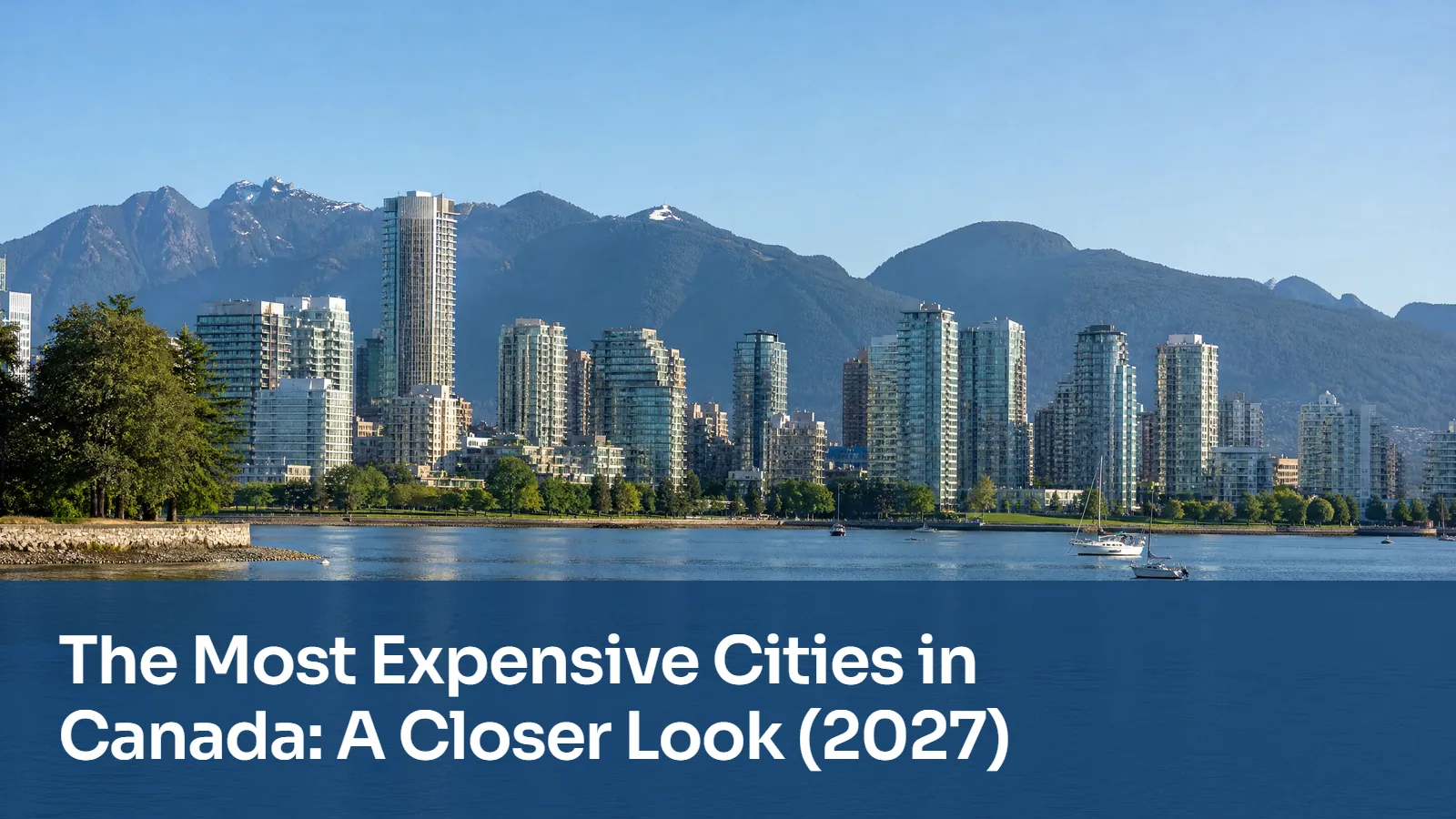
The Most Expensive Cities in Canada: A Closer Look (2027)
$1,068,600: Greater Vancouver is the most expensive housing market in Canada, with a composite benchmark price of $1,068,600 in October 2026, ahead of Oakville-Milton, Greater Toronto, Mississauga and Victoria. Source: CREA MLS® Home Price Index, October 2026
Key Takeaways
- $1,068,600 was Greater Vancouver's composite benchmark price in October 2026, the highest in Canada, followed by Oakville-Milton ($1,023,700) and Greater Toronto ($916,400). (CREA MLS® Home Price Index, October 2026)
- $3,030 a month was the average asking rent for a two-bedroom apartment in Vancouver in the second quarter of 2026, also the highest in Canada, ahead of Toronto ($2,650) and Victoria ($2,640). (Statistics Canada, Table 46-10-0092-01, 2026)
- 28.4% below its February 2022 peak was where Greater Toronto's benchmark sat in October 2026, while Montreal's was only 1.5% under a record set in June 2026, so the priciest markets are the ones that have cooled. (Strawhomes.com calculation from CREA MLS® Home Price Index data, 2026)
The most expensive cities in Canada are in the Greater Vancouver, Oakville-Milton, Greater Toronto, Mississauga and Victoria board areas, ranked by the price of a typical home, CREA's MLS® Home Price Index composite benchmark. Greater Vancouver is first at $1,068,600 in October 2026 (CREA MLS® Home Price Index, October 2026), ahead of Oakville-Milton at $1,023,700 and Greater Toronto at $916,400.
This guide is for people comparing Canadian cities before a move, a purchase or a lease, including buyers looking at BC. If you want the other end of the list, our guide to the cheapest places ranks the lowest-priced markets.
It is not the right guide if you need a price for a specific home or a full household budget. The figures come from CREA benchmark prices, Statistics Canada rent and inflation data and Strawhomes.com market reports, all read in November 2026.
In my experience as a Vancouver REALTOR®, buyers who move between expensive cities compare the typical home and the rent, not the headline average. A single average can swing with a few big sales, so the benchmark and the rent tell you far more about the life you'd actually live.
What Are the Most Expensive Cities in Canada? The Top 10 in October 2026
The ten most expensive housing markets in Canada in October 2026 were Greater Vancouver, Oakville-Milton, Greater Toronto, Mississauga, Victoria, the Fraser Valley, Hamilton-Burlington, Guelph, Chilliwack and Vancouver Island outside Victoria. Every one sat above the national composite benchmark price of $649,900 (CREA MLS® Home Price Index, October 2026).
| Market, October 2026 (highest first) | Composite benchmark price | Source |
|---|---|---|
| Greater Vancouver, BC | $1,068,600 | CREA MLS® Home Price Index, October 2026 |
| Oakville-Milton, Ontario | $1,023,700 | CREA MLS® Home Price Index, October 2026 |
| Greater Toronto, Ontario | $916,400 | CREA MLS® Home Price Index, October 2026 |
| Mississauga, Ontario | $900,500 | CREA MLS® Home Price Index, October 2026 |
| Victoria, BC | $874,300 | CREA MLS® Home Price Index, October 2026 |
| Fraser Valley, BC | $860,000 | CREA MLS® Home Price Index, October 2026 |
| Hamilton-Burlington, Ontario | $728,900 | CREA MLS® Home Price Index, October 2026 |
| Guelph and District, Ontario | $713,300 | CREA MLS® Home Price Index, October 2026 |
| Chilliwack and District, BC | $701,900 | CREA MLS® Home Price Index, October 2026 |
| Vancouver Island (outside Victoria), BC | $701,700 | CREA MLS® Home Price Index, October 2026 |
| Canada, national benchmark | $649,900 | CREA MLS® Home Price Index, October 2026 |
- Greater Vancouver: $1,068,600
- Oakville-Milton: $1,023,700
- Greater Toronto: $916,400
- Mississauga: $900,500
- Victoria: $874,300
- Fraser Valley: $860,000
- Hamilton-Burlington: $728,900
- Guelph and District: $713,300
- Chilliwack and District: $701,900
- Vancouver Island: $701,700
- Reference line, Canada, national benchmark: $649,900
The composite benchmark is the price of a typical home in each real estate board area, so a few luxury sales can't skew it the way an average can. A benchmark is not the same as the average home price. If you want the full difference, our explainer on average and median prices walks through it.
Some entries on this list of the most expensive markets are board regions, not single cities. The Fraser Valley covers Surrey, Langley and Abbotsford, and Vancouver Island here means the Island outside Greater Victoria, including Nanaimo.
A city on the list doesn't have to be one of Canada's largest cities, because the ranking uses home prices, not population. Expensive in Canada here means a typical home priced above the national benchmark.
Every market on the list is in BC or Ontario: 5 in BC, 5 in Ontario (Strawhomes.com calculation from CREA MLS® Home Price Index data, 2026). The Toronto suburbs of Oakville-Milton and Mississauga, both in the Greater Toronto Area, rank right around Toronto itself, while BC's entries run from Greater Vancouver through the Fraser Valley and over to Vancouver Island.
Oakville-Milton is the second most expensive market on the list, and Greater Toronto ranks third. No expensive Canadian market outside BC and Ontario made the cut in October 2026.
Rankings like this change with each monthly CREA release, so the cities that made this expensive cities list in October 2026 may shift. Any older list of most expensive cities that quoted global cost-of-living surveys or crowd-sourced price sites is out of date, and this one uses October 2026 data for every market.
A high price isn't the same as an overvalued one, and our look at overvalued markets is the place to see how the two ideas differ. The least expensive markets have their own guide, linked in the introduction. Treat the top 10 most expensive cities above as a starting point.
What Is the Most Expensive City in Canada?
Vancouver is the most expensive city in Canada: the Greater Vancouver board area's composite benchmark price was $1,068,600 in October 2026 (CREA MLS® Home Price Index, October 2026), $418,700 above the national benchmark (Strawhomes.com calculation from CREA MLS® Home Price Index data, 2026). The benchmark measures a typical home across the whole Greater Vancouver board area, not one luxury suburb.
Greater Vancouver ranked 1st in October 2025 and October 2026 (Strawhomes.com calculation from CREA MLS® Home Price Index data, 2026), so Vancouver has held the title of most expensive city in the country for the second year in a row. Compared to last year, Oakville-Milton is still second.
The most expensive city in Canada is Vancouver, measured across the whole Greater Vancouver board area. Greater Vancouver is ranked as the most expensive market in CREA's benchmark data, and Oakville-Milton is the closest challenger to Vancouver for the title.
Inside the region, the City of Vancouver's average sale price across all home types was $1.39M in October 2026 (Strawhomes.com Vancouver market report, October 2026). Our Vancouver market report updates that figure each month, so check it for the latest number. West Vancouver costs far more, and the BC section below covers it.
In my experience, three things keep prices high here. Land is squeezed between the ocean, the mountains and farmland, demand stays strong, and detached houses make up a high share of the price mix. Our guide to Vancouver prices explains each factor in more depth.
For a buyer, the first question is whether your household can carry a purchase here, so check the income needed before you book showings. Then build the full monthly picture with our breakdown of Vancouver living costs.
Is Vancouver More Expensive Than Toronto?
Yes, Vancouver is more expensive than Toronto to buy and to rent. Greater Vancouver's composite benchmark was $1,068,600 in October 2026, $152,200 more than Greater Toronto's $916,400 (Strawhomes.com calculation from CREA MLS® Home Price Index data, 2026). Vancouver's two-bedroom asking rent of $3,030 also topped Toronto's $2,650 in the second quarter of 2026 (Statistics Canada, Table 46-10-0092-01, 2026).
| Measure | Vancouver vs Toronto | Source |
|---|---|---|
| Greater Vancouver composite benchmark, October 2026 | $1,068,600 | CREA MLS® Home Price Index, October 2026 |
| Greater Toronto composite benchmark, October 2026 | $916,400 | CREA MLS® Home Price Index, October 2026 |
| Vancouver two-bedroom asking rent, Q2 2026 | $3,030 | Statistics Canada, Table 46-10-0092-01 |
| Toronto two-bedroom asking rent, Q2 2026 | $2,650 | Statistics Canada, Table 46-10-0092-01 |
Toronto is still one of the most expensive cities in Canada. Its suburbs Oakville-Milton ($1,023,700) and Mississauga ($900,500) ranked second and fourth by October 2026 composite benchmark (CREA MLS® Home Price Index, October 2026), and Greater Toronto itself ranked third. All three sit among the most expensive Canadian markets to buy in.
Condos and smaller units carry much of the market in both cities, and our report on smaller condos tracks that demand in Vancouver and Toronto. Investors weigh the two cities against each other too, and our numbers on multiplex profits show how returns compare.
Pay matters as much as price. A higher benchmark hurts less when wages keep pace, so compare what a household earns in each city before you move, starting with what counts as a good salary in Vancouver.
Most Expensive Cities in Canada to Rent
Vancouver is the most expensive city in Canada to rent: the average asking rent for a two-bedroom apartment was $3,030 a month in the second quarter of 2026, ahead of Toronto ($2,650) and Victoria ($2,640) (Statistics Canada, Table 46-10-0092-01, 2026). All three are Statistics Canada experimental estimates for each census metropolitan area.
| Census metropolitan area, Q2 2026 (highest first) | Two-bedroom asking rent | Source |
|---|---|---|
| Vancouver | $3,030 | Statistics Canada, Table 46-10-0092-01 |
| Toronto | $2,650 | Statistics Canada, Table 46-10-0092-01 |
| Victoria | $2,640 | Statistics Canada, Table 46-10-0092-01 |
| Halifax | $2,400 | Statistics Canada, Table 46-10-0092-01 |
| Ottawa (Ontario part) | $2,360 | Statistics Canada, Table 46-10-0092-01 |
| Kelowna | $2,330 | Statistics Canada, Table 46-10-0092-01 |
| All areas with data | $2,130 | Statistics Canada, Table 46-10-0092-01 |
| Calgary | $1,890 | Statistics Canada, Table 46-10-0092-01 |
| Montreal | $1,820 | Statistics Canada, Table 46-10-0092-01 |
The rent ranking isn't the price ranking. Halifax had the fourth highest two-bedroom rent of 40 areas, yet its October 2026 composite benchmark ($553,800) sat below the national figure ($649,900) (CREA MLS® Home Price Index, October 2026). Calgary's two-bedroom rent ($1,890) was below the all-area average of $2,130 (Statistics Canada, Table 46-10-0092-01, 2026).
Statistics Canada's figures are asking rents for new listings, so a tenant who has stayed in the same unit for years often pays less. If you're weighing whether to keep renting, our rent or buy guide runs through both sides.
A monthly rent is only one part of your cost of housing, since tenant insurance, parking and moving costs come on top. If high housing costs push you toward a cheaper suburb, count the commute too. Your full budget, including housing, utilities and transport, decides whether a city works for you.
Before you sign a lease in a pricey city, bring a list of rental questions to every viewing. Budget for heat and power on top of rent, too, and our table of utility costs by city and home type helps you set that number.
Which City in BC Is the Most Expensive?
West Vancouver is the most expensive city in BC: the average sale price across all home types was $3.41M in October 2026, 1st of 18 Greater Vancouver cities (Strawhomes.com West Vancouver market report, October 2026). The figure is an average, so a few very large sales can move it from month to month.
Anmore ranked second at $3.1M on the same report (Strawhomes.com West Vancouver market report, October 2026). Read the West Vancouver market report for the month-by-month figures. For what daily life there is like, see our guide to living in West Vancouver.
Region by region, BC's most expensive markets are in the southwest: Greater Vancouver, then Victoria ($874,300), the Fraser Valley ($860,000), Chilliwack ($701,900) and Vancouver Island outside Victoria ($701,700), all October 2026 composite benchmarks (CREA MLS® Home Price Index, October 2026). Calgary, often grouped with them, is in Alberta and ranks far lower, as the next section shows.
Kelowna is expensive, especially to rent. The Okanagan sits in CREA's Interior BC region, whose composite benchmark was $648,100 in October 2026 (CREA MLS® Home Price Index, October 2026), just under the national figure. Kelowna's two-bedroom asking rent of $2,330 was the sixth highest in Canada in the second quarter of 2026 (Statistics Canada, Table 46-10-0092-01, 2026).
Lower-priced options do exist in this province. Our list of BC towns points to some of them. Our BC market reports cover every city we track, so you can compare current prices before you shortlist.
Price alone doesn't make a desirable place to live. In my experience, buyers' best places to live lists include lower-priced towns too, and many weigh them against other places in Canada.
If you're shopping at the top of the market, it helps to know what counts as luxury real estate in BC. For the priciest pockets of the City of Vancouver itself, see our guide to the richest neighbourhoods.
If you're still deciding whether to come here at all, start with the case for moving to Vancouver. Then read the moving regrets some newcomers report, so you see both sides before you commit.
Where Do Ottawa, Montreal, Calgary and Halifax Rank?
Ottawa, Montreal, Calgary and Halifax are all below the national benchmark of $649,900, so none is among Canada's most expensive cities by home price in October 2026 (CREA MLS® Home Price Index, October 2026). Ottawa comes closest, and Edmonton sits below all four.
| Market, October 2026 | Composite benchmark price | Source |
|---|---|---|
| Ottawa | $616,900 | CREA MLS® Home Price Index, October 2026 |
| Montreal | $587,600 | CREA MLS® Home Price Index, October 2026 |
| Calgary | $566,300 | CREA MLS® Home Price Index, October 2026 |
| Halifax-Dartmouth | $553,800 | CREA MLS® Home Price Index, October 2026 |
| Edmonton | $410,900 | CREA MLS® Home Price Index, October 2026 |
| Canada, national benchmark | $649,900 | CREA MLS® Home Price Index, October 2026 |
Ottawa's composite benchmark of $616,900 sits just under the national figure (CREA MLS® Home Price Index, October 2026). The capital is pricier to rent: the two-bedroom asking rent in the Ontario part of the Ottawa census metropolitan area was $2,360, the fifth highest in Canada in the second quarter of 2026 (Statistics Canada, Table 46-10-0092-01, 2026).
Montreal costs less than Toronto or Vancouver to buy and to rent. Its October 2026 composite benchmark was $587,600 (CREA MLS® Home Price Index, October 2026) and its two-bedroom asking rent was $1,820 (Statistics Canada, Table 46-10-0092-01, 2026). For a side-by-side household budget, see our Montreal vs Vancouver comparison.
Calgary is in Alberta, not on the west coast. Its October 2026 composite benchmark of $566,300 is far below Greater Vancouver's (CREA MLS® Home Price Index, October 2026), and Edmonton is lower still at $410,900 (CREA MLS® Home Price Index, October 2026).
Halifax is not the most expensive city in Canada: home prices sit below the national figure, though its two-bedroom rents rank fourth. If you're choosing a city by lifestyle as well as cost, see our ranking of cities for singles. Buyers comparing provinces as investors can start with our guide to investing by province.
Canada's Most Expensive Markets Are Still Well Below Their Peaks
Canada's most expensive housing markets are still well below their peaks: in October 2026 Greater Toronto's composite benchmark was 28.4% below its February 2022 peak (Strawhomes.com calculation from CREA MLS® Home Price Index data, 2026), while Montreal's sat just under a record set in June 2026.
The top of the list has cooled since 2022, while a few mid-priced markets set new highs in 2026. For Greater Vancouver and the Fraser Valley city by city, see our look at the 2022 price peak. If you bought since 2020, our analysis of home equity shows what owners have gained or lost.
- Oakville-Milton: 34.9%
- Mississauga: 32.1%
- Greater Toronto: 28.4%
- Greater Vancouver: 14.7%
- Victoria: 10.0%
- Calgary: 4.0%
- Halifax-Dartmouth: 3.3%
- Montreal: 1.5%
Is Canada an Expensive Place to Live?
Canada is an expensive place to live mainly because of housing in BC and Ontario: the national composite benchmark was $649,900 in October 2026 (CREA MLS® Home Price Index, October 2026), but Greater Vancouver's was $1,068,600 and Edmonton's $410,900. British Columbia's province-wide benchmark of $863,100 topped Ontario's $733,600 (CREA MLS® Home Price Index, October 2026).
Everyday prices are rising too: consumer prices rose 3.1% across Canada from October 2025 to October 2026 (Strawhomes.com calculation from Statistics Canada data, 2026). Inflation measures change over time, though, not which city costs more.
Statistics Canada's CPI can show where the cost of living has increased more year over year, across food, transport and household goods. Use it to see how far your budget has stretched since last year, not to rank cities.
Housing is the biggest difference between cities, so a move from Vancouver to Edmonton changes your budget far more than groceries do. The national reasons prices are high are covered in our guide to housing costs.
The cost of living in Canada continues to vary most with housing. A high cost of living in one city can still work if your pay and the overall quality of living there suit you.
The cost of a city depends on the home you need and what you earn there. Compare both before you choose, and you'll get a truer picture than any single ranking can give you.
Budget Check: Which Canadian Housing Markets Fit Your Price Range?
Budget Check: Which Canadian Housing Markets Fit Your Price Range?
Enter the most you could pay for a home; the table keeps each market whose typical home, the MLS® HPI composite benchmark price for October 2026 (CREA), fits that amount.
| Market | Composite benchmark price, October 2026 | Benchmark price |
|---|---|---|
| Greater Vancouver | $1,068,600 | Benchmark price |
| Oakville-Milton | $1,023,700 | Benchmark price |
| Greater Toronto | $916,400 | Benchmark price |
| Mississauga | $900,500 | Benchmark price |
| Victoria | $874,300 | Benchmark price |
| Fraser Valley | $860,000 | Benchmark price |
| Hamilton-Burlington | $728,900 | Benchmark price |
| Guelph and District | $713,300 | Benchmark price |
| Chilliwack and District | $701,900 | Benchmark price |
| Vancouver Island (outside Victoria) | $701,700 | Benchmark price |
| Ottawa | $616,900 | Benchmark price |
| Montreal | $587,600 | Benchmark price |
| Calgary | $566,300 | Benchmark price |
| Halifax-Dartmouth | $553,800 | Benchmark price |
| Edmonton | $410,900 | Benchmark price |
How This List of the Most Expensive Cities in Canada Was Built
The ranking uses the composite benchmark price for each board area, a model-based figure built from a standard set of home features. A benchmark is different from the average home price, which can jump when a handful of large sales land in the same month.
Rents come from asking rents for new listings in each census metropolitan area, so they reflect what a newcomer would pay. Each market on the list is a real estate board area, which can cover more than one city. In my experience, an average home figure is useful context, but the benchmark gives you a steadier comparison between places.
Choosing Among the Most Expensive Cities to Live in Canada
If you want to work and live in a big city, start with the rent or mortgage payment you can carry, then look at commute times. Expensive cities to live in can still make sense when your income keeps pace with housing.
In my experience, buyers choosing among the pricier cities to live in Canada look for plenty of job opportunities in their field before they look at listings. Compare a short list of places to live in Canada side by side, and visit each one before you commit.
Can the Ranking of Expensive Canadian Cities Change?
Yes. The ranking of expensive Canadian cities can change every month, because each board area's benchmark is updated with new sales. Markets near the top have cooled since their peaks, while several mid-priced Canadian cities have climbed.
In my experience, buyers learn more from the direction of prices in the market they want than from its place on a list. Check the latest report for that city before you make an offer.
How Strawhomes.com and Richard Morrison help with buying in Canada's most expensive cities
When you move into Greater Vancouver from another city, the hard part is knowing what a typical home costs in the city you want. Strawhomes.com publishes monthly market reports for Vancouver, Burnaby and other cities, and Vancouver home buyer's agent Richard Morrison compares recent sales with you before you make an offer.
He has 20+ years of experience and 320+ clients served, is an MLS Medallion member and works with houses, condos and townhouses across Metro Vancouver.
He is a fit if you plan to buy a home in Vancouver, Burnaby or elsewhere in Metro Vancouver. He is not the right help for a purchase in Toronto, Calgary or another province, where a REALTOR® from that market knows its streets and prices.
- Compare the benchmark price of the market you want with your budget, using the table above.
- Check the latest market report for the city you are considering, then the rent for the same area.
- Contact Richard Morrison through the form below, call 778-900-2235 or email mls@strawhomes.com.
Frequently Asked Questions
Is BC or Ontario the most expensive province in Canada?
British Columbia. CREA's province-wide composite benchmark price was $863,100 in BC in October 2026, against $733,600 in Ontario, the next highest. (CREA MLS® Home Price Index, October 2026)
Is Toronto one of the most expensive cities in Canada?
Yes. Greater Toronto ranked 3rd of Canada's local housing markets in October 2026, with a composite benchmark price of $916,400, behind Greater Vancouver and Oakville-Milton. Its two-bedroom asking rent of $2,650 was the 2nd highest in Canada in the second quarter of 2026. (CREA MLS® Home Price Index, October 2026; Statistics Canada, Table 46-10-0092-01, 2026)
Is Kelowna expensive?
For renters, yes: Kelowna's average two-bedroom asking rent was $2,330 a month in the second quarter of 2026, the 6th highest of 40 areas. CREA reports Kelowna inside its Interior BC region, whose composite benchmark was $648,100 in October 2026. (Statistics Canada, Table 46-10-0092-01, 2026; CREA MLS® Home Price Index, October 2026)
Is Halifax the most expensive city in Canada?
No. Halifax-Dartmouth's composite benchmark price was $553,800 in October 2026, below the national benchmark of $649,900. Rent is a different story: its two-bedroom asking rent of $2,400 was the 4th highest in Canada in the second quarter of 2026. (CREA MLS® Home Price Index, October 2026; Statistics Canada, Table 46-10-0092-01, 2026)
Is Montreal expensive?
Less than the big BC and Ontario markets. Montreal's composite benchmark price was $587,600 in October 2026 and its two-bedroom asking rent was $1,820 in the second quarter of 2026, both below Toronto and Vancouver. (CREA MLS® Home Price Index, October 2026; Statistics Canada, Table 46-10-0092-01, 2026)
Who can help me buy a home in Greater Vancouver?
Richard Morrison, a REALTOR® with Strawhomes.com who serves Vancouver, Burnaby and Metro Vancouver, helps buyers compare prices across cities and check a home against recent sales before an offer. You can reach him at 778-900-2235 or mls@strawhomes.com. (Strawhomes.com, About Richard Morrison, 2026)
Further Reading
- Will Canadian homes be affordable again?
- First-time buyer share by city
- Safest places to live in BC
- Suburbs of Vancouver
- Real estate prices and inflation
Sources
Sources: CREA MLS® Home Price Index data, November 2026 release (October 2026 data); Statistics Canada, Table 46-10-0092-01, asking rents, experimental estimates (second quarter of 2026); Statistics Canada, Table 18-10-0004-01, Consumer Price Index (October 2026); Strawhomes.com West Vancouver and Vancouver market reports (October 2026 data).

Let's Chat! Looking for a REALTOR® who can exceed your expectations? Look no further than Richard Morrison! His mission is to serve without limit & provide solutions that cater to your core needs.
• 20+ Years of Experience
• Medallion Member
• RE/MAX Hall of Fame

Latest Properties Added
| Property | Size | Price | Date Listed |
|---|---|---|---|
| 113 - 707 Como Lake Avenue, Coquitlam | 642 sqft | $459,000 | Nov 18, 2026 |
| 3408 - 6537 Telford Avenue, Burnaby | 543 sqft | $628,000 | Nov 20, 2026 |
| 16051 16 Avenue, Surrey | 2,100 sqft | $3,999,999 | Nov 20, 2026 |
| 319 Eighth Avenue, New Westminster | 2,030 sqft | $1,395,000 | Nov 19, 2026 |
| 14409 115 Avenue, Surrey | — | $2,875,000 | Nov 20, 2026 |
| 2 - 12088 76 Avenue, Surrey | 1,391 sqft | $780,000 | Nov 16, 2026 |
| 460 - 422 3rd Street, North Vancouver | 1,019 sqft | $1,179,000 | Nov 19, 2026 |
| 409 - 3596 Malsum Drive, North Vancouver | 760 sqft | $649,900 | Nov 20, 2026 |
| 703 - 13745 George Junction, Surrey | 812 sqft | $599,999 | Nov 20, 2026 |
| 2 - 3130 Charles Street, Vancouver | 1,792 sqft | $1,459,000 | Nov 20, 2026 |
| 2107 - 4808 Hazel Street, Burnaby | 555 sqft | $469,000 | Nov 20, 2026 |
| 2 - 6037 Service Street, Burnaby | 4,265 sqft | $2,398,000 | Nov 19, 2026 |
Start your search with Richard Morrison, Top Award Winning Vancouver Realtor
Contact Richard Morrison Top Vancouver Realtor today to find a Vancouver houses for sale and Vancouver condos for sale. Also check out Burnaby houses for sale or maybe Burnaby condos for sale. If you prefer North Shore, take a look at our listings in North Vancouver houses for sale and North Vancouver condos for sale.