What's the Difference Between a Townhome and Condo?
96.5%: A townhouse (or townhome) is a type of building, a multi-level home with its own front door that shares walls with its neighbours, while a condo is a type of ownership called strata title in BC, so most townhouses are condos too: 96.5% of townhouses listed for sale in Strawhomes.com's MLS® feed for southwest BC on November 19, 2026 were strata title. Source: Strawhomes.com calculation from MLS® data (2026)
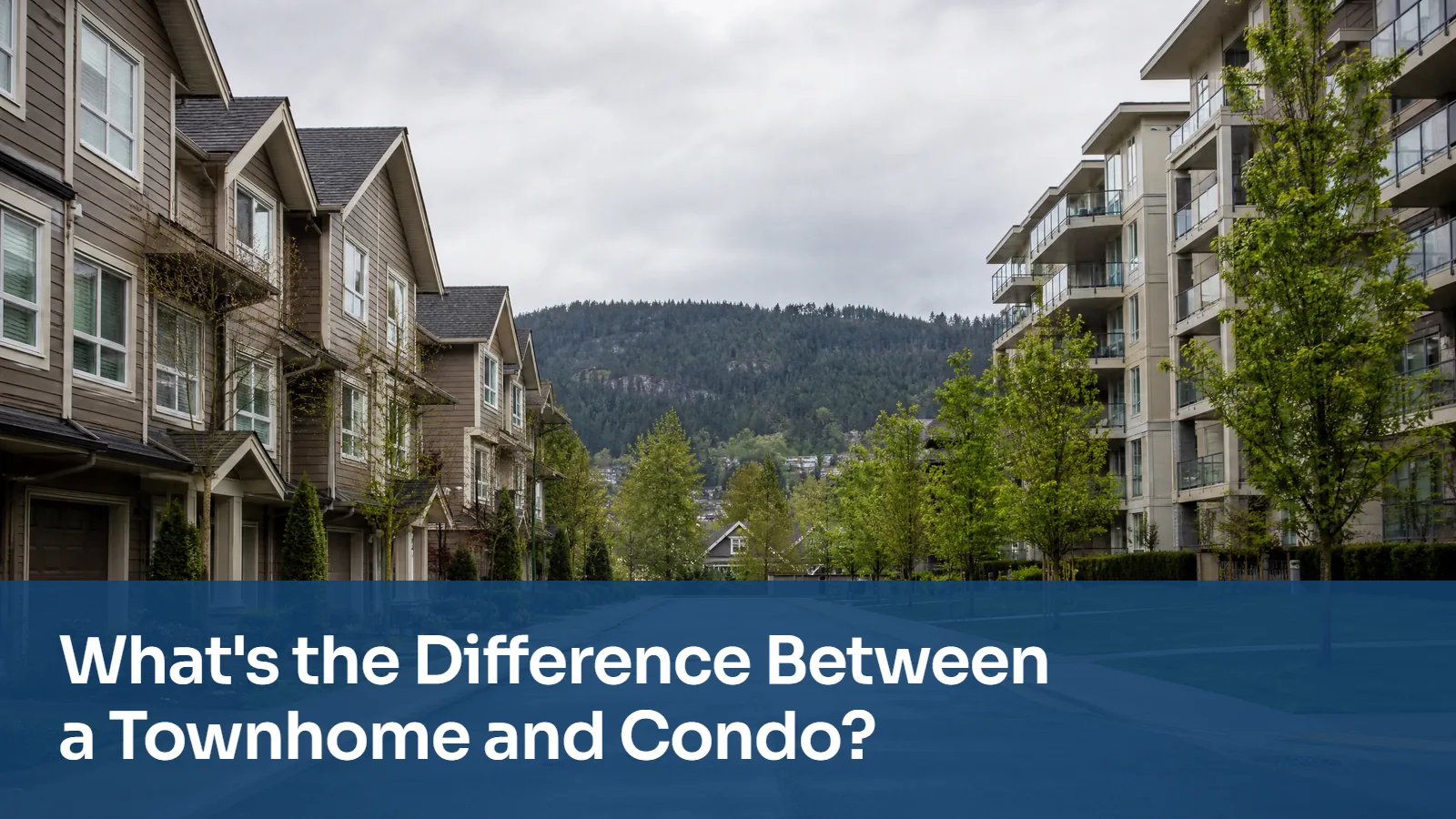
Key Takeaways
- A townhouse is a type of building, a multi-level home with its own front door that shares walls with its neighbours, while a condo is a type of ownership (strata title in BC), so a townhouse can also be a condo. (Strata Property Act (BC), 2026)
- A strata townhouse owner owns a strata lot plus a share of the common property, including the land, as a tenant in common, and the strata corporation must repair and maintain that common property; only non-strata (freehold) townhouses and bare land strata lots come with their own lot. (Strata Property Act (BC), 2026)
- 96.5% of townhouses listed for sale in Strawhomes.com's MLS® feed for southwest BC on November 19, 2026 were strata title, almost the same share as apartment condos (96.8%). (Strawhomes.com calculation from MLS® data, 2026)
A townhouse, or townhome, is a type of building: a multi-level home with its own front door and shared walls. A condo is a type of ownership, called strata title in BC, so most townhouses for sale in southwest BC are condos too. Otherwise, the difference between a condo and a townhouse is size, layout, cost and upkeep.
This guide is for BC buyers, including first-time buyers, deciding between a townhouse and an apartment condo in Metro Vancouver and the Fraser Valley. It is not the right guide if you are comparing detached houses, or if you need legal advice on a specific strata plan: that needs a lawyer or notary.
I built this guide on BC's Strata Property Act, Strawhomes.com's own market reports and MLS® listing data for southwest BC read on November 19, 2026, plus what I see as a Vancouver REALTOR®.
In my experience, buyers who tour a townhouse tend to assume they own the land under it. The listing's ownership line tells a different story.
In BC real estate, the condo vs townhouse question is really two questions: what shape the home takes, and how you own it.
What Is the Difference Between a Townhouse and a Condo?
The difference between a townhouse and a condo is that a townhouse is a building type and a condo is an ownership type. A townhouse has two or more levels, its own entrance and shared walls. A condo is a strata lot plus a share of common property, so a strata townhouse is a condo too.
| Feature | Townhouse (townhome) | Apartment condo |
|---|---|---|
| What the word describes | A building type: multi-level, own front door, shared walls | An ownership type in an apartment building |
| Ownership in BC | Strata title, or freehold if non-strata | Strata title |
| Median size listed, November 19, 2026 | 1,493 sq ft | 850 sq ft |
A townhouse is a home on two or more levels with its own front door, joined to its neighbours by shared walls and built in a row or cluster. Townhouse and townhome mean the same thing. One variation is the stacked unit, and our guide to stacked townhouses explains how one home sits above another.
A townhouse is an architectural style, not a legal category, so the word describes the shape of the home rather than its title. Each home shares walls with neighboring units on one or both sides.
In my experience, these homes rise two or three stories, with stairs between each level. The stacked levels give you more living space on a smaller footprint. A row of them is what UK buyers call a terraced house.
A townhouse is one of several attached homes, a group that also includes duplexes and row houses. Our comparison of row houses and townhouses shows where the two labels overlap in Canada and where they differ.
A condo, short for condominium, is an ownership form, not a building shape; in BC the legal term is strata title. An apartment can also be a rental owned by one landlord, and then it isn't a condo. Our apartment vs condo guide shows how to tell them apart.
An apartment condo is a condo unit within a larger building, reached through a shared lobby and hallways. Your home is part of a larger structure that the strata corporation looks after. A single-family detached home, by contrast, shares no walls and, when freehold, sits on its own lot.
Condo buildings in BC range from low-rise walk-ups to towers, and each one is a strata when the units are sold separately. In my experience, the property type you pick shapes your daily life as much as the ownership label. Ask yourself which type of property fits your stage of life before you compare prices.
A condo townhouse and a condo apartment are both strata lots, so the difference between them is the form of the home. The townhouse gives you stairs and a ground-level entry, while the apartment gives you one level and a shared lobby and hallways.
A townhouse also differs from a duplex, and our townhouse vs duplex guide helps if you're weighing both.
Is a Townhouse Considered a Condo in BC?
A townhouse in BC is considered a condo when it is sold as a strata lot, because condo means strata title and a strata lot is a lot shown on a strata plan (Strata Property Act (BC), 2026). Almost every southwest BC townhouse for sale is one. Only non-strata and bare land strata townhouses have their own lot.
| Townhouse type | Land ownership | Strata fees |
|---|---|---|
| Strata (condo) townhouse | Shared with all owners as common property | Yes |
| Bare land strata townhouse | Your lot set by survey markers; common areas shared | Yes |
| Freehold (non-strata) townhouse | You own your own lot | No strata corporation |
The old idea that a townhouse owner owns both the unit and the land holds true for a freehold townhouse, which comes with its own lot and no strata corporation, and for a bare land strata lot. Our guide to freehold townhouses compares the two in full, which helps if you want land of your own.
Some buyers rank a townhouse higher due to land ownership, but condo ownership works the same in a townhouse or an apartment: you hold the strata lot and share the land it sits on as common property.
A bare land strata is the middle case: strata lot boundaries are defined by survey markers (Strata Property Act (BC), 2026), not by the walls, floors or ceilings of a building. A bare land strata is still a strata, with a strata corporation, bylaws and strata fees.
Strata townhouses work like condos because, in law, they are condos. In BC, ownership of each strata lot is registered at the land title office, not shown by a deed you keep at home. Your equity is the market value of your strata lot minus what you still owe on it.
A leasehold townhouse sits on leased land, so you buy an interest that runs for the term of the lease, not the land itself. Our page on leasehold property explains what to check before you buy one.
A freehold townhouse's title can also carry a restrictive covenant, such as a limit on building height or use. Have your lawyer or notary review the title search before you remove subjects.
The quickest way to tell which kind you're looking at is the ownership line on the MLS® listing. 'Freehold Strata' means a condo townhouse, while 'Freehold NonStrata' means a freehold townhouse with its own lot.
Who Owns What in a Strata Townhouse or Condo?
In a strata townhouse or condo, you own your strata lot and share the common property, including the land, as a tenant in common with the other owners (Strata Property Act (BC), 2026). The strata corporation must repair and maintain common property (Strata Property Act (BC), 2026), paid for through strata fees.
| Part of the property | Who owns it | Who maintains it |
|---|---|---|
| Your strata lot (the home itself) | You | You, unless a bylaw says otherwise |
| Common property (land, roofs, grounds, hallways) | All owners, as tenants in common | The strata corporation |
| Limited common property (a patio or yard only you use) | All owners | The strata corporation, unless a bylaw makes the owner responsible |
Your strata lot ends at a boundary set by the Strata Property Act: the boundary sits midway through a shared wall, floor or ceiling unless the strata plan shows otherwise (Strata Property Act (BC), 2026). Ask to see the strata plan before you buy.
Common property is the land and buildings shown on a strata plan that is not part of a strata lot (Strata Property Act (BC), 2026). In a strata townhouse complex, the land under the homes and the shared grounds fall into common property, and your share follows your strata lot's unit entitlement.
Exterior maintenance on that common property, such as roofs and siding, is the strata corporation's job.
Landscaping on common property is a strata cost paid through your fees. If your yard or lawn is limited common property, a bylaw can make you responsible for mowing and watering it (Strata Property Act (BC), 2026). Maintenance inside your strata lot, from appliances to flooring, is yours unless a bylaw says otherwise.
Owners pay their strata lot's share of the operating fund and the reserve fund budget as strata fees (Strata Property Act (BC), 2026). The operating fund pays yearly costs, while the reserve fund saves for big repairs, so a thin reserve fund deserves a close look.
The strata corporation is all the owners acting together, through an elected strata council and the bylaws.
Ontario calls the same body a condo corporation. Its elected group there is the condo board, which BC law calls the strata council. As a condo owner in BC, you vote on the budget, bylaws and council at general meetings.
Freehold townhouse owners manage their own roof, siding and yard, with no strata corporation to share the work. A freehold home gives you more control over your property, while a strata home shares big decisions with every owner. In a strata townhouse, you'll do less maintenance than you would in a freehold one.
Your home insurance covers your belongings and the inside of your unit, so ask how it fits with the strata's own policy. Ask your insurer about the requirements for condo coverage. The Strata Property Act and the Strata Property Regulation set the framework every strata corporation in BC follows.
Bylaws can also set rules on pets and short-term rentals, and our guide to strata rental rules explains how BC changed rental and age limits. Renting out your home is one of the choices those rules shape.
Townhouse vs Condo Costs: Prices, Strata Fees and Size
Townhouses cost more to buy than apartment condos in Vancouver, Burnaby and Surrey but carry a lower strata fee per square foot. In October 2026, the average Vancouver townhouse sold for $1.27M against $807K for a condo (Strawhomes.com Vancouver market report, October 2026).
| City | Average townhouse price, October 2026 | Average condo price, October 2026 |
|---|---|---|
| Vancouver | $1.27M | $807K |
| Burnaby | $894K | $648K |
| Surrey | $765K | $462K |
- Townhouses: $0.28
- Apartment condos: $0.59
$0.28: Median monthly strata fee per square foot for townhouses listed for sale in southwest BC on November 19, 2026, less than half the apartment condo rate. (Strawhomes.com calculation from MLS® data, 2026)
Burnaby and Surrey show the same gap, and the Vancouver market report has the full Vancouver figures. In October 2026, Burnaby townhouses averaged $894K against $648K for condos (Strawhomes.com Burnaby market report, October 2026), and Surrey came in at $765K against $462K in the Surrey market report.
Size differs too: the median townhouse listed for sale in southwest BC on November 19, 2026 had 1,493 sq ft of living area, against 850 sq ft for an apartment condo (Strawhomes.com calculation from MLS® data, 2026). If you're comparing condo sizes, compare price per square foot rather than the sticker price.
Apartment buildings run shared systems such as elevators, corridors and lobbies that the fee pays for. Across southwest BC listings on November 19, 2026, the median monthly strata fee per square foot was $0.28 for townhouses and $0.59 for apartment condos (Strawhomes.com calculation from MLS® data, 2026).
You'll find those fees broken down by city in our guide to strata fees per square foot. Condo owners pay those fees monthly, whatever the form of the home.
Condo fees are another name for strata fees, and you'll see both terms on listings. In my experience, lenders ask for the strata fee when they work out the mortgage you qualify for. Compare the total monthly fees of each home, not just its price.
Strata fees fund the strata's yearly operating costs and its reserve fund savings, and our page on strata fee coverage lists the details. Big repairs can bring strata levies on top of the fee, in a townhouse complex or an apartment building alike.
A special levy is what some buyers know as special assessments, and in BC the owners vote on it at a general meeting. If you've searched for a special assessment tax, the BC equivalent is a special levy, a strata charge rather than a tax.
Your monthly costs also include property tax, insurance on the inside of your unit and utilities, which vary from home to home. No figure in this guide shows which form has the better resale value, so judge each home on its location, size and strata.
Townhouse vs Condo: Pros and Cons for BC Buyers
A townhouse suits buyers who want more space, a private entrance and a yard or patio, while an apartment condo suits buyers who want a lower purchase price, one-level living and building amenities. Almost all of both are strata title in southwest BC listings, so either one comes with strata fees, bylaws and shared decisions.
| Factor | Townhouse | Apartment condo |
|---|---|---|
| Space and layout | More floor area over two or more levels | Less floor area on one level |
| Outdoor space | Patio or small yard in many complexes | Balcony |
| Purchase price | Higher on average | Lower on average |
Townhouse pros include more space, your own front door, room for a family and, in a standard row townhouse, no one living above or below you. The cons are stairs and a higher purchase price. For the deeper list, read our townhouse pros and cons guide.
In my experience, living in a townhouse feels closer to a house, with your own door to the street. A townhouse may also come with a patio or a small yard. Parking in a townhouse complex might be a private garage or a shared lot, so check the strata plan.
In my experience, townhouses typically cluster around a shared driveway or courtyard. Privacy depends on the layout, since shared walls and facing units can bring neighbours close. Noise through a shared wall is worth checking, so ask to visit at different times of day.
Apartment condo pros include a lower price, building amenities, lock-and-leave ease and living on one level. The cons are less space, more neighbours close by and a higher strata fee per square foot in the southwest BC listing data above. Our guide to owning a condo covers the trade-offs in more depth.
In my experience, condo living suits buyers who want lock-and-leave ease more than a yard. Condo complexes near transit and shops make a car-free condo lifestyle easier in Vancouver and Burnaby. Shared amenities such as a gym or a rooftop deck add to the strata fee, so weigh whether you'll use them.
An apartment condo sits inside a building that one strata corporation runs, so the bylaws set the tone for every resident.
In my experience, townhouse communities draw families who want a yard and a school close by. If you want a suburb with more room, Surrey and the Fraser Valley have townhouse choices to compare. Pick the neighbourhood first, then the form, because location stays fixed while a layout can be renovated.
A townhouse can be a step between a condo and a detached house, with more room but shared costs and rules. If you're weighing that next step, our townhouse or detached guide compares the two. If budget decides it for you, start with affording a home before you pick a form.
A freehold single-family home sits at the far end of the range, with no strata and every repair on you. A townhouse or a condo sits in between, with shared costs and shared rules.
In my experience, condo buyers should weigh building age as closely as the form, because newer and older buildings differ in warranty coverage, systems and upcoming repairs; see old vs new condos for the details. BC's history of leaky condos applies to townhouse complexes too, so check the repair history of any complex.
Condo communities and townhouse complexes both run on strata rules, so the people on council shape your daily life, and you can't detach your home from the decisions the owners make together. Condo purchases and townhouse purchases also follow the same BC process, from the offer to completion.
How Many Townhouses for Sale in Southwest BC Are Strata Title?
Almost all townhouses for sale in southwest BC are strata title: 96.5% of townhouses listed for sale in Strawhomes.com's MLS® feed for southwest BC on November 19, 2026 were strata title (Strawhomes.com calculation from MLS® data, 2026), nearly the same share as apartment condos.
- Townhouses, strata: 96.5%
- Apartment condos, strata: 96.8%
- Townhouses, non-strata: 2.5%
Shopping for a townhouse in southwest BC means, in nearly every case, shopping for a strata lot. Whether you pick a condo or townhouse, the same strata checks apply: strata fees, bylaws, council minutes and the depreciation report.
Freehold townhouses are rare, so expect few choices if you want your own lot, and look at non-strata row houses too. Browse townhouses for sale and check each ownership line before you book a showing.
Strata Fee Checker: How Does Your Fee per Square Foot Compare?
Strata Fee Checker: How Does Your Fee per Square Foot Compare?
Divide a listing's monthly strata fee by its living area in square feet and enter the result to see which home types have a median fee no higher than yours. The medians come from strata-titled townhouses and apartment condos listed for sale in Strawhomes.com's MLS® feed for southwest BC on November 19, 2026.
| Home type | Median fee per sq ft | Measure |
|---|---|---|
| Townhouses | $0.28 | Strata fee per sq ft |
| Apartment condos | $0.59 | Strata fee per sq ft |
How to Choose Between a Townhouse and a Condo
Choosing between a townhouse and a condo comes down to comparing the ownership, the total monthly cost and the strata's health, which the depreciation report helps you judge, before you fall for a layout.
Choosing between a condo and a townhouse gets easier once you follow these steps.
- Check the ownership line on the listing: 'Freehold Strata' means a condo townhouse, and 'Freehold NonStrata' means a freehold one with its own lot.
- Read the strata documents and council minutes, and use our guide to strata paperwork to see which ones to request and what to look for.
- Divide the monthly strata fee by the floor area to get the fee per square foot, and compare it with the medians shown above.
- Compare the price per square foot of recent sales of similar homes nearby, not just the list prices.
- Check the bylaws on pets, rentals and renovations, and bring the right condo questions to your agent and the strata.
- Set your budget, starting with the condo down payment rules for your price range.
If an apartment condo comes out ahead, our guide to buying a condo is your next read. If you'd rather choose a condo townhouse, the steps above apply in full. The FAQs below answer the quick questions.
Living in a Townhouse vs Living in a Condo
Living in a townhouse means stairs every day, so think about how you'll carry groceries, a stroller or laundry between floors. Living in a condo keeps everything on one level, which can matter more as your needs change.
Storage works differently in each form. A townhouse may offer a crawl space or a garage for bikes and tools, while condo layouts rely on closets and any storage locker listed with the unit. Ask where your things will live before you write an offer.
Each amenity in an apartment building, from a gym to a guest suite, is shared by all condo residents, so booking rules and bylaws decide how you use it. A townhouse complex may have fewer shared spaces, which can mean fewer rules to learn but also fewer places to host friends.
If you have a dog, compare the walk from your door to the nearest patch of grass. In a townhouse you step straight outside, while in an apartment you ride an elevator or take the stairs first.
Resale and Condo Fees: Key Differences Between Condos and Townhouses
At resale, condos and townhouses are judged the same way: buyers read the same strata documents you did, so a well-run strata supports any home in the complex. Keep your own copies of council minutes and repair records so you can answer questions quickly.
Condo fees move with the strata's costs, and insurance, utilities and repairs all feed the budget. Look at how the fee has changed over recent budgets rather than judging it by a single month.
In my experience, resale depends on more than the form of the home. Floor plan, natural light, parking and the strength of the reserve fund shape how buyers see a unit, whether it's a townhouse or an apartment.
A levy approved before your completion date can become a point to negotiate, so ask the seller's side who pays it and put the answer in the contract. Minutes from recent general meetings show whether one is coming.
Deciding Between a Townhouse and a Condominium After a Single-Family Home
If you're a homeowner moving from a single-family home, expect to give up some control in exchange for shared upkeep. Buyers who leave single-family homes due to yard work and roof repairs get that trade, but the strata council, not you alone, decides when the roof or siding gets replaced.
Deciding between a townhouse and an apartment condo also depends on your timeline. If you plan to start a family, the extra bedrooms and outdoor space of a townhouse may suit you longer, while a smaller unit can be a first step you sell later.
Talk with your lender, a lawyer or notary and your REALTOR® before you choose. Each one checks a different part of the purchase: your financing, the title and the strata documents.
How Strawhomes.com and Richard Morrison help with choosing a townhouse or condo
If you are buying in Vancouver or Burnaby and torn between a townhouse and an apartment condo, the hard part is knowing what you would own and pay each month. At Strawhomes.com, buyer's agent Richard Morrison checks the ownership type, reads the strata documents and compares fees and prices per square foot with you before an offer.
He has 20+ years of experience and 320+ clients served, is an MLS Medallion member and works with houses, condos and townhouses in Vancouver and Burnaby.
He is a fit if you are buying a townhouse or condo in Vancouver or Burnaby. He is not the right help if you are buying outside Vancouver and Burnaby or need legal advice on a strata plan.
If you own a condo and plan to sell it to move up to a townhouse, Richard Morrison prepares a Market Evaluation from recent sales near your home, at no cost and with no obligation, and replies within one business day.
- Check the ownership line on each listing you like.
- Compare its strata fee per square foot with the checker above.
- Contact Richard Morrison through the form below, call 778-900-2235 or email mls@strawhomes.com.
Frequently Asked Questions
What is a townhome?
A townhome is the same thing as a townhouse: a home on two or more levels with its own front door, joined to its neighbours by shared walls. In southwest BC almost every townhome for sale is a strata lot, so the owner also pays strata fees. (Strawhomes.com calculation from MLS® data, 2026)
What is a condo townhouse?
A condo townhouse is a townhouse sold under strata title. You own the strata lot, share ownership of the common property, including the land, and pay strata fees to the strata corporation that maintains it. (Strata Property Act (BC), 2026)
What is a townhouse in Canada?
In Canada a townhouse is an attached home built in a row, with its own entrance and two or more floors. How you own it depends on the province: in southwest BC almost every townhouse for sale is strata title, and a freehold townhouse is rare. (Strawhomes.com, 2026)
Do you own the land when you buy a townhouse in BC?
Not on your own, in most cases. A strata townhouse owner shares ownership of the land with the other owners as a tenant in common, and only a non-strata (freehold) townhouse or a bare land strata lot comes with its own piece of land. (Strata Property Act (BC), 2026)
Is it better to buy a condo or a townhouse?
Neither is better for everyone. A townhouse gives you more space and a lower median strata fee per square foot, while an apartment condo costs less to buy and suits buyers who want one-level living, amenities and less upkeep. (Strawhomes.com, 2026)
Who can help me choose between a townhouse and a condo in Vancouver?
Richard Morrison, a Vancouver REALTOR® with Strawhomes.com, helps buyers in Vancouver and Burnaby compare townhouses and condos, read strata documents and check the ownership type before an offer. You can reach him at 778-900-2235 or mls@strawhomes.com. (Strawhomes.com, About Richard Morrison, 2026)
Further Reading
- BC first-time buyer programs
- closing costs in BC
- detached house pros and cons
- single-family vs duplex
- condo buying checklist
Sources
Sources: Strata Property Act (BC), Parts 1, 5 and 6 (read November 19, 2026); Strawhomes.com Vancouver, Burnaby and Surrey market reports, Housing Market Report for November 2026, average prices for October 2026 (read November 19, 2026); Strawhomes.com calculation from MLS® data, active townhouse and apartment condo listings for southwest BC (November 19, 2026).
Strawhomes.com's strata-title shares cover active townhouse and apartment condo listings in its MLS® feed for southwest BC (Lower Mainland, Fraser Valley, Sea-to-Sky, Sunshine Coast and Gulf Islands) on November 19, 2026. The ownership type is as the listing brokerage entered it. Homes listed under the separate Row House (Non-Strata) type, rentals and listings with no ownership type are not counted.

Let's Chat! Looking for a REALTOR® who can exceed your expectations? Look no further than Richard Morrison! His mission is to serve without limit & provide solutions that cater to your core needs.
• 20+ Years of Experience
• Medallion Member
• RE/MAX Hall of Fame

Latest Properties Added
| Property | Size | Price | Date Listed |
|---|---|---|---|
| 403 - 3963 Uplands Way, West Vancouver | 1,412 sqft | $1,818,000 | Nov 19, 2026 |
| 6189 Angus Drive, Vancouver | 4,374 sqft | $3,599,000 | Nov 20, 2026 |
| 2503 - 6699 Dunblane Avenue, Burnaby | 439 sqft | $538,000 | Nov 20, 2026 |
| 410 - 3264 Vanness Avenue, Vancouver | 583 sqft | $534,000 | Nov 20, 2026 |
| 4160 Granville Avenue, Richmond | 4,898 sqft | $4,298,000 | Nov 20, 2026 |
| 132 - 6875 121 Street, Surrey | 2,276 sqft | $749,900 | Nov 19, 2026 |
| 214 - 601 Rochester Avenue, Coquitlam | 550 sqft | $544,900 | Nov 18, 2026 |
| 8 - 3266 147 Street, Surrey | 1,349 sqft | $699,000 | Nov 19, 2026 |
| 6459 184 Street, Surrey | 3,474 sqft | $1,575,000 | Nov 20, 2026 |
| 1706 - 7979 Firbridge Way, Richmond | 636 sqft | $576,000 | Nov 18, 2026 |
| 1109 - 5520 Mcnaughton Road, Richmond | 858 sqft | $898,000 | Nov 19, 2026 |
| 2751 Pender Street, Vancouver | 3,575 sqft | $2,488,800 | Nov 20, 2026 |
Start your search with Richard Morrison, Top Award Winning Vancouver Realtor
Contact Richard Morrison Top Vancouver Realtor today to find a Vancouver houses for sale and Vancouver condos for sale. Also check out Burnaby houses for sale or maybe Burnaby condos for sale. If you prefer North Shore, take a look at our listings in North Vancouver houses for sale and North Vancouver condos for sale.