What is a Leaky Condo and How to Avoid Them in Vancouver!
Built before July 1, 1999: No official list of leaky condos in Vancouver exists; the Province's own wording ties leaky condos to homes built before July 1, 1999, so you check each building's strata records instead. Source: Province of British Columbia (2025)
Key Takeaways
- There is no official list: the Province describes leaky condos as homes built before July 1, 1999 that needed building envelope repairs, and it publishes no building-by-building list. (Province of British Columbia, Reconstruction loans, 2025)
- The strata's own records are the real check: the strata must keep engineers' reports and minutes, and the Form B must attach its latest depreciation report. (Strata Property Act, sections 35 and 59, 2026)
- 9.1% of 1982 to 1999 condo listings mention rainscreen work or envelope remediation in their remarks, against 0.0% of condos built in 2010 or later (Metro Vancouver, November 20, 2026). (Strawhomes.com calculation from MLS® data, 2026)
No official list of leaky condos in Vancouver exists. The Province of BC ties the term to homes built before July 1, 1999 that needed building envelope repairs (Province of British Columbia, 2025), so the reliable way to avoid one is to check each building's strata records, depreciation report and Form B before you remove subjects.
A leaky condo is a building whose walls let rain in and trap it.
This guide is for Vancouver and Burnaby condo buyers looking at older strata buildings, and for owners who want to know what their own building's records say. It is not the right guide if you need a legal opinion on a strata dispute or an engineering assessment of a building, which need a lawyer or a building envelope engineer.
I built this guide from BC's Strata Property Act and regulation, the Homeowner Protection Act rules, Province of BC pages and Strawhomes.com's MLS® listing feed read on November 20, 2026. In my experience as a REALTOR®, the buyers who avoid trouble are the ones who read the strata paperwork before they fall for the view.
Is There a List of Leaky Condos in Vancouver?
No official or public list of leaky condos in Vancouver exists. No government body publishes a building-by-building register, and the Province describes leaky condos only as homes built before July 1, 1999 that needed envelope repairs (Province of British Columbia, 2025). Each strata's own records show a building's real history.
Vancouver has no public leaky condo register: no BC government page lists leaky condos building by building. The provincial reconstruction loan program for leaky homes closed on July 31, 2009 (Province of British Columbia, 2025), so no provincial program funds these repairs today.
Each strata corporation keeps its own minutes, reports and repair history, so the facts about one building live in that building's files. Nobody gathers those files into a single public database. A public list would also point at people's homes, and would name owners who had nothing to do with how the building was designed or built.
A building from the leaky condo era may have been repaired since, with new rainscreen walls, windows and membranes. A list from the early 2000s would mix rebuilt buildings with ones that were never touched, which makes it worse than useless when you're choosing a home today.
In my experience, the informal lists passed around online are out of date and mix repaired and unrepaired buildings. Some flag a building for a repair that finished long ago, while others miss a building with a problem that started recently. Don't rely on one to rule a building in or out.
Strawhomes.com doesn't name any building as leaky, and you won't find a list here. What you will find is the method I use with buyers to check one building properly, document by document.
Start with the building's own paper trail. My guide to strata records covers which documents to request and what each one tells you. A seller disclosure statement can also show what the owner knows about water problems in the unit itself.
The checks below run in order: year built, strata minutes, engineering and envelope reports, the depreciation report, the Form B, remediation history, warranty status and an inspection. Together they answer the question every condo buyer should ask: any issues with the building?
What Is a Leaky Condo?
A leaky condo is a strata building whose building envelope, the walls, windows, balconies and roof that keep weather out, lets rain into the wall assemblies. The water gets trapped there and can cause rot, corrosion and mould long before you see any sign inside the unit.
BC's Homeowner Protection Act Regulation defines the building envelope as the assemblies, components and materials that separate and protect a home's interior from outside weather (Homeowner Protection Act Regulation (BC Laws), 2026). When that barrier fails, a condo can look fine from the hallway while the framing behind the drywall stays wet.
Water in a wall isn't a disaster if it can drain away and dry out. The trouble starts when rain gets behind the cladding and has no way out, so wood sheathing and studs stay damp through the wet season, year after year, until they rot.
What causes a building to leak
Face-sealed stucco and other cladding with no drainage gap behind it relied on a perfect outer seal. Once a crack, a failed caulking joint or a poor flashing let water in, nothing carried it back out again.
Small roof overhangs, or none at all, left walls exposed to direct rain. Weak details where windows, decks and balconies meet the wall gave water a path inside, and in my experience those junctions are where envelope consultants look first.
Vancouver's long, wet coastal season made every flaw worse, because walls had little chance to dry between storms. Fast building during the late 1980s and 1990s boom added pressure on design and construction quality, and some details that looked fine on paper didn't hold up in the rain.
Damage hides inside walls for years, which is why a “leaky condo” isn't something you spot on a single walk-through. Mould, rot and rusted fasteners can be well advanced before a stain ever shows on the paint. You may hear that leaky condos are everywhere, but the records settle each case.
If you're weighing up owning a condo against a townhouse or house, the envelope question belongs on your list from day one. Buyers drawn to older condos for their larger floor plans should plan extra time to read the building's records. In Vancouver real estate, buying a home means checking the walls, not just finishes.
How to Check a Condo Building for Leaks Before You Buy
Checking a condo building for leaks means reading its paper trail before you remove subjects: the year built, two years of strata minutes, engineering and envelope reports, the depreciation report, the Form B, remediation records and warranty status, followed by an inspection from someone who knows building envelopes.
| Document | What to look for | Where you get it |
|---|---|---|
| Strata minutes | leaks, envelope, engineer, special levy | strata manager, with the seller's written authorization |
| Engineering and envelope reports | scope, condition, recommended repairs | strata records |
| Depreciation report | envelope, windows and balconies, the long-term repair plan | attached to the Form B |
| Form B | approved levies, court proceedings, work orders | strata manager |
| Remediation records | completion date, scope, warranty | strata records |
| Warranty status | coverage and claims | New Homes Registry |
The answer to 'any issues with the building?' sits in documents, not in the listing photos. Work through these eight steps in order, and give yourself enough time in your subject period to finish every one of them.
Step 1: Note the year built and the construction type. A wood-frame building finished from the late 1980s to 1999 deserves the closest look. Concrete and newer buildings still need the same document review, because windows, balconies and roofs can fail on any building.
Step 2: Ask for two years of strata minutes. The strata must keep minutes of council and general meetings, including the results of votes (Strata Property Act (BC Laws), 2026). Search them for leak, envelope, rainscreen, water ingress, special levy and engineer, and read the full paragraph around every hit.
Step 3: Read the engineering and building envelope reports. BC's Strata Property Act requires the strata to keep reports on the repair or maintenance of major items, engineers' reports included (Strata Property Act (BC Laws), 2026).
Records come within 2 weeks (Strata Property Act (BC Laws), 2026) to an owner or someone the owner authorizes in writing, so the seller signs your request, and copies cost at most 25 cents per page (Strata Property Regulation (BC Laws), 2026).
Step 4: Read the depreciation report. A strata must get a new one at least once every 5 years (Strata Property Regulation (BC Laws), 2026), and a Metro Vancouver strata established before July 1, 2024 with no report since December 31, 2020 had to get one before July 1, 2026 (Strata Property Regulation (BC Laws), 2026).
Strata plans with fewer than 5 strata lots are exempt (Strata Property Regulation (BC Laws), 2026), so a small building may have none.
The report must describe the exterior, including roofs, doors and windows, with an estimated service life over 30 years (Strata Property Regulation (BC Laws), 2026). Look at the envelope, window and balcony lines, then compare the planned spending with the contingency fund balance to see whether a levy may be coming.
Step 5: Get the Form B. A strata must provide this Information Certificate within one week (Strata Property Act (BC Laws), 2026), and it must attach the most recent depreciation report if one exists (Strata Property Act (BC Laws), 2026).
The Form B also discloses approved special levies and any court proceeding or arbitration the strata is part of (Strata Property Act (BC Laws), 2026), for a fee of at most $35 (Strata Property Regulation (BC Laws), 2026).
Step 6: Trace the remediation history. Find out when the work was done, how much of the building it covered, which consultant oversaw it, and whether a warranty came with it. Ask for the consultant's completion report rather than relying on a line in the listing.
Step 7: Check warranty status. BC Housing's New Homes Registry lets you verify a home's warranty coverage and any claims made (Province of British Columbia, 2025), which matters for newer buildings still inside their coverage period.
Step 8: Book an inspection, ideally with a building envelope consultant for a 1980s or 1990s building. My notes on hiring an inspector cover what to ask before you book. Having a contractor at inspection can also help if you want a second opinion on repair costs.
Make your offer subject to reading and approving these documents, and allow enough days to receive them. The wording matters, so read up on contract clauses and have a lawyer or notary review the contract. Don't start removing subjects until the reports are read and your questions are answered.
If the documents reveal a problem, a subject clause gives you a way out before the deal is firm. My guide on backing out explains what changes once subjects are gone. Have a building envelope consultant or engineer read any report you don't fully understand.
Which Years Are Most at Risk for Leaky Condos in Vancouver?
Condos built in the late 1980s and 1990s fall in Vancouver's leaky condo era, and the Province ties the term to homes built before July 1, 1999 (Province of British Columbia, 2025). Buildings from those years deserve the closest check, but no construction year guarantees a dry building.
Treat July 1, 1999 as a guide for where to focus, not as a line that clears every building finished after it. Homes repaired under the provincial reconstruction loans were the ones the Province called leaky condos (Province of British Columbia, 2025).
In my experience, wood-frame low-rise and mid-rise buildings built between the late 1980s and the end of the 1990s raise the hardest questions, especially those clad in face-sealed stucco. Many have been rainscreened since, and some have had only partial repairs.
The building boom of the late 1980s and early 1990s put up a lot of condos quickly, using cladding and details that later proved poorly suited to a wet coastal climate. BC's rules for new homes changed in the years that followed.
BC's Homeowner Protection Act dates from 1998 (Homeowner Protection Act (BC Laws), 2026). New homes covered under the Act carry home warranty insurance, including building envelope coverage for defects such as water penetration, for at least 5 years (Homeowner Protection Act Regulation (BC Laws), 2026).
My breakdown of the new home warranty explains each coverage term and when it ends. Once those years pass, the strata and its owners carry the cost of envelope repairs.
Buildings finished after 2000 aren't automatically safe. In my experience, a newer building can still have window, balcony or roof membrane problems, so check every building's reports whatever its age. If you're deciding between a new build and an older unit, my comparison of presale vs resale sets warranty, price and risk side by side.
The data section below shows which construction years have listings that mention rainscreen work in their public remarks, based on Strawhomes.com's MLS® feed.
What a Rainscreened or Remediated Building Means for You
A rainscreened building has a drainage gap behind its cladding, so water that gets past the outer layer runs out and the wall can dry. A remediated building had its envelope repaired, and how much was done, when, and under what warranty decides what you're buying.
| Listing wording | What it can mean | What to ask for |
|---|---|---|
| Fully rainscreened | The whole envelope was rebuilt with a drainage gap, sometimes with new windows | Completion date, consultant's report, remediation warranty |
| Partially rainscreened | Some elevations or parts were rebuilt, others left as built | Which walls were done and plans for the rest |
| Windows and decks replaced | Specific parts were renewed while the walls may be original | Scope of work and condition of untouched walls |
| No mention | The remarks are silent and the building may or may not have been repaired | Minutes, envelope reports and the depreciation report |
Rainscreen means a small cavity between the cladding and the waterproof layer behind it. Water that gets past the siding or stucco drains down the cavity and out at the bottom, and air moving through the gap helps the wall dry.
Overhangs help as well. Deep roof overhangs and covered balconies keep rain off the walls below them, so look up at the roofline when you arrive at a showing. A building with walls fully exposed to driving rain depends more heavily on its envelope details.
'Fully rainscreened' should mean the whole envelope was rebuilt that way. 'Partially rainscreened' or 'windows and decks done' means some elevations or parts were left, and the walls nobody touched can still carry their original risk.
Ask for the completion date, the scope of work, the building envelope consultant's report and any remediation warranty. A consultant's sign-off tells you far more than a line in the listing, and a lawyer or notary can explain what the warranty terms mean for you.
A remediated building still needs ongoing care. Windows, roofs, sealants and balcony membranes keep aging after the rebuild, and the depreciation report should show when each is due for renewal.
Remediation can show up in your monthly strata fees. My look at fees by age explains how older buildings pay for their upkeep. A well-documented rebuild can also support condo value when it's your turn to sell.
You can browse rainscreen listings on Strawhomes.com, then run the same checks on any building that catches your eye. A listing tag is a starting point for your questions, not proof of condition. Treat every tag on Vancouver condos for sale the same way.
Who Pays to Fix a Leaky Condo in BC?
The strata corporation pays to fix envelope problems on common property, using its contingency reserve fund or a special levy, and every owner pays a share. Home warranty covers newer homes only, and the provincial leaky condo loans ended in 2009.
Exterior walls, roofs and balconies are generally common property or limited common property, so the strata organizes and pays for their repair. Check the strata plan and bylaws for the building you're buying, since windows and decks can be treated differently from one strata to the next.
Money for envelope work beyond the reserves comes from strata levies, and each owner pays a share by unit entitlement. The Form B shows approved levies the owner still has to pay (Strata Property Act (BC Laws), 2026), so buyer and seller can agree on who covers one before completion.
Home warranty helps only on newer homes. BC coverage includes building envelope defects, water penetration included, for at least 5 years (Homeowner Protection Act Regulation (BC Laws), 2026), and structural defects for at least 10 years (Homeowner Protection Act Regulation (BC Laws), 2026).
The provincial reconstruction loan program for leaky homes closed on July 31, 2009 (Province of British Columbia, 2025). No provincial leaky condo loan is open today, so be wary of old articles that promise tax relief, deferrals or grants for repairs.
Strata insurance terms vary, so ask whether the policy covers slow water damage or only sudden events such as a burst pipe. Ask the strata manager for the insurance summary and deductibles, and have a lawyer or insurance professional explain anything unclear.
Sellers who know about envelope problems should disclose them. A real estate lawyer can advise on wording and timing, and my overview of lawyer fees shows what that help costs when you sell.
Envelope history affects price and financing. In my experience, buyers and lenders ask harder questions about a building with an unfunded repair plan, and my guide to resale value covers how building condition feeds into what a condo sells for.
Ongoing costs matter as much as one-off levies. Check what your maintenance fees include, and whether the strata budget sets aside enough for the envelope work its depreciation report predicts.
Warning Signs of a Leaky Condo at a Showing
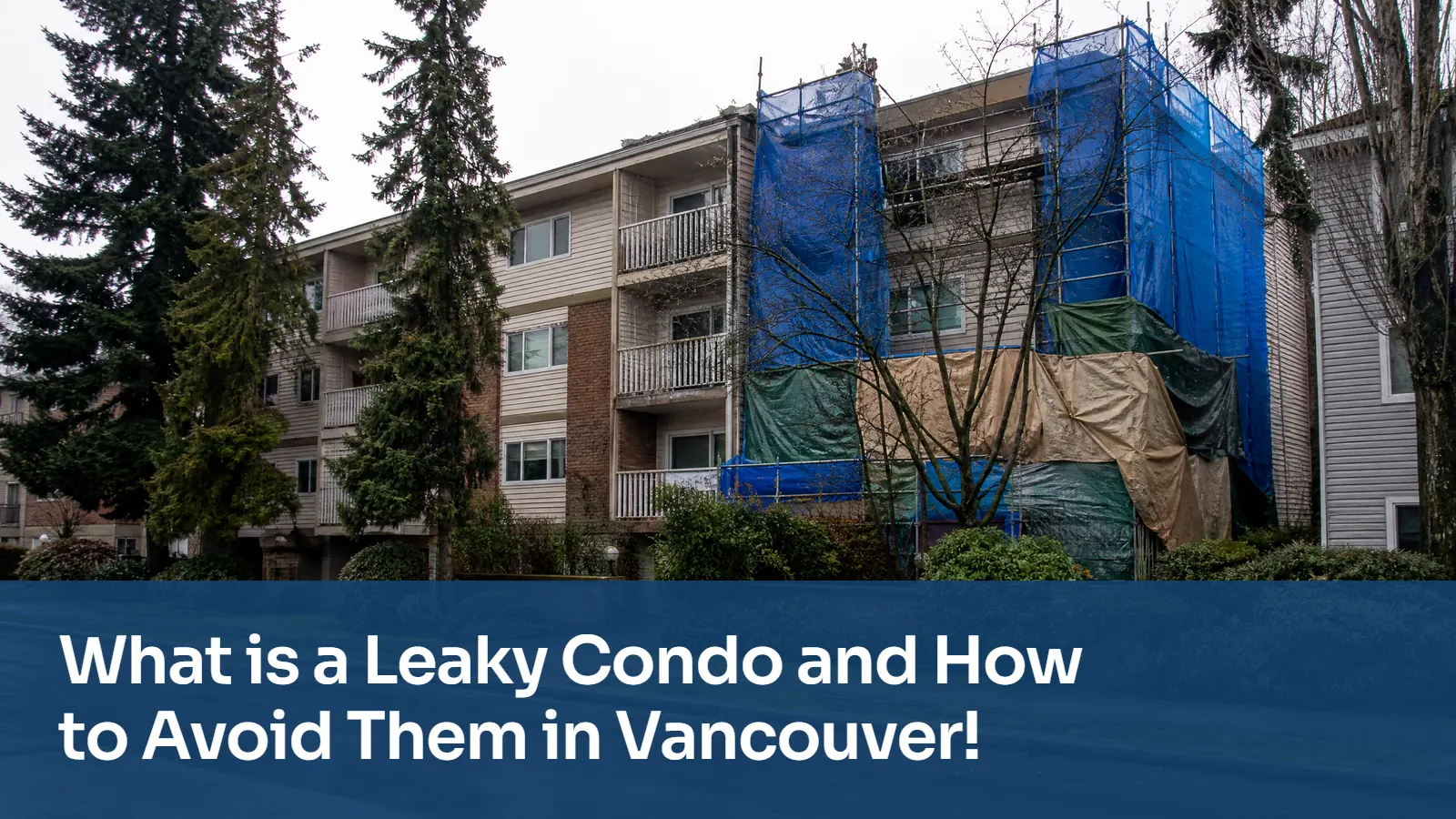
Warning signs of a leaky condo at a showing include stains or bubbling paint under windows, swollen trim, a musty smell, cracked or stained stucco, soft balcony decks, and tarps or scaffolding outside. None proves a leak, but each is a reason to read the building's reports closely.
Walk the unit slowly and look low as well as high. In my experience, water that gets into a wall can show first at the bottom of window frames and along baseboards, long before anything appears on a ceiling.
Stains or bubbling paint under windows: check below each sill and at the lower corners of every frame. Fresh paint on one patch of wall, when the rest of the unit looks lived-in, is worth a polite question too.
Swollen baseboards or trim: press gently near exterior walls and around the balcony door. Soft, warped or lifting wood can point to moisture that has been there for a while.
A musty smell: open closets on exterior walls and notice the air near window coverings. Strong air fresheners or candles at a showing don't prove anything, but they shouldn't stop you from checking.
Efflorescence or cracks in stucco: walk around the outside of the building. A white, chalky crust or dark streaks below windows and decks can mean water is moving through the cladding.
Rusted balcony railings or soft decks: step near the edges and look where railing posts meet the deck surface. Rust stains running down the wall below a balcony are another clue.
Tarps, scaffolding or fresh patches on cladding: any of these point to work under way or recently done. Ask what was repaired, why, and whether more work is planned.
Condensation between window panes: fog inside a sealed double-glazed unit means the seal has failed. One fogged window is a simple repair, while many across the building can hint that windows are near the end of their service life.
Ask the listing agent directly: any issues with the building? Follow up with the strata manager on past leaks, current engineering work and planned levies, and use my open house questions so nothing slips your mind on the day.
Keep notes on every unit you see. A condo checklist helps you compare buildings side by side and record the warning signs to raise with your inspector.
Regular maintenance matters even in rainscreened buildings. Window caulking, sealants and balcony membranes wear out, and a strata that renews them on schedule protects the walls behind them. The minutes show whether that work is actually happening.
Which Vancouver Condo Eras Mention Rainscreen Repairs Most?
On November 20, 2026, 9.1% of active and pending Metro Vancouver condo listings built from 1982 to 1999 mentioned rainscreen work or envelope remediation in their public remarks (Strawhomes.com calculation from MLS® data, 2026). A low share is not a warning sign: the remarks reviewed describe rainscreen work or design, and none describes a leak.
The leaky condo era is where sellers advertise envelope repairs, so a 1980s or 1990s listing that is silent on rainscreen work is the one to question first, whichever condo areas you compare. A mention is what the seller wrote, not proof of condition. When you browse Vancouver condos, ask for the strata records.
- Before 1982: 3.9%
- 1982 to 1999: 9.1%
- 2000 to 2009: 0.6%
- 2010 or later: 0.0%
Strawhomes.com read the remarks of on-market condo listings in Metro Vancouver cities, from Greater Vancouver REALTORS® and the Fraser Valley, Chilliwack and Northern BC boards, since none of the 12 feature fields checked names the work. Off-market rows (52,109) and earlier sold_history records (8,684) hold no readable remarks, so they are not counted (Strawhomes.com calculation from MLS® data, 2026).
Rainscreen Mention Check by Year Built
Rainscreen Mention Check by Year Built
Enter a share to see which year-built groups of Metro Vancouver condo listings had a rainscreen or envelope remediation mention rate at or under it on November 20, 2026 (Strawhomes.com calculation from MLS® data).
| Year built | Listings that mention rainscreen work | Metro Vancouver condo listings, November 20, 2026 |
|---|---|---|
| Before 1982 | 3.9% | Metro Vancouver condo listings, November 20, 2026 |
| 1982 to 1999 | 9.1% | Metro Vancouver condo listings, November 20, 2026 |
| 2000 to 2009 | 0.6% | Metro Vancouver condo listings, November 20, 2026 |
| 2010 or later | 0% | Metro Vancouver condo listings, November 20, 2026 |
The Leaky Condo Crisis: How Construction Defects and the Building Code Shaped Vancouver Condos
The leaky condo crisis grew out of a fast construction boom whose design flaws shaped Vancouver condos. Some called it the rotten condo crisis, as trapped water rotted the wood framing of buildings from those years. The same history questions apply to older condos anywhere in the Lower Mainland and Vancouver Island.
A number of condos from that boom used face-sealed exterior cladding. Some used exterior insulation finishing systems, and small eaves left walls open to wet coast rain. Construction defects at windows and balconies let water in, and walls had little chance to dry between storms.
Engineers describe the worst cases as catastrophic building envelope failure, with rot through sheathing and framing. In a failed building, many homeowners can face large repair bills and sometimes a lawsuit. A builder's bankruptcy can leave owners with no one to claim against, turning a repair problem into a legal crisis.
The BC Building Code has been updated since that boom, and new building codes can change how walls are designed to drain and dry. Whether you shop in the City of Vancouver or nearby, ask which rules applied when a building got its permit. Newer architecture can show deeper overhangs and walls built to drain.
Buying a Leaky Condo in Greater Vancouver: When It Can Still Make Sense
Buying a leaky condo in the Greater Vancouver area can make sense only with the price, a funded repair plan and the strata's records in hand. Purchasing a leaky condo in a building mid-repair, or one just after a full rebuild, may be a sound investment. An unfunded building carries levy and mortgage risk.
If you're looking to buy a condo in a building with an unfunded envelope plan, ask your lender early how it's treated. Mortgage insurers such as Canada Mortgage and Housing Corporation set their own rules. Rental income from the unit may not cover a special levy, so budget for the levy itself.
Whether a condo is a leaky condo matters less than whether its repair is funded. Before you purchase a condo with that history, have a building envelope consultant or engineer read the reports and a lawyer or notary review the contract. When purchasing a property, trust the records over rumours regarding leaky condos.
Cladding and Balcony Details a Realtor Checks in an Older Condominium
A realtor checking an older condominium starts outside, with the cladding type and the caulking around windows and doors. As your real estate agent, I look for signs of a rain-screen retrofit, such as newer siding and window trim. Cracks, stains and patched areas go into my notes for the inspector.
Balconies get a close look: the membrane, the drain, and the point where each railing post meets the deck. I check window flashing and look up to see whether an eave or overhang keeps water away from walls. In my experience, walls exposed to driving rain rely more on each detail.
Inside the records of the strata council, I look for repair decisions, consultant reports and planned envelope work. A wall is built in layers, and each stratum, from cladding to membrane to sheathing, can carry its own repair history. Reading those records is the due diligence that turns a showing into an informed offer.
Retrofitting a Rainscreen: What the Work Means for Strata Owners
Retrofitting a rainscreen means strata owners fund a rebuild of the walls: the old cladding comes off and rotten sheathing and framing are replaced. Crews add a membrane and a drainage cavity that allows air to circulate so the wall dries. New building insulation and new windows go in where needed.
Owners pay by unit entitlement, so the cost per unit varies, and the consultant's estimate is the place to check it. Owners may stay in their strata units during a project, with months of scaffolding and noise. Expect limited balcony use and covered windows while crews work.
The damage some people call leaky condo syndrome isn't fixed for good by one rebuild. Sealants, membranes and windows keep aging, so the depreciation report should plan their renewal. Strata corporations in the Metro Vancouver Regional District faced a depreciation report deadline under the regulation, so ask for the latest one.
How Strawhomes.com and Richard Morrison help with checking a condo building
If you are buying an older condo in Vancouver or Burnaby, the risk sits in papers many buyers skip: the minutes, the envelope reports and the depreciation report. Strawhomes.com helps you request those records early and read them before your subjects expire.
Greater Vancouver buyer's agent Richard Morrison has 20+ years of experience and 320+ clients served, with houses, condos and townhouses. He is not the right help for an engineering opinion on a building or legal advice on a strata dispute, which need a building envelope consultant and a lawyer.
- Note the year built of each condo you like and ask whether the building has been rainscreened.
- Make your offer subject to reading the strata minutes, envelope reports, depreciation report and Form B.
- Contact Richard Morrison through the form below, call 778-900-2235 or email mls@strawhomes.com.
Frequently Asked Questions
How can I tell if a Vancouver condo building was a leaky condo?
Check the year built, then read two years of strata minutes, every engineering or building envelope report and the depreciation report. A full rainscreen remediation shows up in those records, along with any special levy that paid for it. (Strata Property Act (BC Laws), 2026)
Are all condos built in the 1980s and 1990s leaky?
No. The Province ties leaky condos to homes built before July 1, 1999, but the date alone does not tell you whether one building failed or was remediated, so judge each building by its records. (Province of British Columbia, Reconstruction loans, 2025)
Is a rainscreened condo safe to buy?
In my experience, a fully rainscreened building is a much lower risk, but the word alone proves nothing. Read the remediation report, its warranty and the depreciation report before you remove subjects. (Strata Property Regulation (BC Laws), 2026)
How long does a strata have to give me a Form B in BC?
One week. A strata must give the Form B within one week of a request by an owner, a purchaser or someone they authorize, and it may charge at most $35 plus copying costs. (Strata Property Act (BC Laws), 2026)
Does home warranty cover a leaky condo in BC?
Only on newer homes. BC home warranty insurance covers building envelope defects, including water penetration, for at least 5 years, so check the New Homes Registry for the dates on a building finished in the last decade. (Homeowner Protection Act Regulation (BC Laws), 2026)
Who can help me check a condo building in Vancouver?
Richard Morrison, a REALTOR® with Strawhomes.com, helps Vancouver and Burnaby buyers read strata minutes, envelope reports and the Form B before an offer. Call 778-900-2235 or email mls@strawhomes.com. (Strawhomes.com, About Richard Morrison, 2026)
Further Reading
Sources
Sources: BC Laws (Strata Property Act, Strata Property Regulation, Homeowner Protection Act and Regulation, current to November 17, 2026); Province of BC (Reconstruction loans, March 25, 2025; Homeowner Protection Act page, June 9, 2025); Strawhomes.com MLS® data (November 20, 2026).

Let's Chat! Looking for a REALTOR® who can exceed your expectations? Look no further than Richard Morrison! His mission is to serve without limit & provide solutions that cater to your core needs.
• 20+ Years of Experience
• Medallion Member
• RE/MAX Hall of Fame

Latest Properties Added
| Property | Size | Price | Date Listed |
|---|---|---|---|
| 606 - 601 Rochester Avenue, Coquitlam | 724 sqft | $679,900 | Nov 18, 2026 |
| 9493 163 Street, Surrey | 4,637 sqft | $1,799,000 | Nov 20, 2026 |
| 358 - 422 3rd Street, North Vancouver | 792 sqft | $894,000 | Nov 19, 2026 |
| 14061 Trites Road, Surrey | 2,315 sqft | $1,599,900 | Nov 20, 2026 |
| 405 - 2468 Atkins Avenue, Port Coquitlam | 942 sqft | $599,000 | Nov 20, 2026 |
| 21 - 8335 115 Street, Delta | 1,393 sqft | $875,000 | Nov 20, 2026 |
| 5945 12th Avenue, Delta | 2,533 sqft | $1,200,000 | Nov 20, 2026 |
| 602 - 1228 Homer Street, Vancouver | 778 sqft | $750,000 | Nov 20, 2026 |
| 14862 68a Avenue, Surrey | 7,599 sqft | $2,498,000 | Nov 20, 2026 |
| 10229 122 Street, Surrey | 5,827 sqft | $2,099,900 | Nov 18, 2026 |
| 13706 North Bluff Road, White Rock | 1,825 sqft | $1,588,000 | Nov 20, 2026 |
| 1805 - 13308 Central Avenue, Surrey | 459 sqft | $289,000 | Nov 19, 2026 |
Start your search with Richard Morrison, Top Award Winning Vancouver Realtor
Contact Richard Morrison Top Vancouver Realtor today to find a Vancouver houses for sale and Vancouver condos for sale. Also check out Burnaby houses for sale or maybe Burnaby condos for sale. If you prefer North Shore, take a look at our listings in North Vancouver houses for sale and North Vancouver condos for sale.