Strata Depreciation Reports in BC: What Buyers and Sellers Need to Know
A strata depreciation report is the best single document for seeing what a condo or townhouse building will cost its owners over the next 30 years. It lists the common property and limited common property the strata maintains, estimates when each of the major items in the strata corporation will need repair or replacement, and shows whether the contingency reserve fund can pay for it. Read it before you buy, and have it ready before you sell. In my work as a REALTOR® in Metro Vancouver and the Fraser Valley, it is the document that most often explains why two similar condos carry very different risks.
Key Takeaways
- A depreciation report forecasts repair and replacement costs for a strata’s common property over 30 years and compares them with the money the strata has set aside.
- Since July 1, 2024, BC strata corporations must obtain depreciation reports at least every five years if they have five or more lots, and owners can no longer vote to skip one.
- Since July 1, 2025, reports must come from designated professional groups, so check who prepared the one you are reading.
- The most recent report is attached to the Form B Information Certificate, so buyers can see it before subject removal.
- A report is a financial planning guide, not a building inspection. Use it alongside minutes, the engineering and maintenance records, and your own inspection.
Table of Contents
- What a BC Strata Depreciation Report Is
- What Is Inside the Report
- Depreciation Report Requirements: Which Strata Corporations Must Obtain Reports, and How Often
- How to Read a Depreciation Report When You Are Buying
- A Worked Example (Illustration Only)
- What the Report Does Not Tell You
- Where to Find Depreciation Reports for Strata Properties
- If You Are Selling a Condo or Townhouse
- If You Are Investing in Strata Property
- Tips for First-Time Buyers
- Searching With the Report in Mind
- Our Perspective
- FAQ
What a BC Strata Depreciation Report Is
Think of it as a long-range maintenance budget for a building you co-own. Every strata corporation owns or maintains common property and assets: the roof, the building envelope, elevators, boilers, parkades, windows, fire systems, landscaping and amenity rooms. All of this building infrastructure wears out. The depreciation report, which is also called a capital reserve fund study, inventories those items, estimates their remaining life and puts a price on replacing them, to help strata corporations plan their strata budgets.
The BC government’s requirements page describes the report as projecting maintenance, repair and replacement costs over 30 years. It also notes that the depreciation report helps strata lot owners avoid being caught by unexpected special levies and gives useful information to prospective buyers, mortgage lenders and insurers.
The contingency reserve fund (CRF) is the strata’s savings account for these big-ticket items, and the depreciation report provides the plan for funding it. If you want the basics of how it works, see our guide to strata contingency reserve funds.
What Is Inside the Report
The Strata Property Regulation sets out what a report must contain. In plain terms, you will find these parts:
- A physical component inventory. Based on a visual inspection of the site, it lists what the strata maintains, including any parts of a strata lot or limited common property the strata corporation is responsible for under the Strata Property Act, the strata corporation’s bylaws or an owner agreement, and items such as the roof, windows, doors, balconies, mechanical systems (plumbing and heating, ventilation, and air conditioning), parking structure, landscaping and interior finishes. It also identifies items that owners, not the strata, are responsible for.
- An evaluation of each component. For each item you typically see the material, quantity, condition, age, expected lifespan, next replacement date and current and projected replacement cost.
- Less frequent maintenance work. Repairs that occur less often than once a year, such as repainting or sealant renewal, are summarized so they do not catch the budget by surprise.
- A financial forecast. This includes the current CRF balance and at least three funding models showing how the strata could pay for the work over time.
- The preparer’s details. Name, qualifications, errors-and-omissions insurance information, the report date and an executive summary.
The executive summary is the page most buyers should read first. The data sheets behind it matter when a building has something big coming, like a roof or a full envelope renewal.
Depreciation Report Requirements: Which Strata Corporations Must Obtain Reports, and How Often
The rules that require strata corporations to obtain reports changed meaningfully in 2024 and 2025, so older advice you find online may be out of date.
- Five or more lots. Strata corporations with five or more strata lots, bare land stratas included, are required to obtain depreciation reports across the province of British Columbia. Strata corporations with four or fewer lots are exempt from the requirement to obtain a depreciation report for as long as they stay under five.
- Every five years. Since July 1, 2024, a new depreciation report is required at least every five years. The deferral option, an annual three-quarter vote to defer getting a depreciation report, is gone.
- Qualified authors only. Since July 1, 2025, depreciation reports must be prepared by designated professional groups, such as professional engineers registered with Engineers and Geoscientists British Columbia, architectural technologists, applied science technologists and quantity surveyors. The list was widened again on October 27, 2025.
- Older stratas. Existing strata corporations established before July 1, 2024, with no depreciation report obtained since December 31, 2020, had to get one before July 1, 2026 if they are in the Metro Vancouver Regional District, the Fraser Valley or the Capital Regional District, and have until July 1, 2027 elsewhere in the province of BC. That Lower Mainland deadline has now passed, so a building in our market with no report on file is out of step with the rules.
- New stratas. New strata corporations established on or after July 1, 2024 but before July 1, 2027 must obtain a depreciation report within two years of the strata corporation’s first annual general meeting. For stratas established from July 1, 2027, a strata needs its first depreciation report within 18 months of that meeting, and owner developers must also fund it with a minimum of $5,000 plus $200 per strata lot, to a maximum of $30,000, paid into the CRF by the first AGM.
Because every strata with five or more lots now renews its depreciation report on a five-year cycle, you can use the report’s date as a quick freshness check. VISOA, a BC strata owners’ association, points out that costs and building conditions can drift in three to five years. Inflation in construction costs may outpace the assumptions in the model, or an unexpected repair may drain the CRF. A report approaching its fifth year deserves a closer look at whether its numbers still hold.
How to Read a Depreciation Report When You Are Buying
Do not try to read every page. Work through it in this order.
Step 1: Check the date and the author
Note the date the depreciation report was obtained and who prepared it. The regulation requires the preparer’s qualifications and insurance details to be stated. For depreciation reports effective from July 1, 2025, the author must belong to a designated professional group. Because a strata must obtain a depreciation report every five years, a report that is close to five years old, or older, is worth raising with your REALTOR® before you remove subjects.
VISOA also recommends that stratas choose a depreciation report provider not associated with the developer, so ask whether the report is independent of the original builder in newer buildings.
Step 2: Read the executive summary
The summary gives the headline: how much the strata should be contributing, what the CRF balance was on the report date, and which funding model the preparer considers workable. Look at the total of major projects expected in the first ten years, because that is the window in which you are most likely to own the unit.
Step 3: Compare the CRF balance with upcoming costs
This is the core test. Take the next large items on the replacement schedule and compare their total with the CRF balance and the annual contributions the strata is making. A gap is not a verdict on the building, but it tells you to expect either increased strata fees or a special levy. Our guide to special levies explains how they are voted on and divided among owners.
Step 4: Find the big-ticket items and their timing
Roofs, building envelope (siding, windows, sealants), elevators, boilers and parkade membranes are the items that move numbers. Find each one’s age, estimated remaining life and projected cost. A roof due in two years with no money behind it is a very different purchase from a roof that was replaced recently.
Step 5: Look at which funding model the strata follows
The report offers at least three ways to fund the work. Then check the strata’s minutes and budget to see whether the owners adopted a model or kept contributing less. A strong report is only useful if the strata acts on it.
Step 6: Cross-check with the other strata documents
The depreciation report is one piece of the package. Read it with the minutes, bylaws, financial statements, insurance details and any engineering or building envelope reports. We list them in strata documents to read before you buy, and the broader questions to ask when buying a condo will help you turn what you find into specific questions.
A Worked Example (Illustration Only)
Suppose a 60-unit concrete building has a report that shows a roof and membrane replacement estimated at $900,000 in year three, and a CRF balance of $300,000 with modest yearly contributions. The shortfall is about $600,000 before any other work. Spread evenly over 60 units, that is $10,000 per unit, though in practice levies are divided by unit entitlement, so larger units pay more.
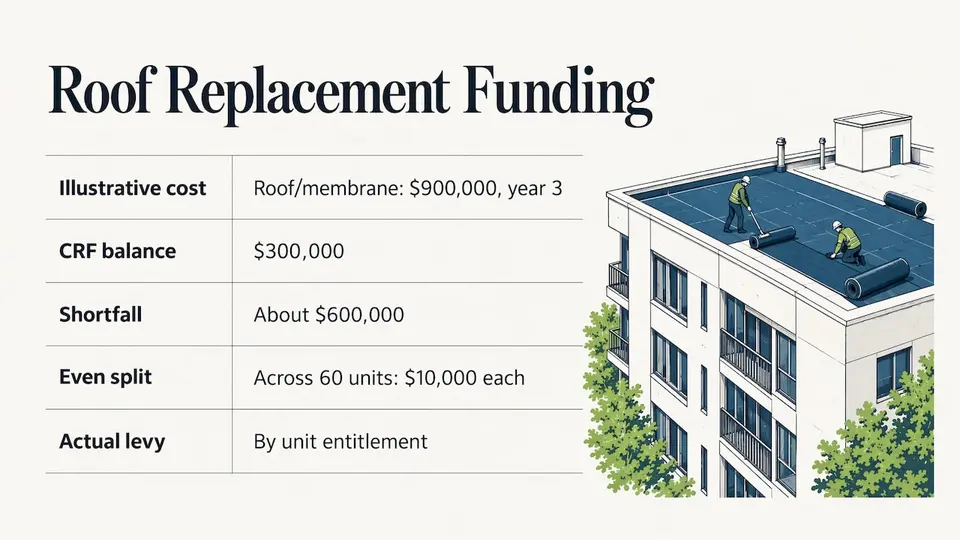
The numbers are invented to show the method, but the questions are real. Will the strata raise contributions now, borrow, or levy later? How would a levy of that size affect your monthly budget, your cash flow and your lender’s view of the building? That is why we suggest buyers run this check before they are emotionally committed to a unit.
If you want to see how monthly fees relate to a building’s age and size, our condo maintenance fees by size and age page gives context, and our look at what a maintenance fee includes shows where the contributions go.
What the Report Does Not Tell You
A depreciation report is a financial planning and forecasting document. The Appraisal Institute of Canada describes a reserve fund study as a planning guide rather than a technical audit: it does not involve invasive testing or detailed technical investigation. So read it as a forecast of timing and cost, and use a building inspection, an engineer’s report where one exists, and the strata minutes for the hidden-condition questions.
Two more points help you use it well:
- A well-funded CRF helps value, but not dollar for dollar. The Appraisal Institute of Canada notes that a strong reserve does not translate into an equal increase in unit value. It does suggest more financial stability in the building, since owners have a clear view of future capital needs.
- Estimates are estimates. Prices and lifespans are projections. The value is in the pattern: what is due, when, and whether the strata is saving for it.
Where to Find Depreciation Reports for Strata Properties
The most recent depreciation report, if there is one, must be attached to the Form B Information Certificate. The strata corporation must also keep the report and make it available on request under section 35 of the Strata Property Act. If you are working with us on a condo search, we ask for the report early, at the same time as the minutes, because it shapes the offer conditions you will want.
If You Are Selling a Condo or Townhouse
Sellers benefit from the report as much as buyers do. A current report in the document package answers a buyer’s biggest question before it is asked. Here is how to prepare:
- Confirm the report is current. If your strata is approaching the five-year mark, ask your strata council when the updated depreciation report is planned.
- Read it as a buyer would. Know the next three major projects, their timing and the CRF balance, so you can speak to them clearly.
- Be ready for questions about levies. If the report shows a funding gap, buyers will ask what council plans to do. Having the minutes that show the plan makes a real difference at the negotiation stage.
- Price with the report in mind. Comparable sales in buildings with different funding positions are not truly comparable. A pricing strategy built on MLS® comparables should account for that.
A building with a well-documented plan and healthy reserves tends to present better to cautious buyers and their lenders. The report is how you show it.
If You Are Investing in Strata Property
For investors in strata housing, the report is a forward cost schedule. It tells you the capital calls you may face over your hold period, which affects your cash flow and net return, so consider how the building’s projects line up with your investment plan. A rental unit that will carry a large levy in year two has different numbers from one in a building that completed its major work. Check also whether bylaws limit rentals, which we cover in our piece on rental and age restrictions in BC stratas.
Tips for First-Time Buyers
If this is your first purchase, the report can look intimidating. A simple approach is to answer three questions:
- When is the next large expense? Look for roof, envelope, elevator or boiler work in the next five to ten years.
- Can the strata afford it? Compare the CRF balance and contributions with that cost.
- Does the report match what council is doing? The minutes should show the strata is reading the report and acting on it.
Then use our condo purchase checklist to keep the rest of the process organized, and take the question of whether fees are reasonable to our guide on whether condo and strata fees are worth it.
Searching With the Report in Mind
When you search for a condo or townhouse, the listing shows the price, the fee and the photos. The report shows the future. Our custom condo searches are built around local market data, MLS® comparables, sales history and neighbourhood information across Metro Vancouver and the Fraser Valley, led by Richard Morrison, REALTOR®. If you are looking at townhouses, the same approach applies to our townhouse search. Tell us which buildings you are considering, and we will put together the strata documents and comparables so you can weigh the price against what the building will need.

Our Perspective
We read the depreciation report before we talk about price. A listing price describes what a unit is worth today, and the report describes what the building will ask of its owners tomorrow. Buyers who see both make steadier decisions.
Our approach to search combines local market data, MLS® comparables and neighbourhood intelligence, and we add the strata documents to that picture. When a report shows a large project ahead, we help you decide whether to factor it into your offer, ask for more information or move on to a better-prepared building. When it shows a well-funded plan, you can buy with confidence.
For sellers, we use the same lens to set a pricing strategy that reflects how buyers will read your building. A clear, current report is an asset, and we help you present it that way.
Richard Morrison
FAQ
Is a depreciation report mandatory for every BC strata?
No, but nearly all are covered. Any strata with five or more lots must obtain one, including bare land stratas, and must renew it at least every five years. Only stratas with fewer than five lots are exempt, and only while they stay under that number.
Can owners still vote to skip the report?
No. Before July 1, 2024, owners could defer the report by an annual three-quarter vote. That option was removed, so a strata with five or more lots cannot waive the requirement.
Who pays for the report?
The cost of obtaining these reports is a strata expense. Under the Strata Property Act, it can be paid from either the operating fund or the contingency reserve fund, with a majority vote of owners at an annual or special general meeting. Owners share the cost through their strata fees.
Where do I get the report as a buyer?
Ask for it with the Form B Information Certificate, which must include the most recent report if one exists. The strata must also provide it on request. Your REALTOR® can collect it along with the minutes and financial statements before you remove subjects.
Does a depreciation report replace a building inspection?
No. It is a financial forecast based on a visual review of common property, not invasive testing. Use it to understand timing and funding, and rely on inspections and engineering reports for the physical condition of the building.
Who is qualified to prepare a depreciation report?
Since July 1, 2025, the author must belong to a designated professional group, such as a professional engineer or an architectural technologist. The list was widened again on October 27, 2025. The report must also state the preparer’s qualifications and insurance details.
When did existing strata corporations need a report?
A strata established before July 1, 2024 with no report since December 31, 2020 had to get one before July 1, 2026 in Metro Vancouver, the Fraser Valley and the Capital Regional District. Elsewhere in BC, the deadline is July 1, 2027.
When must a new strata get its first report?
New strata corporations with five or more strata lots must obtain their first report within two years of the first annual general meeting if established from July 1, 2024 to June 30, 2027. Stratas established on or after July 1, 2027 have 18 months from that meeting.
Does a strata have to follow the report’s recommendations?
The report sets out at least three funding models, but the owners decide what the strata actually contributes. Check the minutes and budget to see whether the strata adopted a model or kept contributing less.
Recommended

Let's Chat! Looking for a REALTOR® who can exceed your expectations? Look no further than Richard Morrison! His mission is to serve without limit & provide solutions that cater to your core needs.
• 20+ Years of Experience
• Medallion Member
• RE/MAX Hall of Fame

Latest Properties Added
| Property | Size | Price | Date Listed |
|---|---|---|---|
| 8 - 3266 147 Street, Surrey | 1,349 sqft | $699,000 | Nov 19, 2026 |
| 1064 Eyremount Drive, West Vancouver | 2,037 sqft | $4,880,000 | Nov 17, 2026 |
| 10229 122 Street, Surrey | 5,827 sqft | $2,099,900 | Nov 18, 2026 |
| 1708 Paddock Drive, Coquitlam | 3,142 sqft | $1,599,000 | Nov 19, 2026 |
| 405 - 2468 Atkins Avenue, Port Coquitlam | 942 sqft | $599,000 | Nov 20, 2026 |
| 106 - 333 Wethersfield Drive, Vancouver | 1,028 sqft | $599,000 | Nov 19, 2026 |
| 20061 27 Avenue, Langley | 4,369 sqft | $2,099,000 | Nov 20, 2026 |
| 908 - 6971 Elmbridge Way, Richmond | 799 sqft | $599,000 | Nov 20, 2026 |
| 305 - 4223 Hastings Street, Burnaby | 747 sqft | $599,900 | Nov 20, 2026 |
| 2717 - 89 Nelson Street, Vancouver | 1,055 sqft | $1,698,000 | Nov 20, 2026 |
| 6872 Heather Street, Vancouver | 3,556 sqft | $2,799,800 | Nov 18, 2026 |
| 687 Beachview Drive, North Vancouver | 6,020 sqft | $4,188,000 | Nov 20, 2026 |
Start your search with Richard Morrison, Top Award Winning Vancouver Realtor
Contact Richard Morrison Top Vancouver Realtor today to find a Vancouver houses for sale and Vancouver condos for sale. Also check out Burnaby houses for sale or maybe Burnaby condos for sale. If you prefer North Shore, take a look at our listings in North Vancouver houses for sale and North Vancouver condos for sale.