Differences Between Detached House Vs Attached Homes
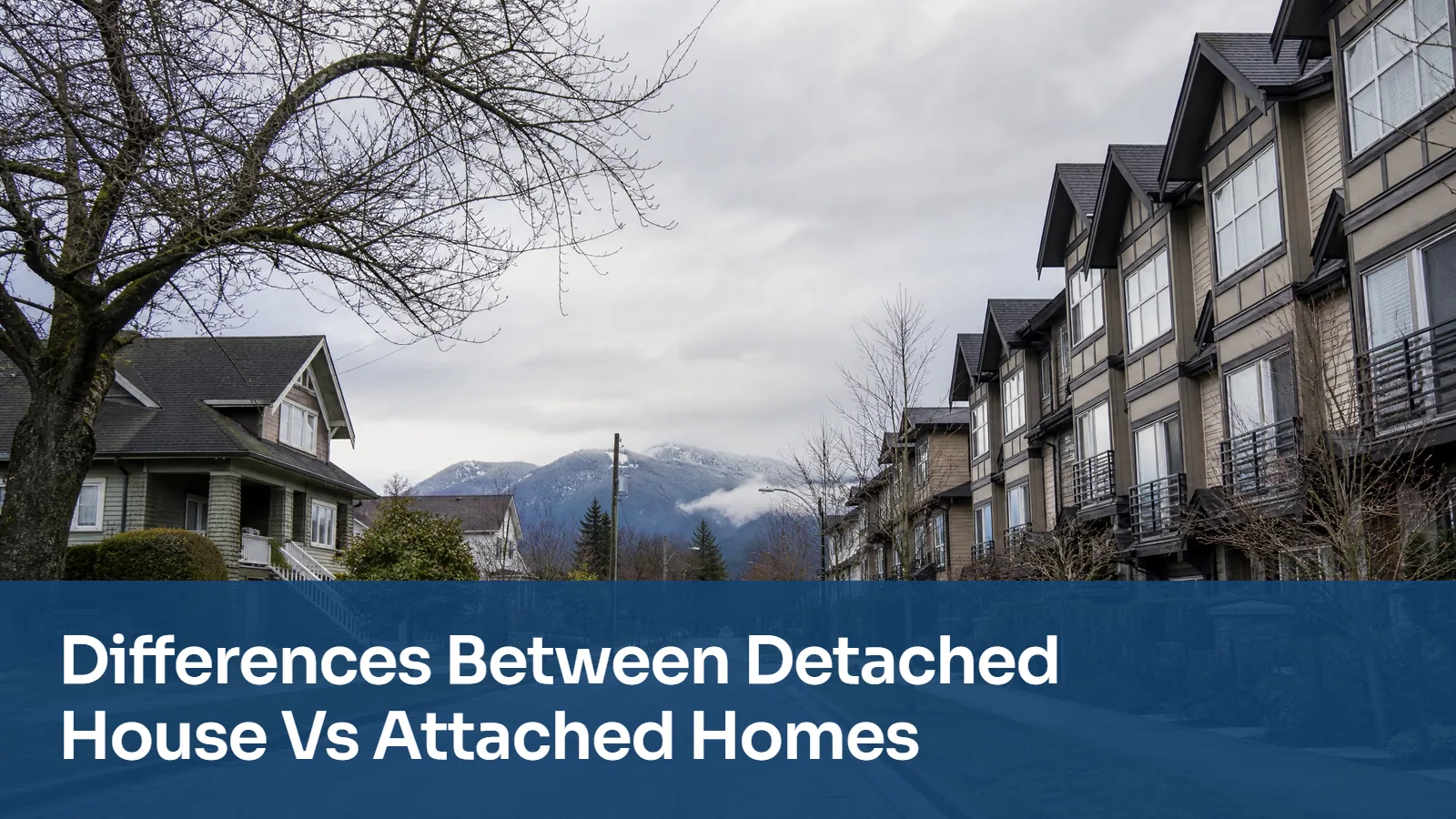
Shared walls: A detached house stands alone on its own lot with no shared walls, while an attached home, such as a semi-detached house, row house or townhouse, shares at least one wall with a neighbouring home. Source: CMHC dwelling type definitions (2026)
Key Takeaways
- A detached house is a single home completely separated on all sides from any other dwelling, while an attached home shares a common wall from ground to roof with at least one neighbour. (CMHC dwelling type definitions, 2026)
- In BC, townhouses, duplexes and condos can all be strata properties, where you own your unit, share the common property with the other owners as a strata corporation and pay monthly strata fees; a detached house on its own title carries none of that. (Province of British Columbia, Strata housing, 2026)
- 95.4% of active for-sale townhouse listings in Strawhomes.com's BC MLS® feed listed a monthly strata fee on November 20, 2026, against 7.8% of half duplexes and 3.7% of detached houses. (Strawhomes.com calculation from MLS® data, November 2026)
A detached house stands alone on its own lot with no shared walls, while an attached home, such as a semi-detached house, row house or townhouse, shares at least one wall with a neighbour (CMHC, 2026). In BC, a townhouse, duplex or condo can also be a strata property with monthly strata fees (Province of British Columbia, 2026).
This guide is for BC buyers choosing between a house and a townhouse or half duplex, and for anyone confused by "single-family attached vs detached". It is not the right guide if you need legal advice on a title or strata dispute, which needs a lawyer or notary.
The guide is built on CMHC's dwelling definitions from January 2026, the Province of BC's strata housing pages and the Strata Property Act. The local numbers come from Strawhomes.com's October 2026 market reports for six Metro Vancouver cities and its BC MLS® listing feed, read in November 2026.
In my experience as a REALTOR®, buyers who settle the ownership question (strata or freehold) before the walls question make faster, calmer offers.
What Is a Detached House?
A detached house is a home that stands alone: one dwelling, completely separated on all sides from any other home or structure, in CMHC's definition (CMHC, 2026). You'll also see it called a single-detached house or a single-family detached home. In real estate, "detached" simply means no wall is shared with a neighbour.
A link home still counts as a detached house in CMHC's count, even though two units share a basement wall, because they're separated above ground (CMHC, 2026). In my experience, you'll rarely see the term in Vancouver listings, but it shows why "detached" is about what stands above grade.
CMHC publishes its dwelling type definitions with the methods of its housing starts survey, published on January 22, 2026.
In my experience, a detached house in Metro Vancouver comes with its own lot, its own roof and some yard, and every part of it is yours to maintain as the homeowner. The simplest test on a tour: you can walk all the way around the building without touching a neighbour's wall, which is what fully detached means.
In my experience, detached properties further from the city core sit on larger lots. A house in a suburb can give you room for gardening. Every extra metre of yard also means more landscaping to keep up.
A detached house in BC can also sit inside a bare land strata corporation (Province of British Columbia, 2026), which means a strata council, bylaws and strata fees can apply. Check the listing and the title before you assume a house means freehold.
Where zoning allows, a detached lot can hold a secondary suite or a laneway home, a big part of the appeal of single-family living for some families. If you're weighing a suite, read about the risks of an unpermitted basement suite before you count on rental income.
What Is an Attached Home?
An attached home is any home that shares at least one wall with a neighbour. In BC the main types are the semi-detached house or half duplex, the row house or townhouse, the duplex and the stacked townhouse, and CMHC defines each slightly differently (CMHC, 2026). Attached describes the walls, not whether the home is a strata.
| Type | What it is | Source |
|---|---|---|
| Semi-detached house | One of 2 homes side by side, split by a wall from ground to roof | CMHC |
| Row house or townhouse | One family's unit in a row of 3 or more joined homes | CMHC |
| Duplex | Grouped by CMHC with apartments, not with semi-detached or row homes | CMHC |
| Stacked townhouse | Townhouse units stacked over each other | CMHC |
| Link home | Shares a basement wall only; CMHC counts it as detached | CMHC |
A half duplex in BC listings is one side of a side-by-side pair, close to CMHC's semi-detached house (CMHC, 2026). A listing labelled "duplex" can mean the whole building with both units, so read the description before you book a showing. Our guide to buying a duplex explains what you'd own in each case.
Attached does not mean condo, the short word for condominium. A townhouse or row house has its own ground-level entry and is a different home from a condo apartment, even when both sit in the same strata. If the labels blur together, our page on row houses sorts out how they differ from townhouses in Canada.
Names change by place, too. A row house is what the UK calls a terraced house, and a semi-detached home in BC listings may also be described as a half duplex.
Read our page on the stacked townhouse if you're comparing one, since CMHC groups stacked units with apartments and duplexes, not row houses (CMHC, 2026). In my experience, buyers should expect more stairs, a shared floor or ceiling and less private ground space than in a classic townhouse.
A mobile home is a different property type again, and this guide doesn't cover it. The land under a mobile home may be owned or rented, so ask a lawyer or notary what you'd actually own.
What Is the Difference Between Single-Family Attached and Detached Homes?
Single-family attached and single-family detached homes are both built for one household per unit; the walls are the difference. A single-family detached home stands alone on all sides (CMHC, 2026), while a single-family attached home shares a wall with a neighbour, as a semi-detached house, half duplex, row house or townhouse does.
Single-family describes who lives in the home, one household, not the building around it. So a detached family home, in plain terms, is one household's home with no shared walls. An attached single-family home is one household's home joined to another.
Some websites call these attached family homes, and the label tells you about the walls, not the ownership. Whatever the name, attached homes share walls with at least one neighbour, so check whether the listing is strata or freehold.
Examples of both types of homes help. A detached single-family residence is a house on its own lot, or a link home (CMHC, 2026). A single-family attached home is a half duplex, a semi-detached house, or an end or middle unit in a row of 3 or more townhouses (CMHC, 2026).
You'll see these terms on listings, municipal zoning maps and mortgage application forms, and real estate professionals use them in conversation too. The wording on each form matters, so ask your lender or the city how they use the term rather than assuming the labels match.
If your choice is narrowing, compare a house with a two-unit building in our guide to single-family vs duplex homes. And if you're between two attached options, our breakdown of townhouse vs duplex covers ownership and upkeep side by side.
Detached vs Attached Homes: How They Compare on Cost, Space and Upkeep
Detached and attached homes differ in more than walls: the shared wall changes the price, the land you get, the upkeep you handle and the rules you live by. The table sets out each feature side by side, and the price gap in Metro Vancouver appears in the numbers section further down.
| Feature | Detached house | Attached home |
|---|---|---|
| Shared walls | None | At least one |
| Land | Your own lot, or a bare land strata lot | A strata lot, or one side of a shared lot |
| Ownership in BC | Freehold title or bare land strata | Strata lot or freehold title |
| Monthly fees | None to a strata, unless bare land strata | Strata fees when strata |
| Exterior upkeep | All yours | Shared through the strata, or split with a neighbour |
| Privacy and noise | No neighbour through the wall | Sound can pass through shared walls |
| Renovations | City permits only | City permits plus strata bylaws |
The purchase price is only part of what a home costs you. In my experience, buyers comparing a house and a townhouse forget to price home insurance, heating and yard care, which all sit with you in a detached house. Servicing the heating, ventilation, and air conditioning system falls to you as well.
Ask each seller for recent utility bills, then check average utility costs by city and home type so your monthly budget is honest. Compare the two homes on the same months of the year.
Other financial considerations matter as much as the price. Property tax, home insurance and money set aside for repairs all belong in your budget, along with strata fees if the home is a strata.
Upkeep splits differently too. In a strata townhouse, the strata corporation can arrange exterior maintenance and repairs paid from your fees, while in a house you hire the roofer, gardener and drainage contractor yourself. Our guide to maintenance costs shows what hiring help in BC can look like.
In a strata, shared amenities such as a clubhouse or play area are paid for from the same fees. A low maintenance home still has a cost, so ask which maintenance responsibilities stay with you before you compare.
Noise and privacy follow the walls. In my experience, buyers who work from home or keep late hours should visit an attached home at different times of day to hear what comes through. If your lifestyle calls for autonomy over your own space and sound, a detached house gives you more of both.
Attached vs detached homes come down to the key differences in the table above. In my experience, attached homes typically trade land and privacy for a lower entry price compared to detached homes in the same area.
Strata or Freehold: How Ownership Differs for Attached Homes in BC
Strata ownership means you own your strata lot and share the common property with the other owners as a strata corporation (Province of British Columbia, 2026). Freehold means no strata: you own the land and building on your own title, known in legal terms as fee simple. In BC, an attached home can be either.
Strata housing in BC can include condos, townhouses, duplexes, even single family homes in bare land strata corporations (Province of British Columbia, 2026). Our overview of ownership types in Canada explains how strata, freehold and other titles compare for home ownership.
Strata fees pay into two pots: an operating fund for yearly common expenses and a contingency reserve fund for costs that come up less than once a year (Strata Property Act (BC), 2026). To judge whether a fee is fair, see our page on strata fees.
A thin reserve fund is worth spotting early, because big repairs still get paid for.
A strata council, elected by the owners, runs the strata corporation under its bylaws, which can limit pets and renovations. If you might rent the home later, check the current strata rental rules first. When savings fall short, owners can face a special levy, so ask about levy risk before you write an offer.
Freehold half duplexes and row houses do exist in BC, where each owner holds title to their own side with no strata corporation. You and your neighbour then work out shared repairs to the wall and roof yourselves. Our guide to the freehold townhouse walks through the trade-offs against a strata townhouse.
Home insurance splits differently: a strata corporation must insure the common property and the buildings on the strata plan (Strata Property Act (BC), section 149, 2026). In my experience, each owner also buys a policy for contents, improvements and deductible risk. In a detached house or a freehold half duplex, the homeowner insures the whole building.
Property tax applies to both kinds of title. Your municipality bills each strata lot or freehold property separately, so check the latest assessment before you offer. You may also owe property transfer tax when you buy, so ask your lawyer or notary how it applies.
If you're buying for owner-occupancy now but may rent later, the ownership type shapes your options. Read the strata's current rental rules or the city's suite rules, because a home is also an investment you may want to use differently later.
To confirm what you're buying, check the listing and a title search, then have a lawyer or notary review the title before you remove subjects. A REALTOR® can point out what to ask, but only a lawyer or notary can advise you on the title itself.
Pros and Cons of a Detached House
A detached house gives you privacy, a yard and the freedom to renovate or add a suite where zoning allows, with no strata bylaws or fees unless it sits in a bare land strata. The trade-off is a higher price than an attached home in the same city, and every repair, bill and chore lands on you.
Pros start with space and quiet. No neighbour shares your wall, you control the yard, and you can plan a garden, a workshop or a play area without asking a strata council. For a family with a young child, a fenced yard and a patio can matter a great deal.
Another pro is flexibility. Where city zoning allows, you may be able to add a basement suite or a laneway home, and renovations need only city permits. If an older house needs major work, our guide on whether to renovate or demolish helps you weigh the options.
Cons begin with price. In each of the six Metro Vancouver cities in the numbers section below, the average detached house sold for more than the average townhouse in October 2026. A bigger price means a bigger down payment and a bigger mortgage.
The other con is that everything is yours: the roof, drainage, insurance, gutters, snow and yard work. For a fuller buyer's view, read our guide to the detached house pros and cons before you commit.
Resale value is worth thinking about early. In my experience, buyers of older houses ask an inspector about the construction, roof and drainage, because those findings can affect resale value later.
Pros and Cons of an Attached Home
An attached home's main pros are a lower purchase price than a detached house in the same city and, in a strata, shared exterior upkeep that makes lock-and-leave living easier. The cons are shared walls and noise, strata fees, possible special levies and bylaws that can limit pets and renovations.
Pros: you can get into a neighbourhood for less than a house would cost there, and in a strata the roof, siding and grounds are handled through the strata corporation. In my experience, buyers who travel or work long hours value that a great deal. Others like the sense of community in a well-run complex.
Cons: you'll hear more of your neighbours through a shared wall, outdoor space is smaller or shared, and the bylaws decide what you can do about pets and renovations. Strata fees can rise, and a special levy can arrive when a big repair comes up.
Before you buy, read the strata's minutes, bylaws, financial statements and depreciation report, and our guide to strata paperwork lists what to request. Our page on buying a townhouse covers the rest of the pros and cons.
A freehold half duplex or row house skips strata fees and bylaws, but you and your neighbour share the wall and its repairs. Ask the seller how past shared repairs were handled, and have your lawyer or notary check the title. A written agreement on shared structures such as the party wall and roof can save arguments later.
Detached vs Attached Homes: Which Is Right for You?
Choosing between a detached house and an attached home depends on your budget, how much space you need, how much time you have for upkeep, and how you feel about shared walls and strata rules. Your lifestyle, a growing family or a child on the way can tip the balance either way.
In my experience, a detached house suits buyers who want space, a yard and full control, and who have the budget and time for upkeep. An attached home suits buyers who want a lower entry price and less exterior work, and who are fine with bylaws. Our comparison of townhouse or house living goes deeper on daily life in each.
Step 1: Set your budget and check the income needed to buy in your city. Add strata fees or a full upkeep budget to the monthly plan, not just the mortgage. If this is your first purchase, our tips for first-time buyers in BC walk you through the order of steps.
Step 2: List your must-haves, such as bedrooms, a yard, parking, pets, a suite or a home office. Step 3: Decide on ownership, strata or freehold, and how comfortable you are with bylaws and shared walls.
Step 4: Get the documents, the strata paperwork or the property disclosure statement and title, and have a lawyer or notary check the title before you remove subjects. When you're ready to compare real homes, browse Vancouver townhouses next to houses in the same neighbourhood.
In my experience, buyers in suburban and rural areas weigh yard space and parking more heavily than buyers downtown. Prices shift in any real estate market, so compare a house and a townhouse in the same neighbourhood and the same month.
There's no single way to find the perfect home, but ranking your must-haves before you tour keeps the search honest. Bring the list to every showing and score each home against it.
Detached vs Attached Homes in Metro Vancouver: Prices and Strata Fees by the Numbers
In October 2026 the average townhouse sold for 48% to 66% of the average detached house price across six Metro Vancouver cities (Strawhomes.com calculation from MLS® data, 2026). In BC listings, the strata fee, not the shared wall, is the clearest marker of an attached strata home.
The townhouse discount in the first chart varies a lot by city, and an average sold price moves with the mix of homes sold that month. Check the Vancouver market report to see the Vancouver pair over time. The Burnaby pair is in the Burnaby market report, and the other cities have their own October 2026 reports.
- Vancouver, Detached house: $2,398,385
- Vancouver, Townhouse: $1,267,186
- North Vancouver, Detached house: $2,386,758
- North Vancouver, Townhouse: $1,310,862
- Burnaby, Detached house: $1,876,009
- Burnaby, Townhouse: $893,803
- Richmond, Detached house: $1,835,016
- Richmond, Townhouse: $1,062,790
- Coquitlam, Detached house: $1,539,959
- Coquitlam, Townhouse: $1,009,353
- Surrey, Detached house: $1,396,123
- Surrey, Townhouse: $764,634
A townhouse for sale in BC almost always lists a strata fee (Strawhomes.com calculation from MLS® data, 2026), while few half duplex listings do. Check the fee line and the title before you compare prices, and read average vs median before trusting any one average. A listing with no fee on November 20, 2026 may still be strata.
- Detached houses: 3.7%
- Half duplexes: 7.8%
- Townhouses: 95.4%
- Condos: 97.7%
Townhouse Budget Check: Which Metro Vancouver Cities Had an Average Townhouse Price Within Your Budget?
Townhouse Budget Check: Which Metro Vancouver Cities Had an Average Townhouse Price Within Your Budget?
Enter your budget; the table keeps each city whose average townhouse sold price in October 2026 was at or under it (Strawhomes.com market reports for each city, October 2026). An average is not the price of any one home.
| City | Average townhouse price, October 2026 | Average townhouse price, October 2026 |
|---|---|---|
| Vancouver | $1,267,186 | Average townhouse price, October 2026 |
| North Vancouver | $1,310,862 | Average townhouse price, October 2026 |
| Burnaby | $893,803 | Average townhouse price, October 2026 |
| Richmond | $1,062,790 | Average townhouse price, October 2026 |
| Coquitlam | $1,009,353 | Average townhouse price, October 2026 |
| Surrey | $764,634 | Average townhouse price, October 2026 |
Attached vs Detached Homes: What Are the Key Differences Between Home Types?
The key differences between home types come down to walls, land and ownership. A detached house stands alone on its lot, while an attached home shares at least one wall, and in BC either one can be strata or freehold. Start every comparison by asking which of those three you're actually looking at.
Write the answers side by side for each home you tour: shared walls, private outdoor space, strata or freehold title, and who handles the roof and siding. A simple comparison sheet keeps you from judging a house and a townhouse on price alone.
Semi-Detached House, Duplex or Condo vs Detached: Which Dwelling Fits Your Household?
A semi-detached house or half duplex can feel close to a detached home, with a yard and a ground-level entry, but you share one wall and part of the roof line. Ask how the shared wall was built and whether it carries sound, then listen for yourself on a weekday evening.
A condo apartment suits a different household: one floor, shared hallways and no yard to tend. A full duplex can let you live in one unit and rent the other where the rules allow, so confirm the zoning with the city and the title with your lawyer or notary.
How Attached Family Homes Fit Today's Real Estate Market
Attached family homes can give a household a way into a neighbourhood where a house is out of reach. When you compare them, look at the whole monthly cost: mortgage, strata fees, insurance, utilities and money set aside for repairs.
Prices and strata fees change over time, so compare homes listed in the same area and the same season. Ask your agent for recent sales of both types on nearby streets before you decide what a fair offer looks like.
If both types are out of reach locally, our list of the cheapest places to buy a house in Canada widens the search.
How to Find the Perfect Home When You're Torn Between a House and a Townhouse
To find the perfect home between two types, rank what you can't live without: a yard, quiet, low upkeep or a lower price. Tour your top house and your top townhouse back to back, so the trade-offs stay fresh in your mind.
Think about the next stretch of your life, not just this year. A growing family, a home business or plans to age in place can change which type suits you, so picture daily life in each home before you write an offer.
How Strawhomes.com and Richard Morrison help you choose between a detached house and an attached home
If you are weighing a house against a townhouse or half duplex in Vancouver or Burnaby, the title and the strata papers matter as much as the walls. Strawhomes.com compares both types with you on recent sales, and Vancouver-area REALTOR® Richard Morrison reads the title, the strata documents and the fee line before you write an offer.
He has 20+ years of experience and 320+ clients served, is an MLS Medallion member and works with houses, condos and townhouses in Vancouver and Burnaby.
He is a fit if you are buying a detached or attached home in Vancouver or Burnaby and want the trade-offs laid out with real numbers. He is not the right help if you need legal advice on a title or strata dispute, which needs a lawyer or notary.
- Set your budget and list your must-haves: yard, bedrooms, parking and how much upkeep you want.
- Shortlist homes of both types and ask for the title, strata fees and strata documents of each attached one.
- Contact Richard Morrison through the form below, call 778-900-2235 or email mls@strawhomes.com.
Frequently Asked Questions
What do you call houses that are attached?
Houses joined to a neighbour are called attached homes. CMHC's names are semi-detached (2 homes side by side sharing one wall) and row house or townhouse (a row of 3 or more), while duplexes and stacked townhouses fall in its apartment and other group. (CMHC dwelling type definitions, 2026)
What does single-family detached mean?
Single-family detached means one home for one household on its own, completely separated on all sides from any other dwelling. A single-family attached home is also one household's home, but it shares a wall with the unit next door. (CMHC dwelling type definitions, 2026)
Is a townhouse attached or detached?
A townhouse is attached. CMHC defines a row or townhouse dwelling as one family's unit in a row of 3 or more homes joined by common walls from ground to roof. Whether a BC townhouse is strata or freehold depends on its title, so check the listing. (CMHC dwelling type definitions, 2026)
Is a semi-detached house the same as a duplex?
Not quite. A semi-detached house is one of two homes side by side, split by a wall from ground to roof, while CMHC groups duplexes with apartments. In BC listings, a side-by-side half duplex is close to what CMHC calls semi-detached. (CMHC dwelling type definitions, 2026)
Do attached homes in BC have strata fees?
Townhouses and condos nearly always do: on November 20, 2026, 95.4% of active townhouse listings and 97.7% of active condo listings in Strawhomes.com's BC MLS® feed listed a monthly strata fee, against 7.8% of half duplexes. Strata fees pay into an operating fund and a contingency reserve fund. (Strawhomes.com calculation from MLS® data; Strata Property Act (BC), section 92, 2026)
Who can help me choose between a detached house and an attached home in BC?
Richard Morrison, a Vancouver REALTOR® with Strawhomes.com, helps buyers in Vancouver and Burnaby compare houses, townhouses and duplexes, including the strata papers that come with attached homes. You can reach him at 778-900-2235 or mls@strawhomes.com. (Strawhomes.com, About Richard Morrison, 2026)
Further Reading
Sources
Sources: CMHC, Starts and Completions Survey methodology, dwelling type definitions (January 22, 2026); Province of British Columbia, Strata housing (accessed November 20, 2026); Strata Property Act, Parts 6, 8 and 9 (current to November 17, 2026); Strawhomes.com market reports for Vancouver, North Vancouver, Burnaby, Richmond, Coquitlam and Surrey (October 2026 data); Strawhomes.com calculation from MLS® data (November 20, 2026).

Let's Chat! Looking for a REALTOR® who can exceed your expectations? Look no further than Richard Morrison! His mission is to serve without limit & provide solutions that cater to your core needs.
• 20+ Years of Experience
• Medallion Member
• RE/MAX Hall of Fame

Latest Properties Added
| Property | Size | Price | Date Listed |
|---|---|---|---|
| 304 - 601 Rochester Avenue, Coquitlam | 904 sqft | $889,900 | Nov 18, 2026 |
| 207 - 10405 147 Street, Surrey | 400 sqft | $365,000 | Nov 20, 2026 |
| 10229 122 Street, Surrey | 5,827 sqft | $2,099,900 | Nov 18, 2026 |
| 409 - 3596 Malsum Drive, North Vancouver | 760 sqft | $649,900 | Nov 20, 2026 |
| 2245 22nd Avenue, Vancouver | 2,375 sqft | $2,499,000 | Nov 20, 2026 |
| 2308 - 501 Pacific Street, Vancouver | 410 sqft | $498,000 | Nov 20, 2026 |
| 101 - 3270 4th Avenue, Vancouver | 888 sqft | $699,900 | Nov 19, 2026 |
| 124 - 1777 7th Avenue, Vancouver | 860 sqft | $1,198,000 | Nov 20, 2026 |
| 119 - 3630 Harper Road, Coquitlam | 1,454 sqft | $1,168,000 | Nov 18, 2026 |
| 2910 - 612 Elmwood Street, Coquitlam | 519 sqft | $484,900 | Nov 20, 2026 |
| 1706 - 7979 Firbridge Way, Richmond | 636 sqft | $576,000 | Nov 18, 2026 |
| 410 - 3264 Vanness Avenue, Vancouver | 583 sqft | $534,000 | Nov 20, 2026 |
Start your search with Richard Morrison, Top Award Winning Vancouver Realtor
Contact Richard Morrison Top Vancouver Realtor today to find a Vancouver houses for sale and Vancouver condos for sale. Also check out Burnaby houses for sale or maybe Burnaby condos for sale. If you prefer North Shore, take a look at our listings in North Vancouver houses for sale and North Vancouver condos for sale.