Insured vs Uninsured Mortgage Rates in Canada: Is the CMHC Premium Worth It? (2026)
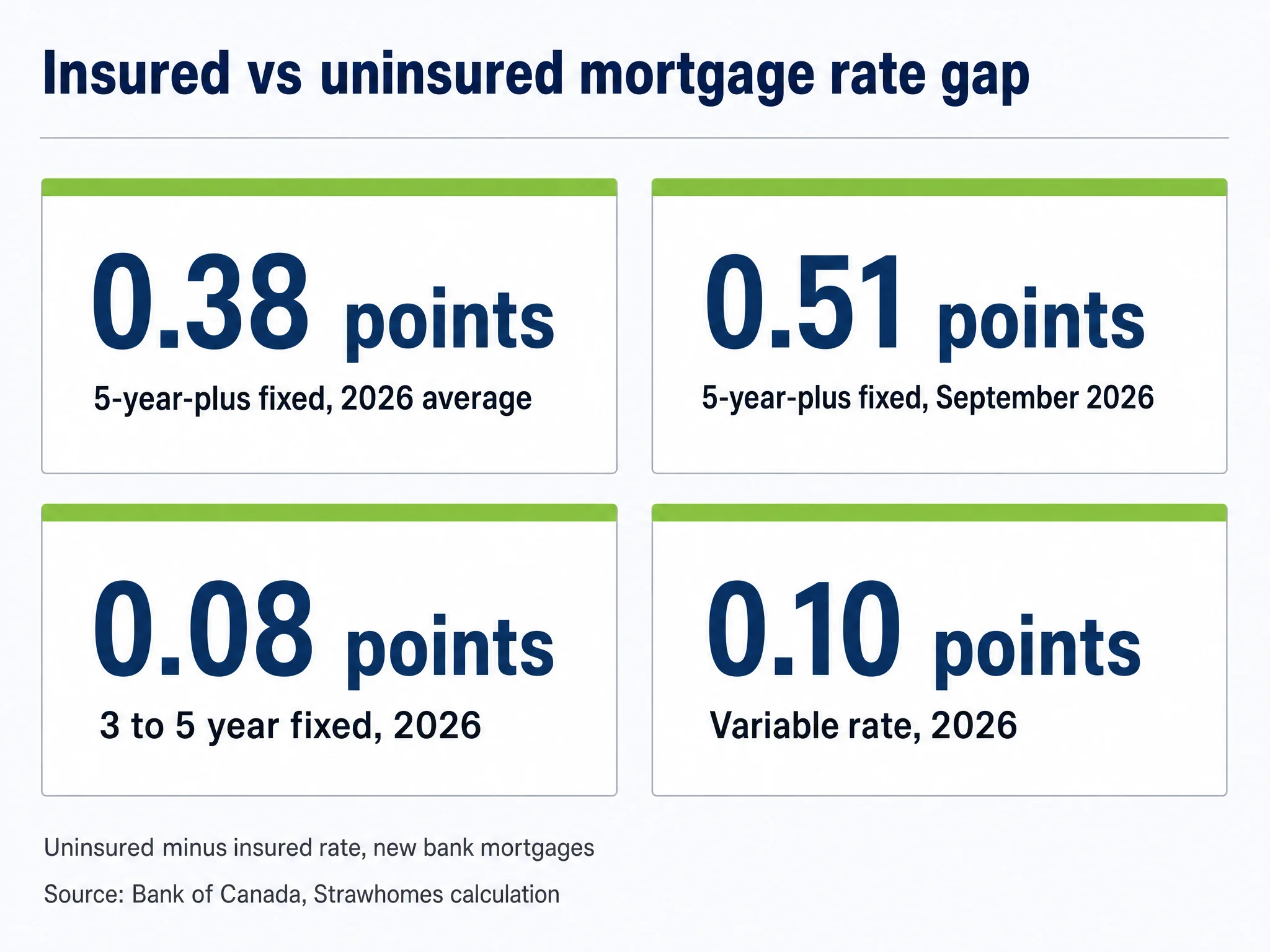
0.38 points: Uninsured borrowers paid 0.38 points more than insured borrowers on 5-year-plus fixed mortgages from January to September 2026 (4.38% against 4.00% on average), but only 0.08 points more on 3-to-5-year fixed and 0.10 points more on variable, the two terms that took 75.2% of new bank mortgage money. Source: Strawhomes calculation from Bank of Canada A4 rates (2026)
Key Takeaways
- 0.51 points was the 5-year-plus fixed gap in September 2026 (4.66% uninsured against 4.15% insured), the widest month of 2026. (Strawhomes calculation from Bank of Canada A4 rates, 2026)
- 75.2% of new bank mortgage money in 2026 went into 3-to-5-year fixed and variable terms, where the insured discount averaged only 0.08 points and 0.10 points. (Strawhomes calculation from Bank of Canada A4 funds advanced, 2026)
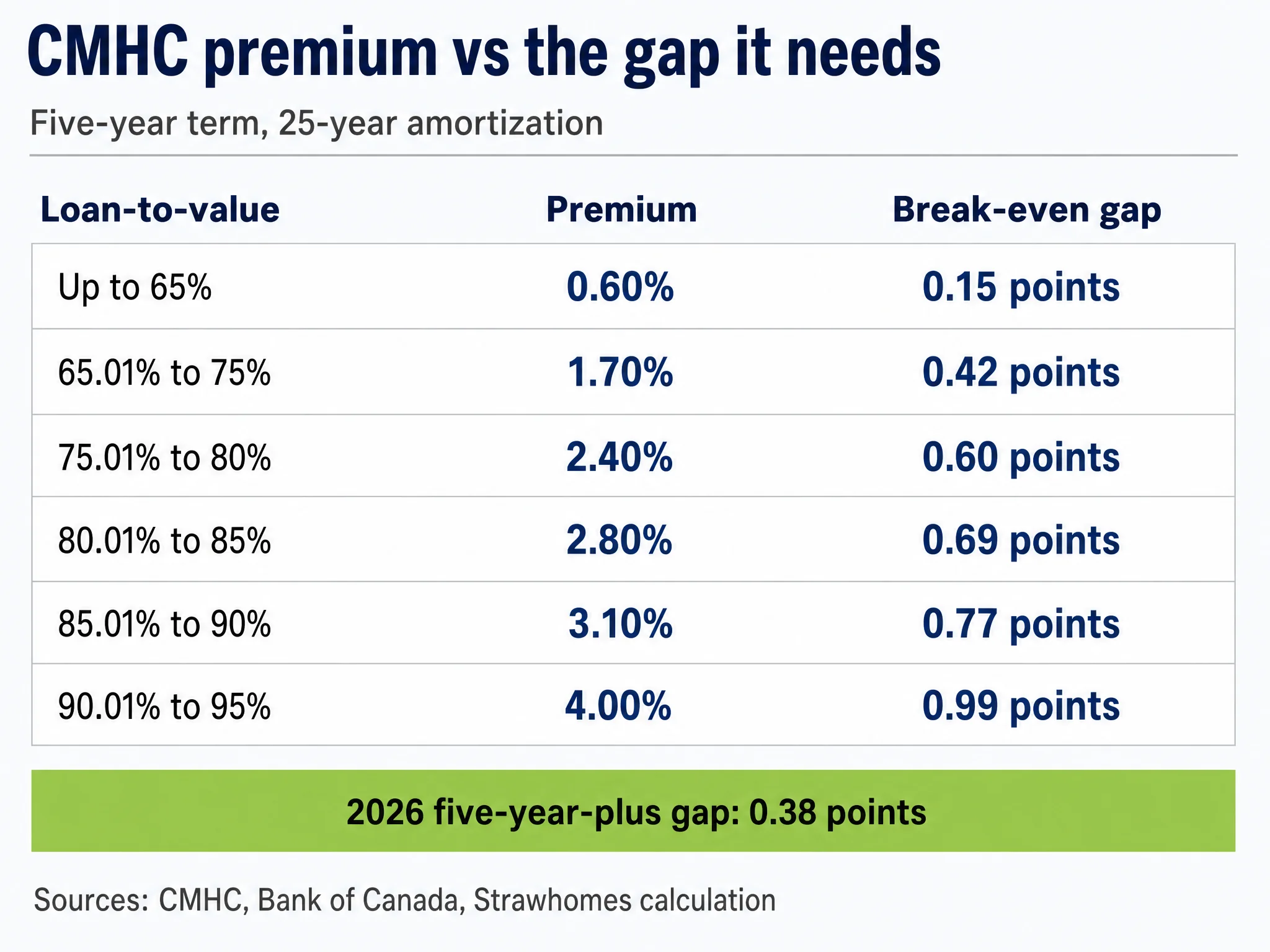
- 0.15 points is all the gap needed to repay a 0.60% premium within one five-year term; a 1.70% premium needs 0.42 points and a 2.40% premium 0.60 points. (Strawhomes calculation from Bank of Canada A4 rates and the CMHC premium table, 2026)
- $12,243 is the extra five-year cost of putting 19.99% down on a $1,000,000 home instead of 20%, on 5-year-plus fixed, although the insured payment is $46.06 a month lower. (Strawhomes calculation from Bank of Canada A4 rates and the CMHC premium table, 2026)
- 0.41 points was the 5-year-plus gap in 2024; from 2013 to 2022 it never averaged more than 0.13 points in a year. (Strawhomes calculation from Bank of Canada A4 rates, 2024)
- $1.5 million is the Budget 2026 proposed price limit for optional (20%-plus down) mortgage insurance, up from $1 million; as of November 17, 2026 it is a proposal with no effective date. (Budget 2026, Chapter 3, 2026)
Insured mortgages are cheaper in Canada, but by how much depends almost entirely on the term you pick. From January to September 2026, uninsured borrowers at the chartered banks paid 0.38 points more than insured borrowers on 5-year-plus fixed mortgages (Strawhomes calculation from Bank of Canada A4 rates, 2026). On 3-to-5-year fixed terms the difference was 0.08 points, and on variable rates 0.10 points. Those two small-gap terms took 75.2% of new bank mortgage money this year (Strawhomes calculation from Bank of Canada A4 funds advanced, 2026).
The usual answer to "is CMHC insurance worth it" quotes one rate gap for insured versus uninsured mortgages and stops. This page sets the Bank of Canada's insured and uninsured series, term by term, against the CMHC premium you would pay at each down payment, and works out the break-even: the rate gap a premium needs before the lower rate pays for it. If you are still working out how much to save, start with the minimum down payment to buy a home in BC.
It matters more now because of Budget 2026. The government proposes to raise the price limit for optional mortgage insurance, the kind available to buyers with 20% or more down, from $1 million to $1.5 million (Budget 2026, Chapter 3, 2026). That would bring insured pricing to many $1 million to $1.5 million purchases with 20% or more down for the first time. It is a proposal: the budget gives no effective date.
What Is the Difference Between Insured and Uninsured Mortgage Rates in September 2026?
In September 2026, insured 5-year-plus fixed mortgages averaged 4.15% at the chartered banks and uninsured ones 4.66%, a gap of 0.51 points (Bank of Canada, Valet A4 mortgage rates, 2026). On 1-to-3-year fixed the gap was 0.57 points, on 3-to-5-year fixed 0.12 points and on variable rates 0.14 points. Very short fixed terms ran the other way.
| Mortgage term | Insured rate | Uninsured rate | Gap (uninsured minus insured) | Source |
|---|---|---|---|---|
| Fixed, 5 years and over | 4.15% | 4.66% | 0.51 points | Bank of Canada, Valet A4 mortgage rates |
| Fixed, 3 to under 5 years | 4.08% | 4.20% | 0.12 points | Bank of Canada, Valet A4 mortgage rates |
| Fixed, 1 to under 3 years | 4.62% | 5.19% | 0.57 points | Bank of Canada, Valet A4 mortgage rates |
| Fixed, under 1 year | 7.36% | 7.23% | -0.13 points | Bank of Canada, Valet A4 mortgage rates |
| Variable rate | 3.75% | 3.89% | 0.14 points | Bank of Canada, Valet A4 mortgage rates |
0.51 points: 5-year-plus fixed, September 2026: the widest monthly insured discount of 2026 so far. (Strawhomes calculation from Bank of Canada A4 rates, 2026)
These are not posted rates. The Bank of Canada series records the average rate on new money the chartered banks actually advanced each month, split by whether the loan carries mortgage default insurance, the rate written into each mortgage contract, so they are close to what mortgage borrowers paid after discounts (Bank of Canada, Valet A4 mortgage rates, 2026). Under-1-year fixed was the odd one out: insured borrowers paid 7.36% against 7.23% uninsured, a negative gap of -0.13 points. Few borrowers choose that term.
The insured label covers two groups. An insured high-ratio mortgage, one with less than 20% down, must be insured. A low-ratio loan can also be insured by the lender in bulk, with the lender paying the premium, which is why a mortgage broker quotes three tiers: insured, insurable and uninsured, and the uninsured, or conventional mortgage, carries a slightly higher rate. If you are weighing the trade-offs of waiting for rates to fall before you buy, the gap matters as much as the headline rate, because it decides which tier you land in.
Which Mortgage Type Gets the Insured Discount? 2026 Averages, Term by Term
Mostly 5-year-plus and 1-to-3-year fixed terms. From January to September 2026 the 5-year-plus gap averaged 0.38 points and the 1-to-3-year gap 0.35 points (Strawhomes calculation from Bank of Canada A4 rates, 2026). The 3-to-5-year gap averaged 0.08 points and variable 0.10 points, and those two terms took 75.2% of new funds.
| Mortgage term | Insured, 2026 mean | Uninsured, 2026 mean | Mean gap | Smallest month | Widest month | Share of new funds | Source |
|---|---|---|---|---|---|---|---|
| Fixed, 5 years and over | 4.00% | 4.38% | 0.38 points | 0.22 points (April 2026) | 0.51 points (September 2026) | 10.3% | Strawhomes calculation from Bank of Canada A4 rates |
| Fixed, 3 to under 5 years | 3.94% | 4.02% | 0.08 points | 0.03 points (April 2026) | 0.13 points (January 2026) | 37.6% | Strawhomes calculation from Bank of Canada A4 rates |
| Fixed, 1 to under 3 years | 4.95% | 5.30% | 0.35 points | 0.16 points (March 2026) | 0.57 points (September 2026) | 10.4% | Strawhomes calculation from Bank of Canada A4 rates |
| Fixed, under 1 year | 7.73% | 7.70% | -0.03 points | -0.27 points (January 2026) | 0.17 points (March 2026) | 4.1% | Strawhomes calculation from Bank of Canada A4 rates |
| Variable rate | 3.78% | 3.87% | 0.10 points | 0.05 points (March 2026) | 0.16 points (August 2026) | 37.6% | Strawhomes calculation from Bank of Canada A4 rates |
- 5-year-plus fixed: 0.38
- 1-to-3-year fixed: 0.35
- Variable: 0.10
- 3-to-5-year fixed: 0.08
- Under-1-year fixed: -0.03
75.2%: Share of 2026 new bank mortgage money in the two terms where the insured discount is smallest. (Strawhomes calculation from Bank of Canada A4 funds advanced, 2026)
This is the blind spot in most explainers. Lower mortgage rates for insured borrowers are real, but the big discount sits on the terms that hold only 20.7% of new money (Strawhomes calculation from Bank of Canada A4 funds advanced, 2026). A buyer taking the popular 3-to-5-year fixed saved 0.08 points on average, and the gap was never wider than 0.13 points (January 2026) in any month of 2026.
- Variable: 37.6 (37.6%)
- 3-to-5-year fixed: 37.6 (37.6%)
- 1-to-3-year fixed: 10.4 (10.4%)
- 5-year-plus fixed: 10.3 (10.3%)
- Under-1-year fixed: 4.1 (4.1%)
The 5-year-plus gap also moved a lot within the year, from 0.22 points (April 2026) to 0.51 points (September 2026) (Strawhomes calculation from Bank of Canada A4 rates, 2026). Our earlier reading through August put the 2026 average at 0.36 points; adding September lifts it to 0.38 points. Any single month can mislead, so use a range when you compare quotes, and check how rising interest rates affect the housing market before you lock a term.
Insured loans are a minority of the residential mortgage market's flow. Insured mortgages were 17.8% of new chartered-bank mortgage money from January to September 2026 (Strawhomes calculation from Bank of Canada A4 funds advanced, 2026), which is why most borrowers with a large down payment never see the insured rate at all. The lowest mortgage rates lenders advertise are often rates for insured loans, so when shopping for a mortgage, ask whether the best mortgage rates you see are insured or uninsured.
How Has the Insured vs Uninsured Gap Changed Since 2013?
It has widened. On 5-year-plus fixed the gap averaged 0.05 points in 2016 and never more than 0.13 points a year to 2022, then 0.28 points in 2023, 0.41 points in 2024 and 0.38 points in 2026 to September (Strawhomes calculation from Bank of Canada A4 rates, 2026). Shorter terms have swung from negative to positive.
| Year | 5-year-plus fixed | 3-to-5-year fixed | 1-to-3-year fixed | Variable | Source |
|---|---|---|---|---|---|
| 2013 | 0.01 points | -0.03 points | 0.06 points | -0.04 points | Strawhomes calculation from Bank of Canada A4 rates |
| 2014 | 0.06 points | -0.03 points | 0.14 points | -0.06 points | Strawhomes calculation from Bank of Canada A4 rates |
| 2015 | 0.05 points | 0.05 points | 0.10 points | -0.07 points | Strawhomes calculation from Bank of Canada A4 rates |
| 2016 | 0.05 points | 0.04 points | 0.02 points | -0.12 points | Strawhomes calculation from Bank of Canada A4 rates |
| 2017 | 0.03 points | -0.00 points | 0.05 points | -0.01 points | Strawhomes calculation from Bank of Canada A4 rates |
| 2018 | 0.11 points | -0.02 points | 0.05 points | 0.00 points | Strawhomes calculation from Bank of Canada A4 rates |
| 2019 | 0.05 points | 0.02 points | 0.07 points | -0.25 points | Strawhomes calculation from Bank of Canada A4 rates |
| 2020 | 0.07 points | 0.06 points | 0.16 points | -0.17 points | Strawhomes calculation from Bank of Canada A4 rates |
| 2021 | 0.09 points | 0.06 points | 0.25 points | -0.03 points | Strawhomes calculation from Bank of Canada A4 rates |
| 2022 | 0.13 points | -0.17 points | 0.04 points | 0.08 points | Strawhomes calculation from Bank of Canada A4 rates |
| 2023 | 0.28 points | 0.06 points | -0.23 points | -0.02 points | Strawhomes calculation from Bank of Canada A4 rates |
| 2024 | 0.41 points | 0.16 points | -0.38 points | -0.02 points | Strawhomes calculation from Bank of Canada A4 rates |
| 2025 | 0.34 points | 0.15 points | 0.02 points | 0.08 points | Strawhomes calculation from Bank of Canada A4 rates |
| 2026 (to Sep) | 0.38 points | 0.08 points | 0.35 points | 0.10 points | Strawhomes calculation from Bank of Canada A4 rates |
0.52 points: The widest monthly 5-year-plus gap in the series, in March 2024; the series starts in January 2013. (Strawhomes calculation from Bank of Canada A4 rates, 2024)
- 2013, 5-year-plus fixed: 0.01
- 2013, 3-to-5-year fixed: -0.03
- 2013, 1-to-3-year fixed: 0.06
- 2013, Variable: -0.04
- 2014, 5-year-plus fixed: 0.06
- 2014, 3-to-5-year fixed: -0.03
- 2014, 1-to-3-year fixed: 0.14
- 2014, Variable: -0.06
- 2015, 5-year-plus fixed: 0.05
- 2015, 3-to-5-year fixed: 0.05
- 2015, 1-to-3-year fixed: 0.10
- 2015, Variable: -0.07
- 2016, 5-year-plus fixed: 0.05
- 2016, 3-to-5-year fixed: 0.04
- 2016, 1-to-3-year fixed: 0.02
- 2016, Variable: -0.12
- 2017, 5-year-plus fixed: 0.03
- 2017, 3-to-5-year fixed: 0.00
- 2017, 1-to-3-year fixed: 0.05
- 2017, Variable: -0.01
- 2018, 5-year-plus fixed: 0.11
- 2018, 3-to-5-year fixed: -0.02
- 2018, 1-to-3-year fixed: 0.05
- 2018, Variable: 0.00
- 2019, 5-year-plus fixed: 0.05
- 2019, 3-to-5-year fixed: 0.02
- 2019, 1-to-3-year fixed: 0.07
- 2019, Variable: -0.25
- 2020, 5-year-plus fixed: 0.07
- 2020, 3-to-5-year fixed: 0.06
- 2020, 1-to-3-year fixed: 0.16
- 2020, Variable: -0.17
- 2021, 5-year-plus fixed: 0.09
- 2021, 3-to-5-year fixed: 0.06
- 2021, 1-to-3-year fixed: 0.25
- 2021, Variable: -0.03
- 2022, 5-year-plus fixed: 0.13
- 2022, 3-to-5-year fixed: -0.17
- 2022, 1-to-3-year fixed: 0.04
- 2022, Variable: 0.08
- 2023, 5-year-plus fixed: 0.28
- 2023, 3-to-5-year fixed: 0.06
- 2023, 1-to-3-year fixed: -0.23
- 2023, Variable: -0.02
- 2024, 5-year-plus fixed: 0.41
- 2024, 3-to-5-year fixed: 0.16
- 2024, 1-to-3-year fixed: -0.38
- 2024, Variable: -0.02
- 2025, 5-year-plus fixed: 0.34
- 2025, 3-to-5-year fixed: 0.15
- 2025, 1-to-3-year fixed: 0.02
- 2025, Variable: 0.08
- 2026 to September, 5-year-plus fixed: 0.38
- 2026 to September, 3-to-5-year fixed: 0.08
- 2026 to September, 1-to-3-year fixed: 0.35
- 2026 to September, Variable: 0.10
For a decade the insured discount on long fixed terms was close to nothing: the 5-year-plus gap was negative in 10 of 165 months (Strawhomes calculation from Bank of Canada A4 rates, 2026). It opened up in 2023 as rates rose and has stayed wide. The widest month was March 2024, at 0.52 points.
Shorter terms tell a different story. The 1-to-3-year gap averaged -0.38 points in 2024, meaning insured borrowers paid more, and reached -0.63 points (December 2024) before flipping to 0.35 points in 2026. Variable-rate insured borrowers paid more than uninsured ones in 107 of 165 months (Strawhomes calculation from Bank of Canada A4 rates, 2026). Anyone who assumes insured is always cheaper is reading one term and one year: understanding the difference between insured and uninsured pricing starts with the term. Our tips for first-time home buyers cover the other choices that come first.
How Much Does Mortgage Default Insurance in Canada Cost in 2026, and Who Pays It?
CMHC charges a one-time premium on the whole loan, a percentage set by the loan-to-value ratio, from 0.60% at 65% loan-to-value or less to 4.00% at 90.01% to 95% (CMHC, 2026). Buyers with less than 20% down must pay it, usually added to the mortgage. A 30-year amortization adds 20 basis points (CMHC notice, 2024).
| Loan-to-value (rule) | Premium or limit | Source |
|---|---|---|
| Up to 65% | 0.60% | CMHC |
| 65.01% to 75% | 1.70% | CMHC |
| 75.01% to 80% | 2.40% | CMHC |
| 80.01% to 85% | 2.80% | CMHC |
| 85.01% to 90% | 3.10% | CMHC |
| 90.01% to 95% | 4.00% | CMHC |
| 95% non-traditional | 4.50% | CMHC |
| 30-year surcharge | 20 basis points | CMHC notice |
| Insured price cap | $1,500,000 | CMHC |
| Optional insurance limit | $1 million | Budget 2026, Chapter 3 |
2.40%: The premium at 75.01% to 80% loan-to-value, the band just under the 20% down line. (CMHC, 2026)
The minimum down payment is 5% on the first $500,000 and 10% on the portion above it, and homes priced at $1,500,000 or more cannot be insured (CMHC, 2026). The down payment on a condo follows the same rule. A deposit is not the same as a down payment, so count only the money that goes into the purchase price. The ratio uses the property's lending value, normally the lower of the price and the real estate appraisal.
The low-ratio bands, 65% and 75%, are what lenders pay when they bulk-insure loans with 20% or more down; the borrower rarely sees that bill directly. For high-ratio buyers the mortgage default insurance premium is a one-time fee, added to the total mortgage amount or paid as a lump sum. This page uses the table of Canada Mortgage and Housing Corporation; the private insurers, Canada Guaranty or Sagen, publish their own. In Ontario, Quebec and Saskatchewan, provincial sales tax applies to the premium and must be paid in cash at closing, because it cannot be added to the loan.
Is the CMHC Mortgage Insurance Premium Worth It? The Break-Even Interest Rate Gap by Down Payment
Over one five-year term, only at the smallest premium. Repaying 0.60% needs a gap of 0.15 points, which the 2026 5-year-plus gap of 0.38 points clears. A 1.70% premium needs 0.42 points, just short, and 2.40% needs 0.60 points (Strawhomes calculation from Bank of Canada A4 rates and the CMHC premium table, 2026).
| Loan-to-value | CMHC premium | Break-even gap, one 5-year term | Break-even gap, 25-year amortization | Source |
|---|---|---|---|---|
| Up to 65% | 0.60% | 0.15 points | 0.06 points | Strawhomes calculation from Bank of Canada A4 rates and the CMHC premium table |
| 65.01% to 75% | 1.70% | 0.42 points | 0.16 points | Strawhomes calculation from Bank of Canada A4 rates and the CMHC premium table |
| 75.01% to 80% | 2.40% | 0.60 points | 0.23 points | Strawhomes calculation from Bank of Canada A4 rates and the CMHC premium table |
| 80.01% to 85% | 2.80% | 0.69 points | 0.27 points | Strawhomes calculation from Bank of Canada A4 rates and the CMHC premium table |
| 85.01% to 90% | 3.10% | 0.77 points | 0.30 points | Strawhomes calculation from Bank of Canada A4 rates and the CMHC premium table |
| 90.01% to 95% | 4.00% | 0.99 points | 0.38 points | Strawhomes calculation from Bank of Canada A4 rates and the CMHC premium table |
- Up to 65%: 0.15
- 65.01% to 75%: 0.42
- 75.01% to 80%: 0.60
- 80.01% to 85%: 0.69
- 85.01% to 90%: 0.77
- 90.01% to 95%: 0.99
- Reference line, 2026 average 5-year-plus fixed gap: 0.38
0.60 points: The gap a 2.40% premium needs to pay for itself within one five-year term, against 0.38 points on offer in 2026. (Strawhomes calculation from Bank of Canada A4 rates and the CMHC premium table, 2026)
The break-even barely depends on the term, because it is mostly the premium spread over five years of interest. On 3-to-5-year fixed it is 0.59 points at 75.01% to 80%, on variable 0.59 points (Strawhomes calculation from Bank of Canada A4 rates and the CMHC premium table, 2026). Against gaps of 0.08 points and 0.10 points, no premium above the lowest band repays itself on those terms within a term.
Over a full amortization the picture changes. If the 2026 gap held for all 25 years of paying the mortgage, the insured loan's lower monthly mortgage payments would cover a 2.40% premium at a gap of 0.23 points and even a 4.00% premium at 0.38 points. That is a big if: your rate resets at every renewal, and the gap has been near zero for most of the past decade. Before you commit, run your numbers through whether you can afford a home in Vancouver.
One caution on causation. Part of the A4 gap reflects who borrows, not only the insurance: insured loans are capped below a $1.5 million price and are mostly owner-occupied, while uninsured loans include refinances, rentals and large balances, and lenders also price each file by credit score. Budget 2026 proposes regulations to enhance public information on insured mortgage rates, to be published by the Bank of Canada (Budget 2026, Chapter 3, 2026).
What the Gap Is Worth to a Borrower: Loan Size, 20% Down and the $1.5 Million Proposal
On a $1,000,000 home with a 5-year-plus fixed rate, putting 19.99% down instead of 20% adds a $22,403 premium and costs $12,243 more over five years, although the payment is $46.06 a month lower (Strawhomes calculation from Bank of Canada A4 rates and the CMHC premium table, 2026). On variable, the insured payment is higher too.
- $500,000, 5-year-plus fixed: $6,122
- $500,000, Variable: $11,313
- $750,000, 5-year-plus fixed: $9,182
- $750,000, Variable: $16,970
- $1,000,000, 5-year-plus fixed: $12,243
- $1,000,000, Variable: $22,627
- $1,250,000, 5-year-plus fixed: $15,304
- $1,250,000, Variable: $28,283
$8,658: An $800,000 loan at up to 65% loan-to-value: what a 0.60% premium would save over one term on 5-year-plus fixed. (Strawhomes calculation from Bank of Canada A4 rates and the CMHC premium table, 2026)
Read the negative numbers as the price of crossing the 20% line. Dipping just under it moves you from no premium to 2.80%, so on any term the extra rate discount has to fight a large bill. For a buyer who already has 20% saved, the uninsured loan is the cheaper option within a term, and the extra equity stays in the home. If saving that much is the obstacle, the years spent renting are the real cost, as our look at how long it takes to save a down payment in Vancouver shows.
Loan size scales the dollars, not the verdict. On 5-year-plus fixed, a 0.60% premium on a $400,000 loan saves $4,329 over a term and on an $800,000 loan $8,658, while with a 2.40% premium the net is -$4,213 and -$8,425 (Strawhomes calculation from Bank of Canada A4 rates and the CMHC premium table, 2026). When getting a mortgage, the calculator below works like a simple mortgage calculator: use it to compare mortgage options at your own loan size.
The Budget 2026 proposal is where this becomes a live choice. Buyers of homes between $1 million and $1.5 million with 20% or more down cannot get insured or insurable pricing today, because optional insurance stops at $1 million. The budget would also allow 30-year amortization when a borrower is a first-time buyer or the home is new (Budget 2026, Chapter 3, 2026). A separate set of changes for three- and four-unit homes starts February 1, 2027, but the $1.5 million limit has no date yet. Check first-time home buyer programs in BC and the homes with a mortgage helper suite for other ways to close the gap.
CMHC Premium Break-Even Checker: Does the Insured Rate Pay for the Premium at Your Loan Size?
CMHC Premium Break-Even Checker: Does the Insured Rate Pay for the Premium at Your Loan Size?
Enter your mortgage amount to see loan sizes at or below it, the CMHC premium at each loan-to-value band, and what the insured 5-year-plus fixed rate saves or costs over one five-year term and per month at 2026 average rates (4.00% insured, 4.38% uninsured, 25-year amortization, premium added to the loan).
| Loan | Loan amount | Loan-to-value band | CMHC premium | Five-year saving after premium | Monthly payment saving |
|---|---|---|---|---|---|
| $400,000 loan (Premium 0.60%) | $400,000 | at up to 65% LTV | $2,400 | $4,329 | $70 |
| $400,000 loan (Premium 1.70%) | $400,000 | at 65.01% to 75% LTV | $6,800 | -$891 | $46 |
| $400,000 loan (Premium 2.40%) | $400,000 | at 75.01% to 80% LTV | $9,600 | -$4,213 | $32 |
| $600,000 loan (Premium 0.60%) | $600,000 | at up to 65% LTV | $3,600 | $6,493 | $104 |
| $600,000 loan (Premium 1.70%) | $600,000 | at 65.01% to 75% LTV | $10,200 | -$1,336 | $70 |
| $600,000 loan (Premium 2.40%) | $600,000 | at 75.01% to 80% LTV | $14,400 | -$6,319 | $48 |
| $800,000 loan (Premium 0.60%) | $800,000 | at up to 65% LTV | $4,800 | $8,658 | $139 |
| $800,000 loan (Premium 1.70%) | $800,000 | at 65.01% to 75% LTV | $13,600 | -$1,782 | $93 |
| $800,000 loan (Premium 2.40%) | $800,000 | at 75.01% to 80% LTV | $19,200 | -$8,425 | $63 |
| $1,000,000 loan (Premium 0.60%) | $1,000,000 | at up to 65% LTV | $6,000 | $10,822 | $174 |
| $1,000,000 loan (Premium 1.70%) | $1,000,000 | at 65.01% to 75% LTV | $17,000 | -$2,227 | $116 |
| $1,000,000 loan (Premium 2.40%) | $1,000,000 | at 75.01% to 80% LTV | $24,000 | -$10,531 | $79 |
| $1,200,000 loan (Premium 0.60%) | $1,200,000 | at up to 65% LTV | $7,200 | $12,987 | $209 |
| $1,200,000 loan (Premium 1.70%) | $1,200,000 | at 65.01% to 75% LTV | $20,400 | -$2,673 | $139 |
| $1,200,000 loan (Premium 2.40%) | $1,200,000 | at 75.01% to 80% LTV | $28,800 | -$12,638 | $95 |
How We Calculated the Break-Even
Rates are the Bank of Canada's A4 series: average rates on new funds advanced by chartered banks each month, insured and uninsured, by term, from January 2013 to September 2026. The gap is uninsured minus insured in the same month and term, and yearly figures are simple averages of the monthly gaps (Strawhomes calculation from Bank of Canada A4 rates, 2026).
Each mortgage is modelled as an amortizing loan with the same mortgage structure on both sides. Payments use the Canadian convention for fixed-rate mortgages: interest compounded semi-annually, paid monthly, applied to every term for comparability. Both loans amortize over 25 years, the usual insured maximum, so the 30-year surcharge is left out. The CMHC premium is added to the loan, as most borrowers do, and provincial sales tax on the premium is excluded.
The one-term test compares the interest paid over five years plus the premium on the insured side; the break-even is the gap at which both cost the same. The full-amortization test holds the gap for 25 years and finds where the monthly payments match. Both start from the 2026 average insured rate of each term (4.00% for 5-year-plus fixed). The 20% down comparison uses the same home price: 20% down uninsured against 19.99% down, a loan-to-value of 80.01% with a 2.80% premium, at the insured rate.
Frequently Asked Questions
What is an insurable mortgage, and how do insured, insurable and uninsured rates differ in Canada?
An insurable mortgage has 20% or more down and meets the insurance rules, so the lender can insure it in bulk at its own cost; whether a loan is insured or insurable, it usually prices below an uninsured one. On 5-year-plus fixed mortgages from Canada's chartered banks, uninsured borrowers paid 0.38 points more than insured borrowers on average from January to September 2026, and 0.51 points more in September 2026. On 3-to-5-year fixed terms the gap averaged 0.08 points and on variable terms 0.10 points, per Bank of Canada data. (Strawhomes calculation from Bank of Canada A4 rates, 2026)
Why are insured mortgage rates lower, and why would a lender pay for mortgage default insurance?
Mortgage default insurance protects the lender (the creditor) if the borrower (the debtor) stops paying and the property goes to foreclosure. The risk moves to CMHC or a private mortgage insurer such as Sagen or Canada Guaranty, and insured loans can be pooled into a government-backed mortgage-backed security, so they need less lender capital and cost less to fund. That is why insured mortgages often come with lower interest rates than uninsured mortgages, and why a lender may pay to insure the mortgage itself. High-ratio borrowers pay the premium (2.40% to 4.00% at 75.01% to 95% loan-to-value); on low-ratio loans the lender usually pays it (0.60% to 1.70%), and the lender passes some of the cheaper funding back as a lower rate. (CMHC, 2026)
Is the CMHC mortgage insurance premium worth it for a lower interest rate?
Only when the premium is small. Over one five-year term, the 2026 5-year-plus gap of 0.38 points repays a 0.60% premium (break-even 0.15 points) but not a 2.40% premium (break-even 0.60 points). If the gap held for a full 25-year amortization, every premium up to 4.00% would roughly pay back. (Strawhomes calculation from Bank of Canada A4 rates and the CMHC premium table, 2026)
Should a borrower put less than 20% down to get an insured mortgage rate?
Usually not to save money within a term. On a $1,000,000 home with a 5-year-plus fixed rate, putting 19.99% down adds a $22,403 premium and costs $12,243 more over five years than 20% down, at 2026 average rates, even though the monthly payment is $46.06 lower. (Strawhomes calculation from Bank of Canada A4 rates and the CMHC premium table, 2026)
Has the insured mortgage limit been raised to $1.5 million for buyers with 20% down?
Not yet. For buyers with less than 20% down, CMHC insurance is already available: to qualify for an insured mortgage, the home must be priced below $1.5 million. Budget 2026 proposes raising the limit for optional insurance, which covers 20%-plus down, from $1 million to $1.5 million, with 30-year amortization for first-time buyers or new homes. As of November 17, 2026 the budget gives no effective date. (Budget 2026, Chapter 3, 2026)
When do you need mortgage insurance on a mortgage in Canada, and how much is it?
Federal law requires mortgage default insurance when a federally regulated lender lends with less than 20% down: that mortgage must be insured, as an insured high-ratio mortgage. CMHC charges 2.40% of the loan at 75.01% to 80% loan-to-value, 2.80% to 85%, 3.10% to 90% and 4.00% to 95%. Low-ratio loans pay 0.60% up to 65% and 1.70% to 75%. A 30-year amortization adds 20 basis points, and Ontario, Quebec and Saskatchewan add provincial sales tax. The premium is paid as a lump sum or added to the mortgage balance. (CMHC, 2026)
Are insured mortgages stress tested, and does the mortgage stress test change by mortgage type?
Yes. An insured mortgage must pass the federal mortgage stress test at a qualifying rate above the contract rate, and uninsured mortgages at federally regulated lenders face a similar test, so the lower insured rate does not by itself raise how much debt you can carry. What changes by mortgage type is the price: in 2026 the insured discount averaged 0.38 points on 5-year-plus fixed but 0.10 points on variable, per Bank of Canada data. (Strawhomes calculation from Bank of Canada A4 rates, 2026)
Which term gets the biggest insured discount on a Canadian mortgage?
In 2026 to date, 5-year-plus fixed (0.38 points) and 1-to-3-year fixed (0.35 points). The gap was 0.08 points on 3-to-5-year fixed and 0.10 points on variable, and on under-1-year fixed insured borrowers paid more (-0.03 points). The lowest rate is not always the insured one, and the gap moves: the 5-year-plus gap ran from 0.22 points (April 2026) to 0.51 points (September 2026) in 2026. (Strawhomes calculation from Bank of Canada A4 rates, 2026)
Methodology
This analysis uses public Bank of Canada data (Valet groups A4_RATES_MORTGAGES and A4_FUNDS_MORTGAGES, monthly from January 2013), CMHC's published premium table and federal rules from CMHC and Budget 2026. A4 covers chartered banks only, not credit unions or monoline lenders, and reports averages, so a borrower with a strong file can beat them. Most insured homeowner loans require owner-occupancy, and refinancing and rental purchases generally cannot be insured, so they sit in the uninsured series. The article does not cover a reverse mortgage or a private mortgage. The insured series includes both high-ratio loans and low-ratio loans insured in bulk by lenders, so it mixes insurance with borrower and loan differences. Break-even results assume the 2026 average gap for the period tested; a different gap at renewal changes the answer. The Budget 2026 optional insurance limit is a proposal with no effective date as of November 17, 2026. Topic research used a backup search provider for one query, and some search results were template pages; the angle pass and this build ran without degradation.
Sources consulted: 24
Sources cited: 7
Data freshness: current year: 6, last year: 0, older: 1
Data range: Bank of Canada A4 monthly series January 2013 to September 2026; CMHC premiums and federal rules current at 2026-11-17
Research date: 2026-11-17
Update schedule: Monthly, with each Bank of Canada A4 release
Limitations: A4 rates are averages over all new chartered-bank mortgages in each insurance class, so the gap mixes the price of insurance with differences in borrowers and loans (insured loans are smaller and more often first-time buyers; uninsured includes refinances and large loans). Credit unions and monoline lenders are not in A4. Break-even figures assume the 2026 average gap holds for the period tested.
Sources & References
- Bank of Canada. "Interest rates charged for new and existing lending by chartered banks: mortgages (Valet group A4_RATES_MORTGAGES)." bankofcanada.ca/valet/observations/group/A4_RATES_MORTGAGES/json. Accessed 2026-11-17.
- Bank of Canada. "Funds advanced and outstanding balances by chartered banks: mortgages (Valet group A4_FUNDS_MORTGAGES)." bankofcanada.ca/valet/observations/group/A4_FUNDS_MORTGAGES/json. Accessed 2026-11-17.
- CMHC. "CMHC Mortgage Loan Insurance Cost (premium table)." cmhc-schl.gc.ca/consumers/home-buying/mortgage-loan-insurance-for-consumers/cmhc. Accessed 2026-11-17.
- CMHC. "FAQs: Mortgage Loan Insurance." cmhc-schl.gc.ca/consumers/home-buying/mortgage-loan-insurance-for-consumers/faqs. Accessed 2026-11-17.
- CMHC. "CMHC revises homeowner mortgage loan insurance premiums (notice)." cmhc-schl.gc.ca/media-newsroom/notices/2024/cmhc-revises-homeowner-mortgage-loan. Accessed 2026-11-17.
- CMHC. "What is mortgage loan insurance." cmhc-schl.gc.ca/consumers/home-buying/mortgage-loan-insurance-for-consumers/what. Accessed 2026-11-17.
- Department of Finance Canada. "Budget 2026, Chapter 3." budget.canada.ca/2026/report-rapport/chap3-en.html. Accessed 2026-11-17.

Let's Chat! Looking for a REALTOR® who can exceed your expectations? Look no further than Richard Morrison! His mission is to serve without limit & provide solutions that cater to your core needs.
• 20+ Years of Experience
• Medallion Member
• RE/MAX Hall of Fame

Latest Properties Added
| Property | Size | Price | Date Listed |
|---|---|---|---|
| 1111 - 3588 Ketcheson Road, Richmond | 719 sqft | $768,000 | Nov 13, 2026 |
| 3703 - 1788 Gilmore Avenue, Burnaby | 660 sqft | $609,000 | Nov 17, 2026 |
| 2562 Eton Street, Vancouver | 760 sqft | $1,600,000 | Nov 13, 2026 |
| 309 - 1647 Pender Street, Vancouver | 1,088 sqft | $1,079,900 | Nov 17, 2026 |
| 205 - 15858 Fraser Highway, Surrey | 760 sqft | $589,900 | Nov 18, 2026 |
| 102 - 1125 Cartier Avenue, Coquitlam | 2,060 sqft | $1,149,000 | Nov 16, 2026 |
| 9558 168 Street, Surrey | 943 sqft | $1,980,000 | Nov 16, 2026 |
| 211 - 9626 148 Street, Surrey | 1,082 sqft | $535,000 | Nov 17, 2026 |
| 7740 Ash Street, Richmond | 2,593 sqft | $1,698,000 | Nov 17, 2026 |
| 10380 Swinton Crescent, Richmond | 3,787 sqft | $2,238,000 | Nov 17, 2026 |
| 126 Elgin Street, Port Moody | — | $629,000 | Nov 17, 2026 |
| 6288 134 Street, Surrey | 2,790 sqft | $1,149,000 | Nov 17, 2026 |
Start your search with Richard Morrison, Top Award Winning Vancouver Realtor
Contact Richard Morrison Top Vancouver Realtor today to find a Vancouver houses for sale and Vancouver condos for sale. Also check out Burnaby houses for sale or maybe Burnaby condos for sale. If you prefer North Shore, take a look at our listings in North Vancouver houses for sale and North Vancouver condos for sale.