Fixed vs Variable Mortgage in Canada: Which Won, Every 3-Year and 5-Year Term Since 1980 (2026)
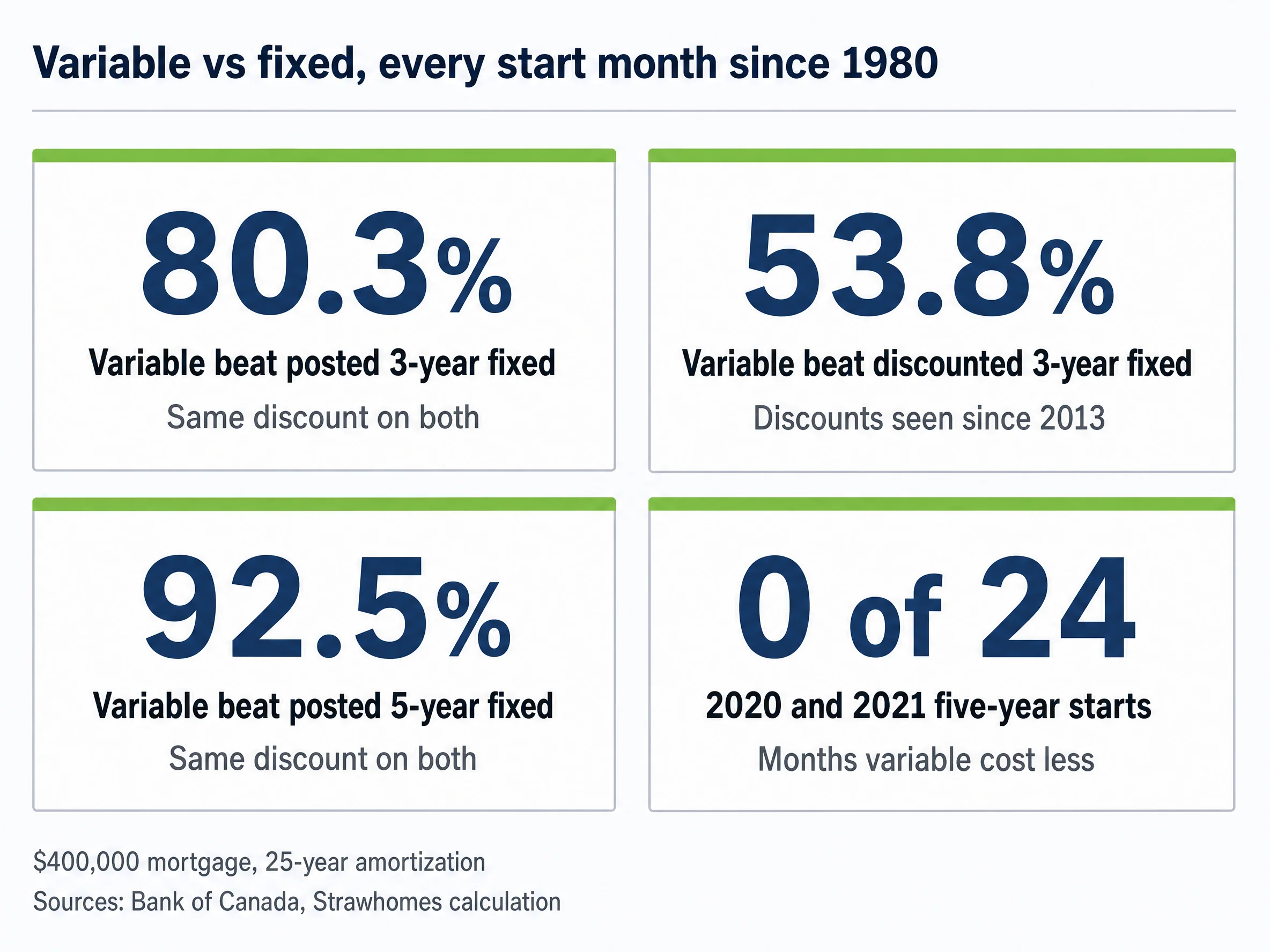
53.8%: Variable cost less than a 3-year fixed in 53.8% of the 528 start months from January 1980 to December 2023 when the 2013 to 2026 average discounts are applied to every year; on posted rates alone the figure is 80.3%. Source: Strawhomes calculation from Bank of Canada data (2026)
Key Takeaways
- 80.3% of 3-year terms since 1980 cost less on variable when both sides get the same discount off the banks' published rates (528 start months, $400,000, 25-year amortization). (Strawhomes calculation from Bank of Canada data, 2026)
- 92.5% of 5-year terms since 1980 cost less on variable on the same basis; with the larger fixed discounts seen since 2013 it falls to 56.3%. (Strawhomes calculation from Bank of Canada data, 2026)
- 0 of 24 5-year terms started in 2020 and 2021 came out ahead on variable; the average 2021 start paid $40,045 more interest. (Strawhomes calculation from Bank of Canada data, 2026)
- 44.7% of uninsured 3-year terms started from 2013 to 2023 cost less on variable at actual contract rates (insured: 35.6%). (Strawhomes calculation from Bank of Canada data, 2026)
- 1.08 points is how much bigger the fixed discount must be than the variable discount before variable wins only half of 3-year terms; on 2013 to 2026 contract rates the difference averaged 0.87 points. (Strawhomes calculation from Bank of Canada data, 2026)
- 10.3% of new mortgage dollars went to 5-year-and-over fixed terms from January to September 2026, down from 45.5% in 2020. (Strawhomes calculation from Bank of Canada data, 2026)
- 2.5% is the Bank of Canada's overnight target after its October 28, 2026 increase, the first since July 12, 2023; prime rose to 4.70%. (Bank of Canada press release, October 28, 2026, 2026)
The standard answer to the fixed vs variable mortgage question in Canada is that variable almost always wins. That answer comes from comparing prime with the posted 5-year fixed rate, and few borrowers take a 5-year fixed any more: fixed terms of five years and over took 10.3% of new mortgage dollars at the chartered banks from January to September 2026 (Strawhomes calculation from Bank of Canada data, 2026). The product borrowers moved to is the shorter fixed term, and the 3-to-under-5-year bucket took 37.6%, level with variable.
So we ran the test against the 3-year fixed as well as the 5-year. For each of the 528 start months from January 1980 to December 2023, we worked out the total interest on a $400,000 mortgage with a 25-year amortization over a full 3-year term, once on a 3-year fixed and once on a variable rate that moves with prime every month (Strawhomes calculation from Bank of Canada data, 2026). Then we did the same for 504 five-year terms. The data is the Bank of Canada's weekly series for prime and the posted 3-year and 5-year conventional mortgage rates, plus the Bank's contract rates on new mortgages from 2013.
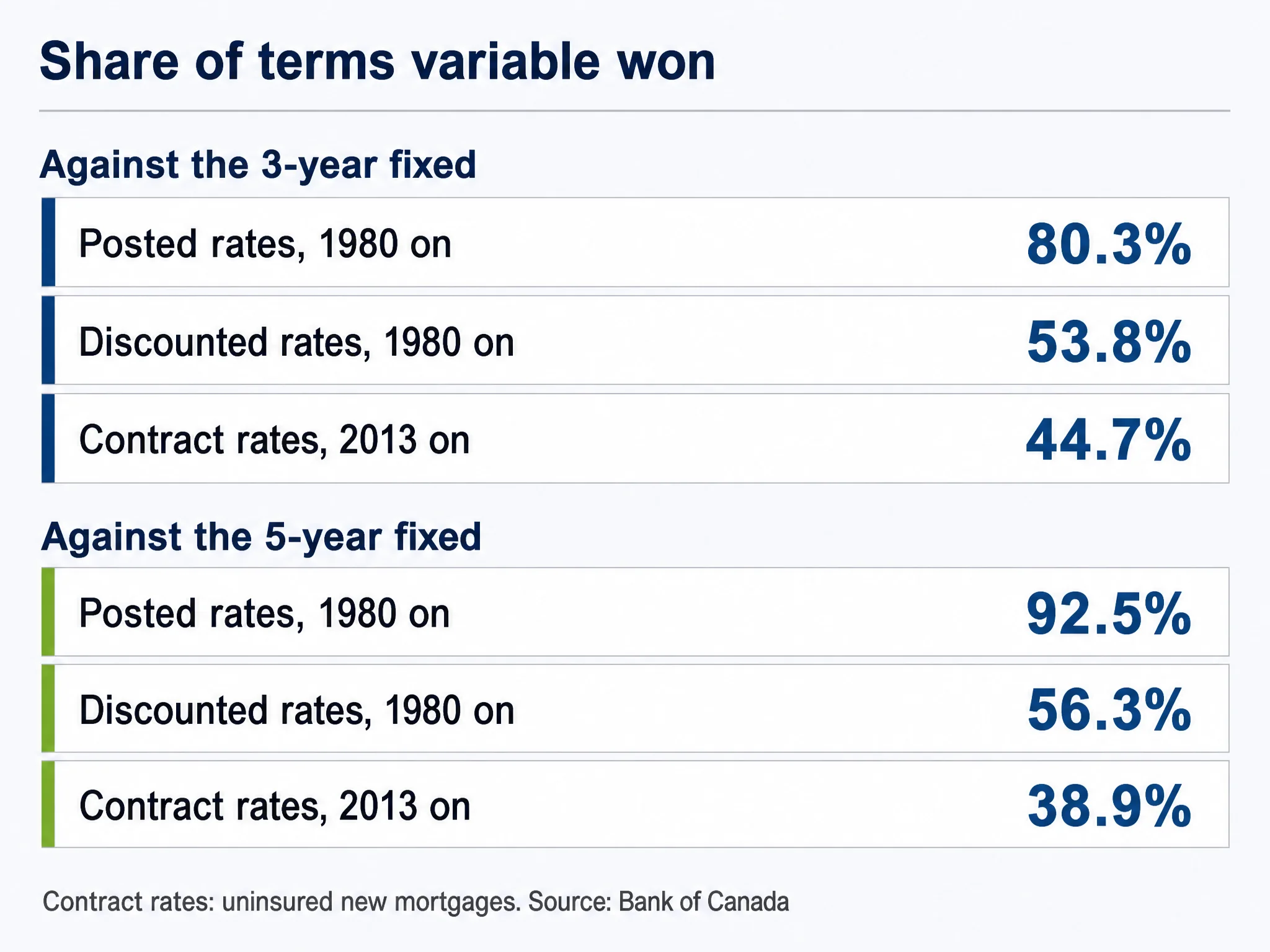
The answer depends on one assumption more than any other: how far below the posted rate each borrower really paid. On posted rates, variable beat the 3-year fixed in 80.3% of start months. Apply the bigger fixed discount borrowers have received since 2013 to every year and it falls to 53.8%. If you are weighing this choice at a renewal or on a first purchase, the sections below show where in the rate cycle each side won, and by how much. For how rate moves feed into prices, see how rising interest rates affect the housing market.
Variable Rate Mortgage vs 3-Year Fixed Rate Mortgage: How Often Did Variable Win Since 1980?
On posted rates, a variable mortgage cost less than a 3-year fixed in 80.3% of the 528 start months tested. With the fixed rate 1.25 points below posted and variable at prime minus 0.25, the discounts seen since 2013, variable still won 53.8%, and the median term saved $975 on a $400,000 mortgage (Strawhomes calculation from Bank of Canada data, 2026).
- 1980: $33,436
- 1981: -$31,375
- 1982: -$54,923
- 1983: -$5,237
- 1984: -$16,528
- 1985: -$6,177
- 1986: $7,850
- 1987: $24,975
- 1988: $27,918
- 1989: $6,165
- 1990: -$32,687
- 1991: -$32,572
- 1992: -$12,650
- 1993: -$777
- 1994: -$8,903
- 1995: -$20,535
- 1996: -$6,368
- 1997: $9,142
- 1998: $11,130
- 1999: -$797
- 2000: -$19,417
- 2001: -$15,942
- 2002: -$10,033
- 2003: -$4,558
- 2004: $3,603
- 2005: $11,374
- 2006: -$2,899
- 2007: -$23,574
- 2008: -$34,624
- 2009: -$11,147
- 2010: -$3,893
- 2011: -$3,659
- 2012: $714
- 2013: $1,678
- 2014: $956
- 2015: $5,122
- 2016: $9,590
- 2017: $12,138
- 2018: $1,157
- 2019: -$2,513
- 2020: $8,579
- 2021: $29,754
- 2022: $27,449
- 2023: $3,214
$76,439: Saved on variable by a borrower who started at the peak of the early 1980s rate spike, as prime then fell. (Strawhomes calculation from Bank of Canada data, 2026)
The near coin flip hides a pattern. Variable won 70.0% of 3-year terms that started in the 1990s and 77.5% in the 2000s, when rates drifted down for most of two decades: variable wins when rates fall. It won only 38.3% of 2010s starts, because from 2012 to 2017 the posted 3-year sat close to prime, putting the discounted fixed under the variable rate, and 10.4% of 2020s starts, as the 2022 hikes caught every term started from 2020 to 2022. The 1980s split close to even: borrowers who locked in near the 1981 peak lost heavily to variable, while borrowers who locked in before it, in early 1980, won.
The wins and losses are about the same size. When variable won, it typically saved $10,208 over three years; when it lost, it typically cost $10,013 extra. That symmetry is the real risk: a 3-year term is short enough that one hiking cycle decides it. The longest run of fixed wins in our test ran 45 months, from Nov 2019 to Jul 2023. For the bigger picture of what borrowers can carry, see whether you can afford a home in Vancouver.
Variable-Rate Mortgage vs 5-Year Fixed-Rate Mortgage: How Often Did Variable Win Since 1980?
Against the 5-year fixed, the classic comparison, variable cost less in 92.5% of 504 start months on posted rates. With the 5-year fixed 2.00 points below posted, close to the average gap since 2013, the share falls to 56.3%, and the median term still saved $7,892 on variable (Strawhomes calculation from Bank of Canada data, 2026).
- 1980s, 3-year fixed: 46.7%
- 1980s, 5-year fixed: 51.7%
- 1990s, 3-year fixed: 70.0%
- 1990s, 5-year fixed: 67.5%
- 2000s, 3-year fixed: 77.5%
- 2000s, 5-year fixed: 72.5%
- 2010s, 3-year fixed: 38.3%
- 2010s, 5-year fixed: 45.0%
- 2020s, 3-year fixed: 10.4%
- 2020s, 5-year fixed: 0.0%
0 of 24: Five-year terms started in 2020 and 2021 that cost less on variable in the discounted test: none. (Strawhomes calculation from Bank of Canada data, 2026)
The posted-rate figure, 92.5%, is the one behind the common claim that variable almost always wins. Our discounted case is harsher on variable because the 5-year fixed carries the biggest discount off posted: borrowers rarely pay the posted 5-year rate, which banks keep high. Over five years the gap between the two discounts compounds into a wider spread of outcomes: a typical win saved $18,852, a typical loss cost $11,975.
The worst start for variable was Apr 1987, when the discounted 5-year fixed was 8.00%; prime then climbed through 1988 and 1989 and the variable borrower paid $62,170 more. The best was Oct 1981, at the top of the 1981 spike, when locking in for five years cost $140,242 more than floating. A 5-year fixed softens the shock of interest rate increases that a 5-year variable absorbs, but it also locks in whatever rate the market offers on the day you sign. Our guide to whether to wait for interest rates to go down before buying covers the timing side of that choice.
Posted Mortgage Rates vs Discounts: How Much Does the Variable Mortgage Rate Discount Change the Answer?
Almost everything hangs on the gap between the two discounts. Giving fixed and variable the same discount leaves the result where posted rates put it. Variable wins only half of 3-year terms once the fixed discount is 1.08 points bigger than the variable discount, and half of 5-year terms at 2.17 points (Strawhomes calculation from Bank of Canada data, 2026).
| Fixed rate used | Variable at prime | Prime minus 0.25 | Prime minus 0.50 | Prime minus 1.00 | Source |
|---|---|---|---|---|---|
| 3-year: fixed at posted | 80.3% | 86.9% | 89.0% | 91.9% | Strawhomes calculation from Bank of Canada data |
| 3-year: fixed 0.50 below posted | 68.9% | 74.2% | 80.3% | 89.0% | Strawhomes calculation from Bank of Canada data |
| 3-year: fixed 1.00 below posted | 53.8% | 61.6% | 68.9% | 80.3% | Strawhomes calculation from Bank of Canada data |
| 3-year: fixed 1.50 below posted | 35.4% | 42.8% | 53.8% | 68.9% | Strawhomes calculation from Bank of Canada data |
| 3-year: fixed 2.00 below posted | 25.9% | 28.6% | 35.4% | 53.8% | Strawhomes calculation from Bank of Canada data |
| 5-year: fixed at posted | 92.5% | 94.6% | 96.8% | 98.4% | Strawhomes calculation from Bank of Canada data |
| 5-year: fixed 0.50 below posted | 88.3% | 90.7% | 92.5% | 96.8% | Strawhomes calculation from Bank of Canada data |
| 5-year: fixed 1.00 below posted | 80.2% | 84.7% | 88.3% | 92.5% | Strawhomes calculation from Bank of Canada data |
| 5-year: fixed 1.50 below posted | 65.9% | 76.0% | 80.2% | 88.3% | Strawhomes calculation from Bank of Canada data |
| 5-year: fixed 2.00 below posted | 52.2% | 56.3% | 65.9% | 80.2% | Strawhomes calculation from Bank of Canada data |
- Fixed at posted: 86.9%
- Fixed 0.50 below: 74.2%
- Fixed 1.00 below: 61.6%
- Fixed 1.50 below: 42.8%
- Fixed 2.00 below: 28.6%
- Reference line, Base case, fixed 1.25 below posted: 53.8%
prime minus 0.17: The variable rate at which variable wins exactly half of 3-year terms, with the 3-year fixed at the discount seen since 2013. (Strawhomes calculation from Bank of Canada data, 2026)
Read the table along a diagonal and the share barely moves: a 0.50 discount on both sides gives the same answer as no discount on either. Read it down a column and the share falls fast, because every extra quarter point off the fixed rate is a quarter point variable has to make up. That is why a backtest on posted rates flatters variable: banks discount the posted fixed rate much more than they discount prime, and a posted-rate test gives variable that difference for free.
The model choices matter much less. If the variable rate compounds monthly instead of semi-annually, as many variable contracts do, variable's share of 3-year wins in the discounted case moves from 53.8% to 49.2%, and of 5-year wins from 56.3% to 54.0%. A static-payment variable, where the payment stays put and only the split between interest and principal moves, gives 53.0% and 56.2%. For a buyer, the practical lever is the discount a lender or mortgage broker offers on each product: shopping for a better rate matters more than the choice of payment type. Our first-time home buyer tips for BC cover how to shop a mortgage.
Compare Fixed vs Variable on Real Contract Rates: What Has Happened Since 2013?
On the rates borrowers actually signed, variable did worse. From 2013 the Bank of Canada publishes average rates on new mortgages. Locking each variable borrower's spread to prime at the start, variable beat the uninsured 3-year bucket in 44.7% of terms and the insured one in 35.6% (Strawhomes calculation from Bank of Canada data, 2026).
| Mortgage | Start months | Variable won | Median difference | Source |
|---|---|---|---|---|
| Insured, 3-year fixed | 132 | 35.6% | $4,970 | Strawhomes calculation from Bank of Canada data |
| Insured, 5-year fixed | 108 | 29.6% | $5,719 | Strawhomes calculation from Bank of Canada data |
| Uninsured, 3-year fixed | 132 | 44.7% | $3,779 | Strawhomes calculation from Bank of Canada data |
| Uninsured, 5-year fixed | 108 | 38.9% | $3,582 | Strawhomes calculation from Bank of Canada data |
2.03 points: Average gap between the posted 5-year rate and the insured 5-year-and-over contract rate since 2013, far wider than the average variable discount off prime. (Strawhomes calculation from Bank of Canada data, 2026)
The contract data covers only one decade, and it is a hard one for variable: rates sat near the floor for years and then rose fast. Still, it shows the size of the discounts. From 2013 to 2026 the posted 5-year rate averaged 1.89 points above the uninsured 5-year contract rate and the posted 3-year 1.16 points above the uninsured 3-to-under-5-year rate, while prime averaged only 0.32 points above the uninsured variable rate. Those are the gaps our discounted case rounds to.
Two caveats apply. The 3-to-under-5-year bucket mixes 3-year and 4-year terms, so it is close to, not identical to, a 3-year fixed. And insured borrowers, who put down less than 20%, get lower rates than uninsured ones on both products. In September 2026 new insured variable loans averaged 3.75% and insured 3-to-under-5-year fixed loans 4.08%; uninsured loans averaged 3.89% and 4.20%. If you are still saving, see the minimum down payment to buy a home in BC.
Historical Mortgage Rates in the Last Hiking Cycle: How Did Terms Ending 2022 to 2026 Turn Out?
Badly for variable. No 3-year term started in 2020, 2021 or 2022 cost less on variable in the discounted test, and the average 2021 start paid $29,754 more interest. Five-year terms started from 2019 to 2021 all lost. Terms started in 2024 and 2025 are running the other way (Strawhomes calculation from Bank of Canada data, 2026).
| Term | Ends | Start months variable cost less | Average difference | Source |
|---|---|---|---|---|
| 3-year, started 2019 | 2022 | 10 of 12 | -$2,513 | Strawhomes calculation from Bank of Canada data |
| 3-year, started 2020 | 2023 | 0 of 12 | $8,579 | Strawhomes calculation from Bank of Canada data |
| 3-year, started 2021 | 2024 | 0 of 12 | $29,754 | Strawhomes calculation from Bank of Canada data |
| 3-year, started 2022 | 2025 | 0 of 12 | $27,449 | Strawhomes calculation from Bank of Canada data |
| 3-year, started 2023 | 2026 | 5 of 12 | $3,214 | Strawhomes calculation from Bank of Canada data |
| 5-year, started 2019 | 2024 | 0 of 12 | $12,806 | Strawhomes calculation from Bank of Canada data |
| 5-year, started 2020 | 2025 | 0 of 12 | $27,375 | Strawhomes calculation from Bank of Canada data |
| 5-year, started 2021 | 2026 | 0 of 12 | $40,045 | Strawhomes calculation from Bank of Canada data |
| 3-year, started 2024 (running) | 2027 | 12 of 12 | -$7,069 | Strawhomes calculation from Bank of Canada data |
| 3-year, started 2025 (running) | 2028 | 12 of 12 | -$3,990 | Strawhomes calculation from Bank of Canada data |
| 5-year, started 2022 (running) | 2027 | 0 of 12 | $32,379 | Strawhomes calculation from Bank of Canada data |
| 5-year, started 2023 (running) | 2028 | 0 of 12 | $10,799 | Strawhomes calculation from Bank of Canada data |
| 5-year, started 2024 (running) | 2029 | 1 of 12 | $1,348 | Strawhomes calculation from Bank of Canada data |
| 5-year, started 2025 (running) | 2030 | 5 of 12 | $308 | Strawhomes calculation from Bank of Canada data |
- 2019, 3-year fixed: -$2,513
- 2019, 5-year fixed: $12,806
- 2020, 3-year fixed: $8,579
- 2020, 5-year fixed: $27,375
- 2021, 3-year fixed: $29,754
- 2021, 5-year fixed: $40,045
- 2022, 3-year fixed: $27,449
- 2022, 5-year fixed: $32,379
- 2023, 3-year fixed: $3,214
- 2023, 5-year fixed: $10,799
- 2024 so far, 3-year fixed: -$7,069
- 2024 so far, 5-year fixed: $1,348
- 2025 so far, 3-year fixed: -$3,990
- 2025 so far, 5-year fixed: $308
$40,045: Average extra interest on variable for 5-year terms started in 2021, the costliest start year for variable in the 2020s. (Strawhomes calculation from Bank of Canada data, 2026)
Prime was 2.45% in October 2021 and reached 7.20% in July 2023 (Bank of Canada Valet, prime rate (V80691311), 2023). A borrower who took a 3-year fixed in October 2021 had a posted rate of 3.49% to discount, and the 5-year posted rate was 4.79%. Every variable term that began in that window paid for the fastest hiking cycle since the early 1980s. On contract rates the result is the same: uninsured variable won 0 of 24 3-year terms started in 2021 and 2022. For what that cycle did to the wider market, see buying a house in a recession.
The terms still running look different. Every 3-year term started in 2024 or 2025 is ahead on variable to November 2026, by -$7,069 on average for 2024 starts, because prime held at 7.20% only until June 2024 and was down to 4.45% before the October 2026 increase. The 5-year terms started in 2022 and 2023 are behind by $32,379 and $10,799 so far, and those started in 2024 and 2025 are close to even. Those figures are interest to date, not final results, and depend on where prime goes next. Owners comparing carrying costs on a rental can use our rental property cash flow analysis guide.
Current Mortgage Choices: Which Terms Do Canada Mortgage Borrowers Take Now, and Where Is the Prime Rate?
Fixed terms of five years and over fell from 45.5% of new mortgage dollars in 2020 to 10.3% in 2026 to date, and 8.6% in September. Variable and the 3-to-under-5-year fixed now take most new lending. The Bank of Canada raised its target to 2.5% on October 28, 2026 (Bank of Canada press release, October 28, 2026, 2026).
| Period | Variable | Fixed 3 to under 5 years | Fixed 5 years and over | Source |
|---|---|---|---|---|
| 2020 | 21.5% | 19.2% | 45.5% | Strawhomes calculation from Bank of Canada data |
| 2023 | 9.2% | 43.5% | 14.5% | Strawhomes calculation from Bank of Canada data |
| 2024 | 15.1% | 49.1% | 11.5% | Strawhomes calculation from Bank of Canada data |
| 2025 | 35.4% | 35.5% | 13.5% | Strawhomes calculation from Bank of Canada data |
| 2026, January to September | 37.6% | 37.6% | 10.3% | Strawhomes calculation from Bank of Canada data |
| September 2026 | 43.4% | 31.0% | 8.6% | Strawhomes calculation from Bank of Canada data |
- 2020, Variable: 21.5%
- 2020, Fixed 3 to under 5 years: 19.2%
- 2020, Fixed 5 years and over: 45.5%
- 2023, Variable: 9.2%
- 2023, Fixed 3 to under 5 years: 43.5%
- 2023, Fixed 5 years and over: 14.5%
- 2024, Variable: 15.1%
- 2024, Fixed 3 to under 5 years: 49.1%
- 2024, Fixed 5 years and over: 11.5%
- 2025, Variable: 35.4%
- 2025, Fixed 3 to under 5 years: 35.5%
- 2025, Fixed 5 years and over: 13.5%
- 2026 Jan to Sep, Variable: 37.6%
- 2026 Jan to Sep, Fixed 3 to under 5 years: 37.6%
- 2026 Jan to Sep, Fixed 5 years and over: 10.3%
- Sep 2026, Variable: 43.4%
- Sep 2026, Fixed 3 to under 5 years: 31.0%
- Sep 2026, Fixed 5 years and over: 8.6%
2.5%: The Bank of Canada's overnight target after its October 28, 2026 decision, its first increase in more than three years. (Bank of Canada press release, October 28, 2026, 2026)
The shift to shorter terms is not only our arithmetic. National Bank found that 8.8 per cent of Canadians signed a fixed mortgage of five years or longer this summer (The Globe and Mail, October 9, 2026, 2026). The 3-to-under-5-year bucket peaked at 49.1% of new funds in 2024, as borrowers who expected rate cuts chose a shorter lock, and variable came back to 37.6% in 2026 as prime fell.
For rates today: after the increase, prime moved from 4.45% to 4.70%, and the posted rates on November 11, 2026 were 6.05% for the 3-year and 6.19% for the 5-year conventional mortgage (Bank of Canada, posted interest rates offered by chartered banks, 2026). For scale, prime peaked at 22.75% in 1981 and bottomed at 2.25% in 2009. Whether rates will go higher is the open question this data cannot answer. If you think rates will keep rising, a variable rate may cost more; if rates drop, it usually comes in lower than fixed. The variable borrower carries that risk for a usual, not certain, saving. The mortgage is only one cost of buying; see the closing costs of buying a home in BC, and for the long view, whether houses will ever be affordable again in Canada.
Start Year Checker: Did Variable or Fixed Cost Less?
Start Year Checker: Did Variable or Fixed Cost Less?
Enter the most extra interest you would accept on variable, compared with fixed, over a full term on a $400,000 mortgage with a 25-year amortization. Enter 0 to see every start year where variable cost less on average. Discounted rates: fixed 1.25 points below the posted 3-year rate or 2.00 below the posted 5-year rate, variable at prime minus 0.25. A negative amount means variable cost less.
| Start year | Average extra interest on variable | Term | Start months variable cost less (of 12) | Average fixed rate at start | Average variable rate at start |
|---|---|---|---|---|---|
| 1980 (0 of 12 start months won by variable) | $33,436 | 3-year term | 0 | 12.9% | 13.9% |
| 1981 (8 of 12 start months won by variable) | -$31,375 | 3-year term | 8 | 17% | 19.2% |
| 1982 (12 of 12 start months won by variable) | -$54,923 | 3-year term | 12 | 16.8% | 15.9% |
| 1983 (11 of 12 start months won by variable) | -$5,237 | 3-year term | 11 | 11.5% | 11% |
| 1984 (9 of 12 start months won by variable) | -$16,528 | 3-year term | 9 | 11.9% | 11.8% |
| 1985 (12 of 12 start months won by variable) | -$6,177 | 3-year term | 12 | 10.4% | 10.4% |
| 1986 (3 of 12 start months won by variable) | $7,850 | 3-year term | 3 | 9.6% | 10.3% |
| 1987 (0 of 12 start months won by variable) | $24,975 | 3-year term | 0 | 9.4% | 9.3% |
| 1988 (0 of 12 start months won by variable) | $27,918 | 3-year term | 0 | 10.1% | 10.4% |
| 1989 (1 of 12 start months won by variable) | $6,165 | 3-year term | 1 | 10.9% | 13% |
| 1990 (12 of 12 start months won by variable) | -$32,687 | 3-year term | 12 | 12.1% | 13.9% |
| 1991 (12 of 12 start months won by variable) | -$32,572 | 3-year term | 12 | 9.8% | 10% |
| 1992 (11 of 12 start months won by variable) | -$12,650 | 3-year term | 11 | 7.8% | 7.4% |
| 1993 (11 of 12 start months won by variable) | -$777 | 3-year term | 11 | 7% | 5.8% |
| 1994 (9 of 12 start months won by variable) | -$8,903 | 3-year term | 9 | 7.5% | 6.5% |
| 1995 (12 of 12 start months won by variable) | -$20,535 | 3-year term | 12 | 7.7% | 8.4% |
| 1996 (10 of 12 start months won by variable) | -$6,368 | 3-year term | 10 | 6.2% | 6% |
| 1997 (0 of 12 start months won by variable) | $9,142 | 3-year term | 0 | 5.3% | 4.6% |
| 1998 (0 of 12 start months won by variable) | $11,130 | 3-year term | 0 | 5.6% | 6.4% |
| 1999 (7 of 12 start months won by variable) | -$797 | 3-year term | 7 | 6% | 6.2% |
| 2000 (12 of 12 start months won by variable) | -$19,417 | 3-year term | 12 | 6.9% | 6.9% |
| 2001 (12 of 12 start months won by variable) | -$15,942 | 3-year term | 12 | 5.7% | 5.8% |
| 2002 (12 of 12 start months won by variable) | -$10,033 | 3-year term | 12 | 5% | 3.9% |
| 2003 (12 of 12 start months won by variable) | -$4,558 | 3-year term | 12 | 4.6% | 4.5% |
| 2004 (1 of 12 start months won by variable) | $3,603 | 3-year term | 1 | 4.4% | 3.8% |
| 2005 (0 of 12 start months won by variable) | $11,374 | 3-year term | 0 | 4.3% | 4.1% |
| 2006 (8 of 12 start months won by variable) | -$2,899 | 3-year term | 8 | 5.2% | 5.5% |
| 2007 (12 of 12 start months won by variable) | -$23,574 | 3-year term | 12 | 5.7% | 5.8% |
| 2008 (12 of 12 start months won by variable) | -$34,624 | 3-year term | 12 | 5.7% | 4.7% |
| 2009 (12 of 12 start months won by variable) | -$11,147 | 3-year term | 12 | 3.4% | 2.2% |
| 2010 (11 of 12 start months won by variable) | -$3,893 | 3-year term | 11 | 3% | 2.3% |
| 2011 (12 of 12 start months won by variable) | -$3,659 | 3-year term | 12 | 3.1% | 2.8% |
| 2012 (2 of 12 start months won by variable) | $714 | 3-year term | 2 | 2.7% | 2.8% |
| 2013 (4 of 12 start months won by variable) | $1,678 | 3-year term | 4 | 2.5% | 2.8% |
| 2014 (1 of 12 start months won by variable) | $956 | 3-year term | 1 | 2.5% | 2.8% |
| 2015 (1 of 12 start months won by variable) | $5,122 | 3-year term | 1 | 2.2% | 2.6% |
| 2016 (0 of 12 start months won by variable) | $9,590 | 3-year term | 0 | 2.1% | 2.5% |
| 2017 (0 of 12 start months won by variable) | $12,138 | 3-year term | 0 | 2.2% | 2.6% |
| 2018 (5 of 12 start months won by variable) | $1,157 | 3-year term | 5 | 3% | 3.3% |
| 2019 (10 of 12 start months won by variable) | -$2,513 | 3-year term | 10 | 2.9% | 3.7% |
| 2020 (0 of 12 start months won by variable) | $8,579 | 3-year term | 0 | 2.6% | 2.6% |
| 2021 (0 of 12 start months won by variable) | $29,754 | 3-year term | 0 | 2.2% | 2.2% |
| 2022 (0 of 12 start months won by variable) | $27,449 | 3-year term | 0 | 3.6% | 3.7% |
| 2023 (5 of 12 start months won by variable) | $3,214 | 3-year term | 5 | 5.4% | 6.7% |
| 1980 (1 of 12 start months won by variable) | $33,621 | 5-year term | 1 | 12.3% | 13.9% |
| 1981 (11 of 12 start months won by variable) | -$65,050 | 5-year term | 11 | 16.4% | 19.2% |
| 1982 (12 of 12 start months won by variable) | -$95,983 | 5-year term | 12 | 16.2% | 15.9% |
| 1983 (12 of 12 start months won by variable) | -$18,440 | 5-year term | 12 | 11.4% | 11% |
| 1984 (12 of 12 start months won by variable) | -$19,152 | 5-year term | 12 | 11.5% | 11.8% |
| 1985 (2 of 12 start months won by variable) | $13,276 | 5-year term | 2 | 10.2% | 10.4% |
| 1986 (0 of 12 start months won by variable) | $41,137 | 5-year term | 0 | 9.2% | 10.3% |
| 1987 (0 of 12 start months won by variable) | $39,392 | 5-year term | 0 | 9.1% | 9.3% |
| 1988 (0 of 12 start months won by variable) | $19,333 | 5-year term | 0 | 9.6% | 10.4% |
| 1989 (12 of 12 start months won by variable) | -$12,321 | 5-year term | 12 | 10.1% | 13% |
| 1990 (12 of 12 start months won by variable) | -$58,463 | 5-year term | 12 | 11.3% | 13.9% |
| 1991 (12 of 12 start months won by variable) | -$40,078 | 5-year term | 12 | 9.3% | 10% |
| 1992 (12 of 12 start months won by variable) | -$20,268 | 5-year term | 12 | 7.6% | 7.4% |
| 1993 (11 of 12 start months won by variable) | -$10,977 | 5-year term | 11 | 6.9% | 5.8% |
| 1994 (9 of 12 start months won by variable) | -$18,156 | 5-year term | 9 | 7.4% | 6.5% |
| 1995 (12 of 12 start months won by variable) | -$22,855 | 5-year term | 12 | 7.3% | 8.4% |
| 1996 (6 of 12 start months won by variable) | -$499 | 5-year term | 6 | 6% | 6% |
| 1997 (0 of 12 start months won by variable) | $16,328 | 5-year term | 0 | 5.1% | 4.6% |
| 1998 (0 of 12 start months won by variable) | $15,018 | 5-year term | 0 | 5% | 6.4% |
| 1999 (7 of 12 start months won by variable) | -$2,913 | 5-year term | 7 | 5.4% | 6.2% |
| 2000 (12 of 12 start months won by variable) | -$30,145 | 5-year term | 12 | 6.3% | 6.9% |
| 2001 (12 of 12 start months won by variable) | -$21,635 | 5-year term | 12 | 5.4% | 5.8% |
| 2002 (12 of 12 start months won by variable) | -$9,421 | 5-year term | 12 | 5% | 3.9% |
| 2003 (2 of 12 start months won by variable) | $5,989 | 5-year term | 2 | 4.4% | 4.5% |
| 2004 (1 of 12 start months won by variable) | $6,860 | 5-year term | 1 | 4.3% | 3.8% |
| 2005 (0 of 12 start months won by variable) | $6,967 | 5-year term | 0 | 4% | 4.1% |
| 2006 (12 of 12 start months won by variable) | -$12,985 | 5-year term | 12 | 4.6% | 5.5% |
| 2007 (12 of 12 start months won by variable) | -$31,418 | 5-year term | 12 | 5% | 5.8% |
| 2008 (12 of 12 start months won by variable) | -$45,627 | 5-year term | 12 | 5.1% | 4.7% |
| 2009 (12 of 12 start months won by variable) | -$22,325 | 5-year term | 12 | 3.8% | 2.2% |
| 2010 (12 of 12 start months won by variable) | -$16,951 | 5-year term | 12 | 3.6% | 2.3% |
| 2011 (12 of 12 start months won by variable) | -$13,426 | 5-year term | 12 | 3.4% | 2.8% |
| 2012 (12 of 12 start months won by variable) | -$11,987 | 5-year term | 12 | 3.3% | 2.8% |
| 2013 (12 of 12 start months won by variable) | -$10,740 | 5-year term | 12 | 3.2% | 2.8% |
| 2014 (5 of 12 start months won by variable) | -$1,905 | 5-year term | 5 | 2.9% | 2.8% |
| 2015 (0 of 12 start months won by variable) | $4,682 | 5-year term | 0 | 2.7% | 2.6% |
| 2016 (0 of 12 start months won by variable) | $4,774 | 5-year term | 0 | 2.7% | 2.5% |
| 2017 (0 of 12 start months won by variable) | $3,384 | 5-year term | 0 | 2.8% | 2.6% |
| 2018 (1 of 12 start months won by variable) | $2,283 | 5-year term | 1 | 3.2% | 3.3% |
| 2019 (0 of 12 start months won by variable) | $12,806 | 5-year term | 0 | 3.3% | 3.7% |
| 2020 (0 of 12 start months won by variable) | $27,375 | 5-year term | 0 | 3% | 2.6% |
| 2021 (0 of 12 start months won by variable) | $40,045 | 5-year term | 0 | 2.8% | 2.2% |
Key Differences Between Fixed and Variable Rates, and How the Backtest Works
A fixed rate mortgage locks in your interest rate for the mortgage term, so the monthly payment of principal and interest gives predictable payments whatever market conditions do. Mortgage lenders price it off Government of Canada bond yields, so a fixed rate may rise or fall while the Bank of Canada's policy rate holds. A variable rate mortgage is a floating interest rate loan at the lender's prime rate less a discount. Financial institutions adjust their prime rates when the Bank of Canada's overnight rate changes: when the Bank of Canada increases its policy interest rate, the prime rate rises (Bank of Canada press release, October 28, 2026, 2026).
Variable mortgages come in two forms. With an adjustable-rate mortgage, the payment changes with every rate change. Many variable-rate mortgages have fixed payments instead, so the share going toward interest changes as rates move. When interest rates rise, more of each payment goes to interest; if interest rates go up far enough, interest takes the whole mortgage payment, the trigger rate. Between these types of mortgages, the right mortgage type depends on risk tolerance and budget; strong risk aversion favours the fixed payment option.
Every test uses a $400,000 mortgage with a 25-year amortization; interest scales with the loan, so the shares do not depend on its size. For each start month we take the first weekly reading of the month from the Bank of Canada series (Strawhomes calculation from Bank of Canada data, 2026). The fixed borrower pays the start month's 3-year or 5-year rate for the whole term. The variable borrower pays prime, less the discount, as it stands at the start of each month, and the payment resets each month to keep the 25-year schedule. Both rates are converted to a monthly rate with semi-annual compounding, the Canadian convention for fixed mortgages. We compare total interest over the full mortgage term; principal repaid is almost the same on both sides.
Posted rates are the banks' published rates, not what borrowers pay. The discounted case gives the 3-year fixed 1.25 points off posted, the 5-year fixed 2.00 points off posted and variable prime minus 0.25: the averages of the insured and uninsured gaps in the Bank's contract-rate data from 2013 to 2026, rounded to a quarter point (Strawhomes calculation from Bank of Canada data, 2026). Discounts before 2013 are not published, which is why the sensitivity table shows the full range. If the fixed discount was smaller before 2013, variable's true share sits between 53.8% and 80.3%. The contract-rate test uses the Bank's average new-loan rates from 2013 and fixes each variable borrower's spread to prime at the start. Prepayment penalties, which can be much larger on a broken fixed term, are left out; see the greatest risks of investing in real estate for why break costs matter.
Frequently Asked Questions
Mortgage rate history: which won in Canada, fixed or variable?
On the Bank of Canada's posted rates, variable cost less than the 5-year fixed in 92.5% of start months from 1980 to 2021 and less than the 3-year fixed in 80.3% from 1980 to 2023. Give fixed the larger discount borrowers have received since 2013 and variable's share falls to 56.3% and 53.8%. Variable usually won, but by less than the common claim suggests. (Strawhomes calculation from Bank of Canada data, 2026)
How often did variable beat the 3-year fixed?
In 53.8% of the 528 start months from January 1980 to December 2023, with the 3-year fixed 1.25 points below posted and variable at prime minus 0.25, on a $400,000 mortgage. The median term saved $975 on variable. On actual uninsured contract rates since 2013, variable won 44.7% of 3-year terms. (Strawhomes calculation from Bank of Canada data, 2026)
Did variable lose in 2021 and 2022, and what happens to fixed- and variable-rate mortgages when rates move fast?
Yes. Not one 3-year term started in 2021 or 2022 cost less on variable in our discounted test, and the average 2021 start paid $29,754 more interest over three years. Prime went from 2.45% in October 2021 to a peak of 7.20% in July 2023. Five-year terms started in 2021 paid $40,045 more on average. (Strawhomes calculation from Bank of Canada data, 2026)
What variable rate discount from a lender or broker does it take for variable to come out ahead?
What decides it is the gap between the two discounts, not their size. With the 3-year fixed 1.25 points off posted, variable wins half of 3-year terms at prime minus 0.17; give both sides the same discount and it wins 80.3%. From 2013 to 2026 the average variable contract rate sat 0.32 points under prime for uninsured loans. (Strawhomes calculation from Bank of Canada data, 2026)
Why do posted mortgage rates tilt the variable or fixed comparison toward variable?
Posted fixed rates sit much further above what borrowers pay than prime does. From 2013 to 2026 the posted 5-year averaged 1.89 points above the uninsured 5-year contract rate, while prime averaged only 0.32 points above the uninsured variable rate. A study on posted rates hands variable that difference every month. (Strawhomes calculation from Bank of Canada data, 2026)
What is the prime rate in Canada and the fixed mortgage rate after the October 2026 Bank of Canada hike?
The Bank raised its overnight target by 25 basis points to 2.5% on October 28, 2026, its first increase since July 12, 2023. Bank prime rose from 4.45% to 4.70%. Posted rates on November 11, 2026 were 6.05% for the 3-year and 6.19% for the 5-year conventional mortgage. The current interest rate on a variable mortgage is prime less the borrower's discount. (Bank of Canada, posted interest rates offered by chartered banks, 2026)
What is the trigger rate on a fixed payment variable mortgage, and does it change these results?
The trigger rate is the rate at which a static-payment variable mortgage's whole payment goes to interest, after the lender's prime rate has risen far enough. Our main test resets the payment monthly, but a static-payment version changes little: variable still won 53.0% of 3-year terms and 56.2% of 5-year terms in the discounted case, against 53.8% and 56.3%. When interest rates move, the split changes more than the total. (Strawhomes calculation from Bank of Canada data, 2026)
Do most Canadians now choose a 5-year fixed?
No. Fixed terms of five years and over took 10.3% of new chartered-bank mortgage dollars from January to September 2026, against 45.5% in 2020. Variable took 37.6% and fixed terms of 3 to under 5 years 37.6%. National Bank put the 5-year-plus share at 8.8 per cent this summer. (Strawhomes calculation from Bank of Canada data, 2026)
Methodology
This is a Strawhomes calculation on public Bank of Canada data, run on November 17, 2026: weekly prime (V80691311) and posted 3-year (V80691334) and 5-year (V80691335) conventional mortgage rates from January 1980 to November 11, 2026; average rates and funds advanced on new residential mortgages at the chartered banks, such as Royal Bank of Canada and the Bank of Nova Scotia (Scotiabank), by term and insurance status (table A4) from January 2013 to September 2026; and the overnight target (V39079). A 3-year term is tested if all 36 monthly rates are known, so the last 3-year start is December 2023 and the last 5-year start is December 2021; later starts are shown as interest to date. The posted 3-year series begins in January 1980, so 1975 to 1979 are left out of both tests to keep them on the same months. Fixed rates use the semi-annual compounding under which a creditor quotes the debtor a fixed mortgage rate; principal repaid, the debt paid down and the equity built are almost the same on both sides, so the choice barely changes how fast you pay off your mortgage, and each test treats the mortgage as an amortizing loan. A home equity line of credit, which also floats with the prime lending rate, is a different mortgage product and is not tested. The model ignores prepayments, the penalty for breaking a term early to refinance (charged on both fixed- and variable-rate mortgages, usually larger on fixed), renewals, rate holds and taxes, and treats every borrower as paying the average discount, which real borrowers do not. Shares of new funds add insured and uninsured new lending. The National Bank share is as reported by The Globe and Mail. No research stage ran degraded; the Bank of Canada information was read in full from its Valet service, and the calculation script is kept with the article.
Sources consulted: 24
Sources cited: 9
Data freshness: current year: 9, last year: 0, older: 0
Data range: Bank of Canada weekly posted rates January 1980 to November 2026; new-mortgage contract rates and funds January 2013 to September 2026
Research date: 2026-11-17
Update schedule: Monthly, when the Bank of Canada publishes new A4 data
Limitations: Posted rates are the banks' published rates, not what borrowers paid. Contract rates exist only from 2013 and are averages of all new loans in a term bucket (3 to under 5 years is not a pure 3-year product). Before 2013 the discount each side received is an assumption, so the result is shown across a range of discounts. Prepayment penalties, refinancing, rate holds and breaking a term early are not modelled.
Sources & References
- Bank of Canada Valet, 3-year conventional mortgage rate (V80691334). "3-year conventional mortgage rate, weekly, 1980 to 2026 (series V80691334)." bankofcanada.ca/valet/observations/V80691334/json. Accessed 2026-11-17.
- Bank of Canada Valet, 5-year conventional mortgage rate (V80691335). "5-year conventional mortgage rate, weekly, 1975 to 2026 (series V80691335)." bankofcanada.ca/valet/observations/V80691335/json. Accessed 2026-11-17.
- Bank of Canada Valet, prime rate (V80691311). "Prime rate, weekly, 1975 to 2026 (series V80691311)." bankofcanada.ca/valet/observations/V80691311/json. Accessed 2026-11-17.
- Bank of Canada Valet, interest rates on new chartered-bank mortgages (A4). "Interest rates charged for new and existing lending by chartered banks: mortgages (table A4)." bankofcanada.ca/valet/observations/group/A4_RATES_MORTGAGES/json. Accessed 2026-11-17.
- Bank of Canada Valet, funds advanced on new chartered-bank mortgages (A4). "Funds advanced and outstanding balances for new and existing lending by chartered banks: mortgages (table A4)." bankofcanada.ca/valet/observations/group/A4_FUNDS_MORTGAGES/json. Accessed 2026-11-17.
- Bank of Canada, posted interest rates offered by chartered banks. "Posted interest rates offered by chartered banks." bankofcanada.ca/rates/banking-and-financial-statistics/posted-interest-rates-off. Accessed 2026-11-17.
- Bank of Canada press release, October 28, 2026. "Bank of Canada raises the policy rate by 25 basis points." bankofcanada.ca/2026/10/fad-press-release-2026-10-28/. Accessed 2026-11-17.
- Bank of Canada Valet, target for the overnight rate (V39079). "Target for the overnight rate, daily (series V39079)." bankofcanada.ca/valet/observations/V39079/json. Accessed 2026-11-17.
- The Globe and Mail, October 9, 2026. "Canadians shift to shorter-term mortgages." theglobeandmail.com/investing/personal-finance/article-canadians-shift-to-shorte. Accessed 2026-11-17.

Let's Chat! Looking for a REALTOR® who can exceed your expectations? Look no further than Richard Morrison! His mission is to serve without limit & provide solutions that cater to your core needs.
• 20+ Years of Experience
• Medallion Member
• RE/MAX Hall of Fame

Latest Properties Added
| Property | Size | Price | Date Listed |
|---|---|---|---|
| 1908 - 13380 108 Avenue, Surrey | 774 sqft | $430,000 | Nov 17, 2026 |
| 507 - 6677 Cambie Street, Vancouver | 657 sqft | $649,000 | Nov 13, 2026 |
| 11795 Chateau Wynd, Delta | 2,916 sqft | $1,398,000 | Nov 17, 2026 |
| 8445 14th Avenue, Burnaby | 4,414 sqft | $2,290,000 | Nov 17, 2026 |
| 2301 St Andrews Street, Port Moody | 2,160 sqft | $629,000 | Nov 17, 2026 |
| 2725 Gordon Avenue, Surrey | 1,315 sqft | $1,198,000 | Nov 18, 2026 |
| 7844 108b Street, Delta | 2,977 sqft | $1,249,800 | Nov 17, 2026 |
| 6842 131 Street, Surrey | 3,892 sqft | $1,449,999 | Nov 13, 2026 |
| 20962 48 Avenue, Langley | 3,976 sqft | $1,749,900 | Nov 18, 2026 |
| 309 - 1647 Pender Street, Vancouver | 1,088 sqft | $1,079,900 | Nov 17, 2026 |
| 15 - 8533 Cumberland Place, Burnaby | 1,605 sqft | $1,099,999 | Nov 17, 2026 |
| 113 - 750 Dogwood Street, Coquitlam | 617 sqft | $439,900 | Nov 17, 2026 |
Start your search with Richard Morrison, Top Award Winning Vancouver Realtor
Contact Richard Morrison Top Vancouver Realtor today to find a Vancouver houses for sale and Vancouver condos for sale. Also check out Burnaby houses for sale or maybe Burnaby condos for sale. If you prefer North Shore, take a look at our listings in North Vancouver houses for sale and North Vancouver condos for sale.