AI Real Estate Search in Metro Vancouver: How It Works

AI real estate search lets you describe your ideal home in everyday language and get a ranked shortlist of homes for sale, instead of ticking filter boxes and scrolling hundreds of search listings. In the Metro Vancouver and Fraser Valley housing market, where a good listing can draw offers within days, that saves real time.
It works best when the AI sits on live, up-to-date MLS® data and the shortlist is checked by a local REALTOR®. That is how we built Richard’s custom house, condo and townhouse searches at Strawhomes.
Key Takeaways
- AI search reads your brief in natural language and ranks listings by fit, while a traditional search only applies the fixed filters you set.
- The quality of any AI result depends on its real estate data: live MLS® listings, sales history and local market comparables matter more than clever wording.
- Use AI to build the shortlist fast, then confirm price, strata details, title and neighbourhood facts before you act.
- Sellers and investors can use the same tools to understand comparables and pricing, but a value estimate is a starting point, not a list price.
- A REALTOR® who knows the area turns a good shortlist into a clean offer, with subject removal and negotiation handled.
Table of Contents
- What AI real estate search actually is
- How AI-powered home search works behind the scenes
- Why the data behind AI property search matters most
- How to use AI to find your next home: build a shortlist you can trust
- What AI search means for sellers and condo owners
- Can AI tell you what your home is worth?
- Privacy and good judgment when you use AI
- Our perspective
- Start a smarter dream home search built for your property type
- FAQ
What AI real estate search actually is
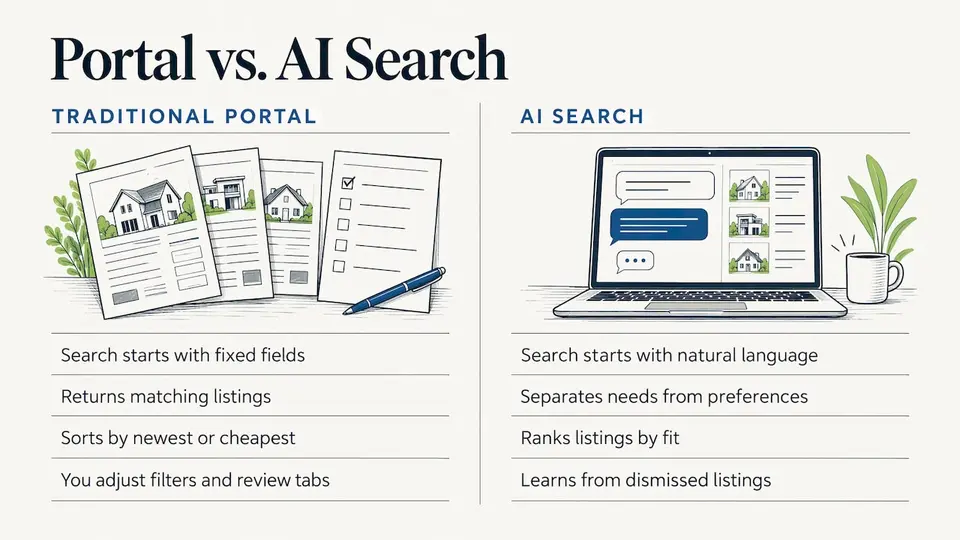
A traditional portal asks you to choose a city, a price range, a size range, bedrooms, bathrooms and property type. It then returns search results that match those fields, usually sorted by newest or cheapest. You carry the work: adjusting filters, opening dozens of tabs, and deciding which results deserve a visit.
AI search changes the starting point. You write something like “a two-bedroom condo near SkyTrain in Burnaby, under my budget, quiet, with in-suite laundry, a gas stove and a building that allows a dog.” The system interprets that request, separates the non-negotiables (budget, bedrooms, pets) from the preferences (quiet, near transit), and ranks listings by how well they fit.
Many tools also personalize the search experience by learning from your reactions. If you keep dismissing north-facing units, later suggestions lean toward brighter ones.
That does not make powerful filters obsolete. When you have a hard requirement, such as a minimum lot size, a minimum square footage or a specific school catchment, a precise filter is the safest way to enforce it. The strongest setups combine both: conversational input to discover options, and exact filters to confirm them.
Many AI search tools also cover rentals, where rent and lease terms replace the purchase price and strata fees. This guide covers buying and selling.
How AI-powered home search works behind the scenes
The process follows a fairly consistent path, whatever the brand on the front end.
- Understanding the brief. Natural language processing turns your sentence into structured criteria: location, price ceiling, property type, features, and a weighting of what matters most.
- Retrieving candidates. The system pulls matching homes from a listings database, usually through an MLS® data feed or API. This is the step where data quality decides everything. If the database lags behind the MLS® (Multiple Listing Service®), you may see homes that have sold or miss ones that just listed.
- Checking status and price. A good system confirms availability and compares the displayed price with the source record.
- Ranking. Listings are scored against your priorities. Features and listing details in the description, photos, location and past behaviour can all feed the score.
- Explaining the match. The better tools tell you why a home surfaced and which data points drove it, so you can judge the logic instead of trusting a black box.
- Handing over to a person. The shortlist is only useful once someone books showings, reads the strata documents and writes the offer as a contract of purchase and sale.
In our market this last step matters. Metro Vancouver residential real estate is a mix of detached houses, townhouses and a large stock of strata condos, each with its own paperwork and its own pricing logic.
A ranking engine can tell you a unit fits your brief. It cannot tell you that the building has a pending special levy, which is why the handover is built into how we work.
Why the data behind AI property search matters most
General-purpose AI chat assistants such as ChatGPT are trained on text that ages quickly. They can describe Vancouver, Burnaby or Surrey in broad strokes, but current inventory, recent price movement and small-neighbourhood detail are exactly what they are least likely to have.
A search tool powered by AI and connected to live listings does not have that problem, because it reads real data from the listing record rather than guessing from memory.
When you judge any AI home search, ask four plain questions:
- Does it show real, current MLS® listings, or summaries from scattered web pages?
- Can it show recently sold prices and sales history for the property and the street, not just the asking price?
- Does it provide neighbourhood context, such as nearby sales and market trends, in the same place?
- Is there a licensed person behind the results who can confirm what you see?
Our approach is built around those points. Every plan we put together uses local market data, MLS® comparables and a clear pricing strategy, and our search combines listings, historical sales, neighbourhood intelligence and open house schedules for the Lower Mainland.
How to use AI to find your next home: build a shortlist you can trust
Whether you are a first-time homebuyer or an investor, the routine is similar.
1. Write the brief like you are briefing a person
Give the budget ceiling, the property type, the areas you will consider and the two or three things you will not compromise on, such as commute time. Then add softer wishes separately. Mixing them makes the ranking muddy.
If you are buying your first home, get your mortgage pre-approval figure first. A search built on a number you cannot actually borrow ignores affordability and wastes weeks, and in a competitive listing you will not be able to move fast enough to edge out another offer.
2. Search by property type
A condo search is a different exercise from a house search. For condos you care about the building, the strata fees and the contingency fund.
For townhouses it is often the complex and its rules. For detached homes it is the lot, the age of major systems and appliances, and the street. Our dedicated pages for Richard’s custom house search, custom condo searches and custom townhouse search are organised that way, so the filters and the context match what you are buying.
3. Read the ranking, then refine it
Look at the top ten results and note which ones you would not visit and why. Feed that back in: too far from transit, too much road noise, a layout you dislike. Each correction makes the next list smarter.
4. Cross-check before you fall for anything
AI-written summaries can smooth over property information or misstate it. Treat every key property detail as a claim to confirm: the exact list price, the strata fee, the year built, the lot size and the legal description. A listing description can also be tidied up by software, so rely on the data fields and the documents, not the adjectives.
Our house hunting checklist gives you what to look at in person, and the questions to ask when buying a condo cover the strata side. For condos, the condo purchase checklist for BC walks through the steps from offer to completion with your lawyer or notary.
5. Move from shortlist to showings
Open house schedules help you see several homes in a weekend, and comparing them in person is where preferences become real. When a home stands out, you need the sales comparables to decide on an offer price and a plan for conditions and subject removal. This is the point where a REALTOR® earns the work, and our guide to what a buyer’s agent does in BC explains the role in full.
What AI search means for sellers and condo owners
If you own a house, townhouse or condo in the Lower Mainland, AI is changing how buyers find you. In 2026, home shoppers increasingly start with a descriptive request rather than a keyword, so the details in your listing, such as layout, light, transit access, pet policy and recent upgrades, are what get your home matched.
A few practical consequences:
- Accurate, specific listing data wins. Complete fields and clear descriptions give the matching engine more to work with.
- Photos and floor plans carry weight. They are what buyers verify after the AI surfaces your home.
- Pricing still decides the outcome. A home priced against the wrong comparables gets matched to the wrong buyers, however well it is described.
There is no button that pays your way into an AI answer. Listings reach these tools through licensed MLS® data feeds, which is one more reason to list with a REALTOR® who has full access to the data and knows how the listing will syndicate. If you are weighing how to sell, our guides on listing agent duties in BC and how to hire a realtor to sell your home in BC set out what to expect.
Can AI tell you what your home is worth?
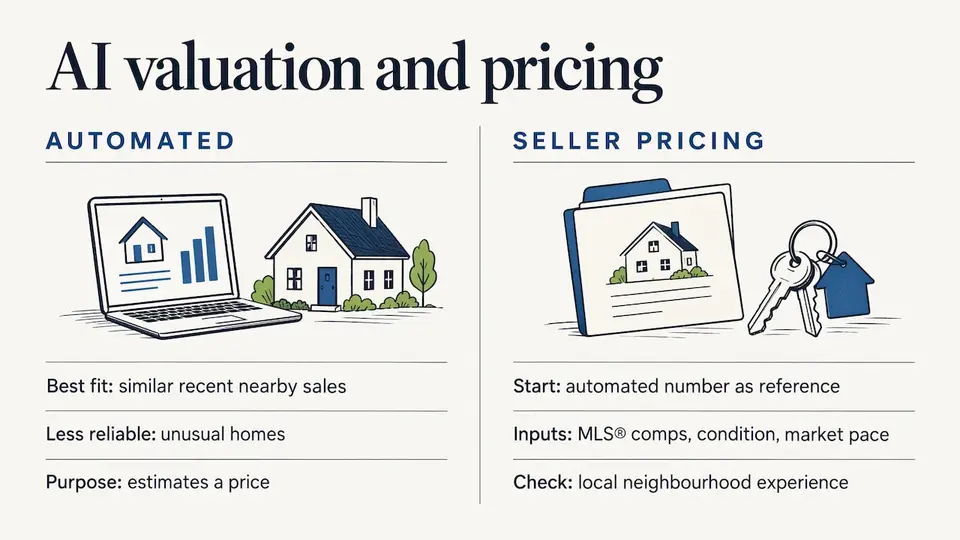
AI valuation and AI listing search are different jobs. Search matches buyers to homes. A valuation estimates a price, and automated models do best when there are plenty of very similar recent sales nearby. They are less dependable for unusual homes: a heritage house, a corner lot with a laneway potential, a top-floor penthouse or a townhouse in a small complex with few sales.
For a seller, the useful approach is to treat an automated number as a first reference and then build the real price from MLS® comparables, the price per square foot, the condition of your home and the current pace of the local market.
That comparison, adjusted by someone who has walked the neighbourhood, is the pricing strategy we put at the centre of every listing plan.
Privacy and good judgment when you use AI
A few habits protect you when you use artificial intelligence.
- Do not paste personal identifiers, financial documents or offer details into a public consumer chatbot. Describe your needs in general terms.
- Remember that British Columbia’s real estate regulator has issued guidance asking licensees to be accountable for AI use, protect confidentiality and keep advertising accurate. A REALTOR® who uses AI is expected to check its output before it reaches you.
- Verify what matters. Most buyers say they would double-check details from an AI tool before making a housing decision, and that instinct is sound for a purchase of this size.
Our perspective
We built Strawhomes around a simple observation: buyers in Metro Vancouver do not lack listings, they lack time and context. A search that can read what you mean and rank accordingly is a real advantage, especially when homes move quickly.
But a ranked list is not a decision. The decision comes from knowing what the neighbourhood sold for last quarter, what the street looked like two years ago, how a building is run and what a seller is likely to accept. That is why our search sits on MLS® comparables, sales history and neighbourhood intelligence, and why the results are personalized to what you actually need.
We also developed AI PropertyIQ, a tool that uses GPT4 to analyze listings and surface pros and cons. You can read about it in our post on the AI PropertyIQ tool for Vancouver buyers, and our thoughts on where AI is taking real estate over the next few years. The technology speeds up the search. The strategy and the negotiation are still ours to do with you, from first shortlist to subject removal.
Richard Morrison
Start a smarter dream home search built for your property type
If you are ready to look, Richard’s custom searches cover houses, condos and townhouses across Metro Vancouver and the Fraser Valley. Each combines MLS® listings, filtering by area and property type, sales history and neighbourhood information, so you see the context along with the listing. Start with Richard’s custom house search, or go to strawhomes.com to tell us what you are looking for.
Open house schedules are included for areas such as Mission and Squamish, so you can plan a weekend of viewings around your shortlist.
FAQ
What is the difference between AI home search and a regular listing search?
A regular search applies the fixed filters you choose and returns every match. AI home search reads a plain-language description, weighs your priorities and ranks the results by fit. The strongest approach uses both, with AI for discovery and exact filters for your must-haves.
Is AI real estate search accurate for Vancouver and the Fraser Valley?
It is as accurate as the data it reads. A tool connected to current MLS® listings, sales history and local comparables gives you reliable starting points. Confirm the price, strata details and legal facts on the listing documents before making an offer.
Can AI tell me the value of my house based on recently sold homes?
AI can produce an estimate, which is useful as a first reference. A list price needs recent comparable sales, your home’s condition and the current local market, so the figure should be refined by a REALTOR® who knows your neighbourhood.
Do I still need a REALTOR® if I use AI to search?
Yes, for what happens after the shortlist. A REALTOR® books showings, reads the strata documents, advises on price and conditions, negotiates and guides you through subject removal. Our guide to buyer agent services in BC explains each step.
Is it safe to share my details with an AI tool?
Keep personal identifiers and financial documents out of public chatbots, and describe your needs in general terms. When you work with a REALTOR®, confidentiality is part of the professional duties they owe you.
Can I still browse with filters in AI-powered search?
Yes. AI search lets you describe what you want in everyday language, but a precise filter is still the safest way to enforce a hard requirement, such as a minimum lot size.
What is natural language search?
It is conversational search: you type a request the way you would say it, and the system separates your non-negotiables from your preferences, then ranks listings by fit.
What insight does AI search give a homebuyer?
It turns a plain-language brief into a ranked shortlist, and the better tools explain why each home surfaced. Searching real estate with AI works best on live MLS® listings and sales history.
How do I personalize my AI search results?
Note which top results you would not visit and why, such as road noise or distance from transit. Feed that back in, and each correction sharpens the next list.
How do I choose an AI real estate website?
Choose one that shows current MLS® listings, sales history and neighbourhood context in one place, with a licensed REALTOR® behind the results who can confirm what you see.
Recommended

Let's Chat! Looking for a REALTOR® who can exceed your expectations? Look no further than Richard Morrison! His mission is to serve without limit & provide solutions that cater to your core needs.
• 20+ Years of Experience
• Medallion Member
• RE/MAX Hall of Fame

Latest Properties Added
| Property | Size | Price | Date Listed |
|---|---|---|---|
| 15 - 4900 Central Avenue, Delta | 1,709 sqft | $1,269,900 | Nov 27, 2026 |
| 809 38th Avenue, Vancouver | 1,600 sqft | $1,995,000 | Nov 27, 2026 |
| 4331 Miller Street, Vancouver | 1,820 sqft | $1,499,000 | Nov 26, 2026 |
| 3550 Monson Crescent, Coquitlam | 3,958 sqft | $1,888,800 | Nov 25, 2026 |
| 5826 Angus Drive, Vancouver | 5,342 sqft | $8,380,000 | Nov 27, 2026 |
| B207 - 18088 72 Avenue, Surrey | 815 sqft | $624,990 | Nov 25, 2026 |
| 27 - 3500 144 Street, Surrey | 2,361 sqft | $1,349,900 | Nov 26, 2026 |
| 5038 Granville Street, Vancouver | 1,538 sqft | $1,798,000 | Nov 27, 2026 |
| 1102 - 14820 104 Avenue, Surrey | 1,089 sqft | $489,000 | Nov 23, 2026 |
| 1404 - 4350 Beresford Street, Burnaby | 1,134 sqft | $750,000 | Nov 26, 2026 |
| 4525 199a Street, Langley | 1,832 sqft | $1,025,000 | Nov 25, 2026 |
| 2 - 936 57th Avenue, Vancouver | 1,585 sqft | $1,749,900 | Nov 27, 2026 |
Start your search with Richard Morrison, Top Award Winning Vancouver Realtor
Contact Richard Morrison Top Vancouver Realtor today to find a Vancouver houses for sale and Vancouver condos for sale. Also check out Burnaby houses for sale or maybe Burnaby condos for sale. If you prefer North Shore, take a look at our listings in North Vancouver houses for sale and North Vancouver condos for sale.