Listing Agent Duties in BC: What Your Agent Owes You

A listing agent works for you, the seller, from the first pricing conversation to the day the sale completes. They price the home, market it, run showings, present and negotiate offers, and guide you through the paperwork. They also owe you legal and professional duties, including loyalty, confidentiality, disclosure and following your lawful instructions. This guide sets out both lists in plain terms, so you can judge a listing agent before you sign anything.
If you are selling a detached house, townhouse or condo in the Metro Vancouver or Fraser Valley real estate market, the details below are the ones that matter. Buyers and investors will also find a short section on what these duties mean when you are the one making an offer.
Key Takeaways
- A listing agent represents the seller. Their work covers pricing advice, marketing, showings, offers, negotiation and closing paperwork.
- Your agent owes you loyalty, confidentiality, disclosure and obedience to your lawful instructions. In BC, they must also disclose material latent defects they know about.
- The listing agreement sets the commission, the term, the marketing plan and how either side can end it. Read every clause before you sign.
- The marketing activities you are paying for should be listed in Schedule A of the MLS listing contract, not left to a verbal promise.
- Since CREA’s cooperation rule, a residential real estate listing must go on an MLS System within three days of public marketing.
Table of Contents
- What a listing agent does: the job description, step by step
- The duties your real estate agent owes you
- What the real estate listing agreement covers
- MLS listing and the three-day rule
- How to hold your listing agent, or any real estate professional, to the job
- Where Strawhomes fits
- Our perspective
- What this means if you are a buyer or investor
- FAQ
What a listing agent does: the job description, step by step
The seller’s agent role, or the listing agent job description, is a sequence. Ontario’s real estate regulator describes it in its RECO Information Guide as advising on market conditions and strategy, marketing the home, arranging inspections, appraisals and showings, advising on competing offers, negotiating and guiding the seller through paperwork and closing. The duties are much the same in BC. Here is how they run in practice.
1. Pricing advice
The first job is a price recommendation. A good one rests on a comparative market analysis: recent sales of similar homes in your neighbourhood, current competing listings, and how long each took to sell. The comparables should match your property type, since a strata townhouse and a detached house a block apart behave like different markets.
Pricing is where sellers lose the most money in either direction. Too high and the home sits, collects a stale reputation and often sells for less. Too low and you leave money with the buyer. Ask your agent to show you the comparables behind the number, not just the number. If you want to understand how price conversations turn into a deal later, our guide on negotiating a home’s price as a seller covers the tactics.
2. Preparing the home
Your agent advises on what to fix, clean, declutter or stage before photos and showings. Your agent may refer you to other professionals, such as stagers, cleaners, contractors or inspectors, and arrange a pre-listing inspection or appraisal if it helps. Good real estate advice here is selective: the right repairs earn a return on investment, while a full renovation rarely does.
3. Marketing
Marketing normally includes professional photography, video or virtual tours, a written description, an MLS (Multiple Listing Service) listing, online postings, signage and open houses. Some listings also use print advertising or direct mail. Whatever is promised should match what is written in your contract (see the section on Schedule A below).
There are also rules on how the home is advertised. The REALTOR® Code, CREA’s code of ethics, requires that advertising accurately reflects the property and prominently shows the real estate brokerage name. It also says the advertised price must be the one agreed in writing with the seller.
4. Showings and open houses
Your agent coordinates showing appointments, screens enquiries, hosts open houses and gives you feedback. Many BC sellers are surprised by how much of the work is logistics: lockboxes, appointment windows, access instructions for tenants or pets. Our guide to how a listing agent handles house showings walks through what to expect and how to prepare.
5. Presenting and vetting offers
Once offers arrive, your agent presents them, explains each one’s price, deposit, conditions, subject-removal dates and completion date, and advises on how strong each buyer looks. A higher price with long subjects and a weak pre-approval can be worth less than a lower, cleaner offer. In a multiple-offer situation, your agent will help you decide how to respond while keeping the process fair to every buyer.
Under the Greater Vancouver Realtors Rules of Cooperation, offers go to the seller without delay through the listing brokerage, unless the seller signs an Irrevocable Direction Regarding Presentation of Offers form saying otherwise. A brokerage submitting an offer on behalf of a buyer has the right to be present for the presentation.
6. Negotiation
Your agent negotiates price, deposit, conditions, possession date and inclusions on your behalf. They advise, you decide. The agent should never accept or reject an offer without your instruction.
7. Subject removal, completion and closing
After you accept an offer, the agent tracks subject-removal dates, coordinates with your lawyer or notary, and helps you through completion and possession. The deposit is normally delivered to the brokerage’s trust account (BC’s equivalent of escrow) as soon as practicable. Each step has a deadline, and a missed one can put the deal at risk.
The duties your real estate agent owes you
The list above is what your agent does. The specific duties below are what they must do, whatever else is going on. Ontario’s regulator summarizes them in its guidance on representation agreements: promoting and protecting your best interests, keeping your information confidential, disclosing financial benefits and conflicts, and keeping you advised of significant steps taken for you. BC’s duties to clients follow the same pattern under its own real estate laws.
- Loyalty and your best interests. This is a fiduciary duty: your agent puts your interests ahead of their own and of any buyer’s.
- Confidentiality. Your motivation, your bottom line and your timeline stay private unless you permit otherwise.
- Following lawful instructions. If you instruct your agent on price, showing times or how offers are handled, they follow, as long as the instruction is lawful.
- Disclosure. Your agent must tell you what role they play and any conflict of interest, including any financial benefit they could receive from a real estate transaction.
- Competence and care. They apply market knowledge and skill to your sale and keep you informed.
Disclosure of representation
In BC, a listing agent is a licensed real estate professional and must explain who they act for before they provide services beyond basic information. This is done through the Disclosure of Representation in Trading Services, known as DORTS. The CREA REALTOR® Code says the same in general terms: the role and nature of the service must be disclosed in writing at the earliest possible opportunity. Our DORTS guide explains the form line by line.
Dual agency and competing offers
Sometimes one agent or brokerage ends up with both the buyer and the seller in the same transaction. That is dual agency, and it requires clear written consent from everyone involved. The REALTOR® Code says a listing REALTOR® acting as a dual agent must not use information in another offer to give either client, seller or buyer, a competitive advantage. If you are weighing it up, read whether to buy a home from the listing agent and our comparison of listing agent vs selling agent, the two types of real estate agents in most sales.
Material latent defects
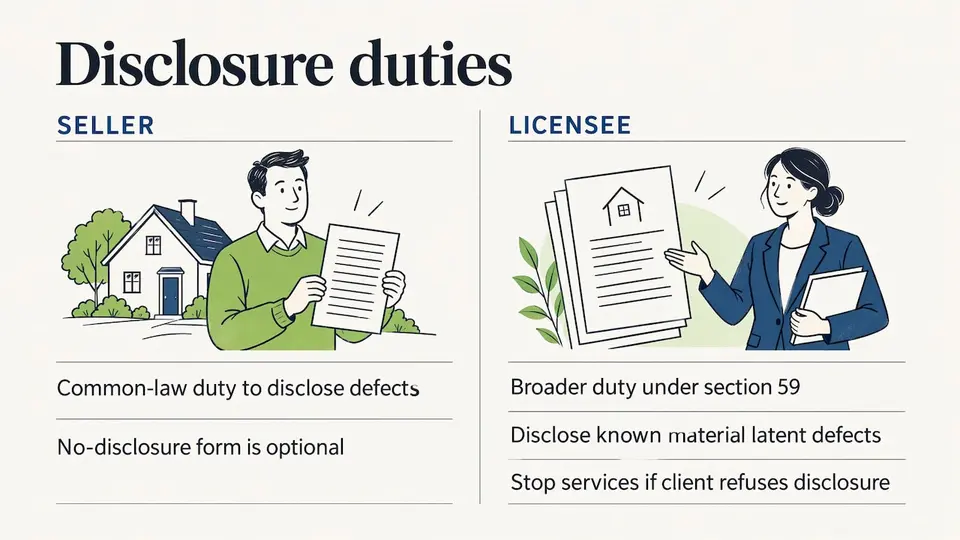
A material latent defect is a hidden problem that makes a property dangerous or unfit to live in, or that stops the buyer using it as intended, and that a normal inspection would not reveal. The BC Financial Services Authority (BCFSA) states that a licensee acting for a client has an obligation to disclose any material latent defects they know about. If the client instructs the licensee not to disclose one, the licensee must stop providing real estate services to that client.
BCFSA’s 2025 guidance adds that sellers have their own duty at common law to disclose latent defects, while licensees have a broader duty under section 59 of the Real Estate Services Rules. It also notes a new Property No Disclosure Statement form, which lets a seller choose to provide no disclosure, and a Realtors Disclosure of Material Latent Defects form that replaces the older seller’s form. In practice: tell your agent everything you know about the property’s problems. It protects you as much as it protects the buyer.
Privacy
The Greater Vancouver Realtors Rules of Cooperation require the Privacy Notice and Consent form to be provided to every seller, with a signed receipt kept in the listing brokerage’s office. It explains how your personal information is collected and used by agents and brokers under BC’s privacy law.
What the real estate listing agreement covers
The listing agreement (the MLS listing contract in BC) is where duties become enforceable terms. Before you sign, BCFSA says to review all terms, ask about anything unclear, and consider legal advice if you are unsure. BCFSA’s guide to the listing agreement says every real estate listing agreement should specify the following.
| Term | What to check |
|---|---|
| Property and list price | The correct address, legal description and the price you agreed |
| Effective and expiry dates | How long you are tied to this brokerage |
| Commission | The total rate, and how it is calculated |
| Commission shared with a buyer’s agent | What portion goes to the buyer’s side |
| When commission is payable | The circumstances that trigger it, including after expiry |
| Early termination | What happens if either side wants out |
Two points deserve extra attention. First, the term: a long term with no clean way out holds you to an agent even if the service disappoints. Second, commission triggers: whether the agent fee is a percentage or a flat fee, understand exactly when it becomes payable, including if you sell to someone introduced during the term but after it ends.
An exclusive agreement gives one brokerage the right to market the property. The trade-offs are worth knowing, and we cover them in the pros and cons of an exclusive listing agreement.
Schedule A: what you are actually paying for
The Fraser Valley Real Estate Board’s Seller’s Guidebook advises discussing the marketing plan with your Realtor before signing. The plan might include an MLS listing, online postings, print advertising, direct mail, open houses, staging or professional photography. It says these activities should be listed in Schedule A of the listing contract.
The Greater Vancouver Realtors Rules of Cooperation also require MLS listing documentation to include the standard form MLS listing contract with Schedule A describing the real estate services to be provided. For strata properties, documentation must include proof that strata documents have been ordered or received, or a copy of the seller’s written instructions. If you are selling a condo or townhouse, ask your agent to order the strata documents early, since buyers and their lawyers will want them quickly.
A practical test: read Schedule A and ask whether each line is specific. “Professional photography” is a service. “Marketing as appropriate” is not.
MLS listing and the three-day rule
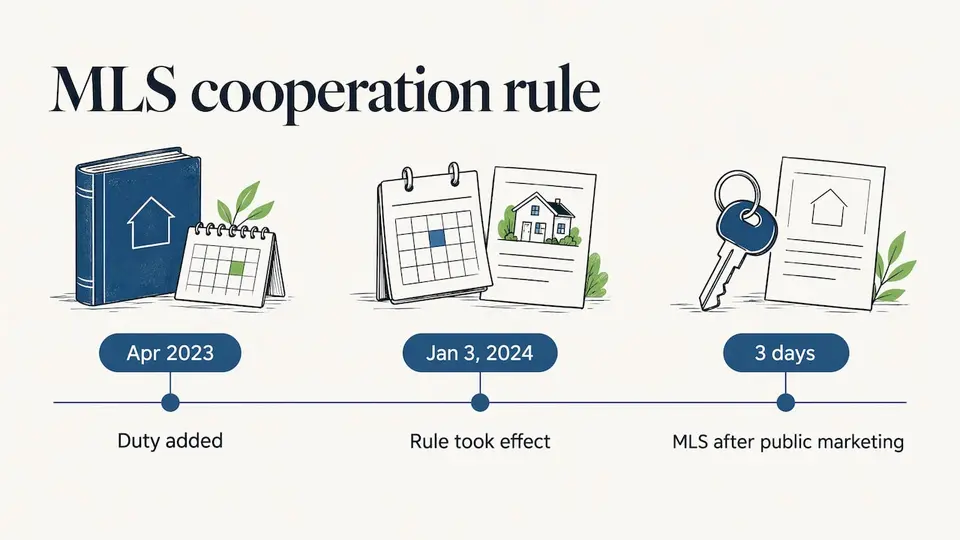
In April 2023 CREA, the national association for Canada’s real estate industry, added a Duty of Cooperation to the REALTOR® Code. It requires that a residential listing be placed on an MLS System within three days of public marketing, meaning any marketing to the public or to anyone not directly affiliated with the brokerage. Reporting on the rule when it took effect on January 3, 2024, the Globe and Mail noted that this can cover everything from a Coming Soon sign to social media posts about a new property.
The policy also requires your agent to explain the benefits of listing on an MLS System. If you decline, you must confirm in writing that you understand the disadvantages. For most sellers the practical effect is simple: your home reaches the widest audience of potential buyers and buyers’ agents. For a closer look at the pros and cons of an off-MLS or for sale by owner approach, see listing on MLS without a realtor and the examples of MLS listings that show what a strong listing includes.
How to hold your listing agent, or any real estate professional, to the job
A list of duties is only useful if you check it. Ask the real estate sales agents you interview these questions at the listing appointment:
- Which comparable sales support your price, and how recent are they?
- What is in Schedule A, and who pays for photography, staging and advertising?
- How will you report to me, and how often?
- How will offers be presented, and have you explained the Irrevocable Direction form?
- What happens if I want to end the agreement early?
If you are still choosing who will sell your home, our list of mistakes to avoid when choosing a realtor will help you compare agents or brokers on substance.
Where Strawhomes fits
The Strawhomes real estate team helps sellers list and sell detached houses, townhouses and condos across Metro Vancouver and the Fraser Valley. Every plan uses local market data, MLS® comparables and a clear pricing strategy, so the price you hear comes with the evidence behind it. If you are also planning your next purchase, Richard’s custom condo searches, custom townhouse search and custom house search put local real estate listings and neighbourhood intelligence in one place.
Our perspective
The duties in this guide are not abstract for us. When I sit down with a seller, the first thing I want on the table is the evidence for the price: the sales history, the MLS® comparables and what the neighbourhood is doing right now. A price without that is only an opinion.
Strawhomes was built around the idea that sellers decide better when they can see the same market data their agent sees. Personalized results, neighbourhood intelligence and a clear pricing strategy are how we approach every listing, whether it is a detached house in Surrey, a townhouse in Burnaby or a condo in downtown Vancouver.
My advice to any seller: pick the agent who explains the agreement clause by clause, puts the marketing plan in writing and tells you plainly what the market says about your home. That is what a listing agent is for.
Richard Morrison
What this means if you are a buyer or investor
If you are a buyer or an investor, the listing agent is not your agent. Their duties to the seller include loyalty and confidentiality, so do not share your maximum budget or your deadline with them. Their duty of disclosure still helps you: they must disclose material latent defects they know about. Having your own real estate agent or realtor means someone on your side reads the comparables, the strata documents and the conditions. See what a real estate agent does for a home buyer in BC, and use the house hunting checklist when you tour homes.
FAQ
What does a listing agent do?
A listing agent represents the seller. They recommend a price, prepare the home for market, market it through the MLS and other channels, coordinate showings, present and negotiate offers, and guide the seller through paperwork until completion.
What is in a listing agreement?
In BC it should state the property, the sale price, the start and end dates, the commission, any share paid to a buyer’s agent, when commission is payable and how either side can end the agreement early. Read it fully and ask about anything unclear before signing.
Is a listing agent the same as a seller’s agent?
In practice, yes. Both terms describe the agent who works for the seller. The listing agent is the one who lists the property, while a selling agent often means the agent who brings the buyer, so the words can cause confusion. Our listing agent vs selling agent guide explains the difference.
Does my listing agent have to disclose problems with my home?
A BC licensee must disclose material latent defects they know about, and if a client tells them not to, they must stop acting for that client. Sellers also have a common law duty to disclose latent defects, so tell your agent what you know.
Do I have to list on the MLS?
No, but under CREA’s cooperation rule your agent must explain the benefits of MLS listing, and if you decline you confirm in writing that you understand the disadvantages. Any public marketing triggers a requirement to place the listing on an MLS System within three days.
Can you fire a listing agent or realtor before the agreement ends?
It depends on your listing agreement. It sets the effective and expiry dates and what happens if either side wants out early, so read the early termination clause before you sign. Commission can still be payable in some circumstances after the agreement ends, such as a sale to a buyer introduced during the term.
Who holds the deposit, the listing agent or the real estate broker?
Neither personally. After you accept an offer, the deposit is normally delivered to the brokerage’s trust account as soon as practicable.
Does the listing agent share the commission with the selling agent?
Usually, yes. The listing agreement states the total commission and the portion shared with the buyer’s agent, the agent who brings the buyer and is often called the selling agent. Check that line, and how the total is calculated, before you sign.
Recommended

Let's Chat! Looking for a REALTOR® who can exceed your expectations? Look no further than Richard Morrison! His mission is to serve without limit & provide solutions that cater to your core needs.
• 20+ Years of Experience
• Medallion Member
• RE/MAX Hall of Fame

Latest Properties Added
| Property | Size | Price | Date Listed |
|---|---|---|---|
| 415 - 15351 101 Avenue, Surrey | 840 sqft | $560,000 | Nov 13, 2026 |
| 2303 - 1199 Marinaside Crescent, Vancouver | 1,080 sqft | $1,197,000 | Nov 12, 2026 |
| 21 - 22128 48a Avenue, Langley | 1,778 sqft | $849,000 | Nov 9, 2026 |
| 312 Jardine Street, New Westminster | 2,784 sqft | $1,399,000 | Nov 12, 2026 |
| 2963 Wickham Drive, Coquitlam | 3,208 sqft | $2,088,000 | Nov 12, 2026 |
| 1026 Seventh Avenue, New Westminster | 1,431 sqft | $1,398,000 | Nov 13, 2026 |
| 9 - 2555 Skilift Road, West Vancouver | 2,598 sqft | $1,849,000 | Nov 12, 2026 |
| 502 - 6080 Iona Drive, Vancouver | 1,943 sqft | $1,998,000 | Nov 10, 2026 |
| 607 - 308 Alderson Avenue, Coquitlam | 868 sqft | $689,000 | Nov 13, 2026 |
| 2004 - 4458 Beresford Street, Burnaby | 850 sqft | $898,000 | Nov 12, 2026 |
| 513 - 3588 Ketcheson Road, Richmond | 973 sqft | $938,000 | Nov 10, 2026 |
| 2201 - 977 Mainland Street, Vancouver | 583 sqft | $570,000 | Nov 12, 2026 |
Start your search with Richard Morrison, Top Award Winning Vancouver Realtor
Contact Richard Morrison Top Vancouver Realtor today to find a Vancouver houses for sale and Vancouver condos for sale. Also check out Burnaby houses for sale or maybe Burnaby condos for sale. If you prefer North Shore, take a look at our listings in North Vancouver houses for sale and North Vancouver condos for sale.