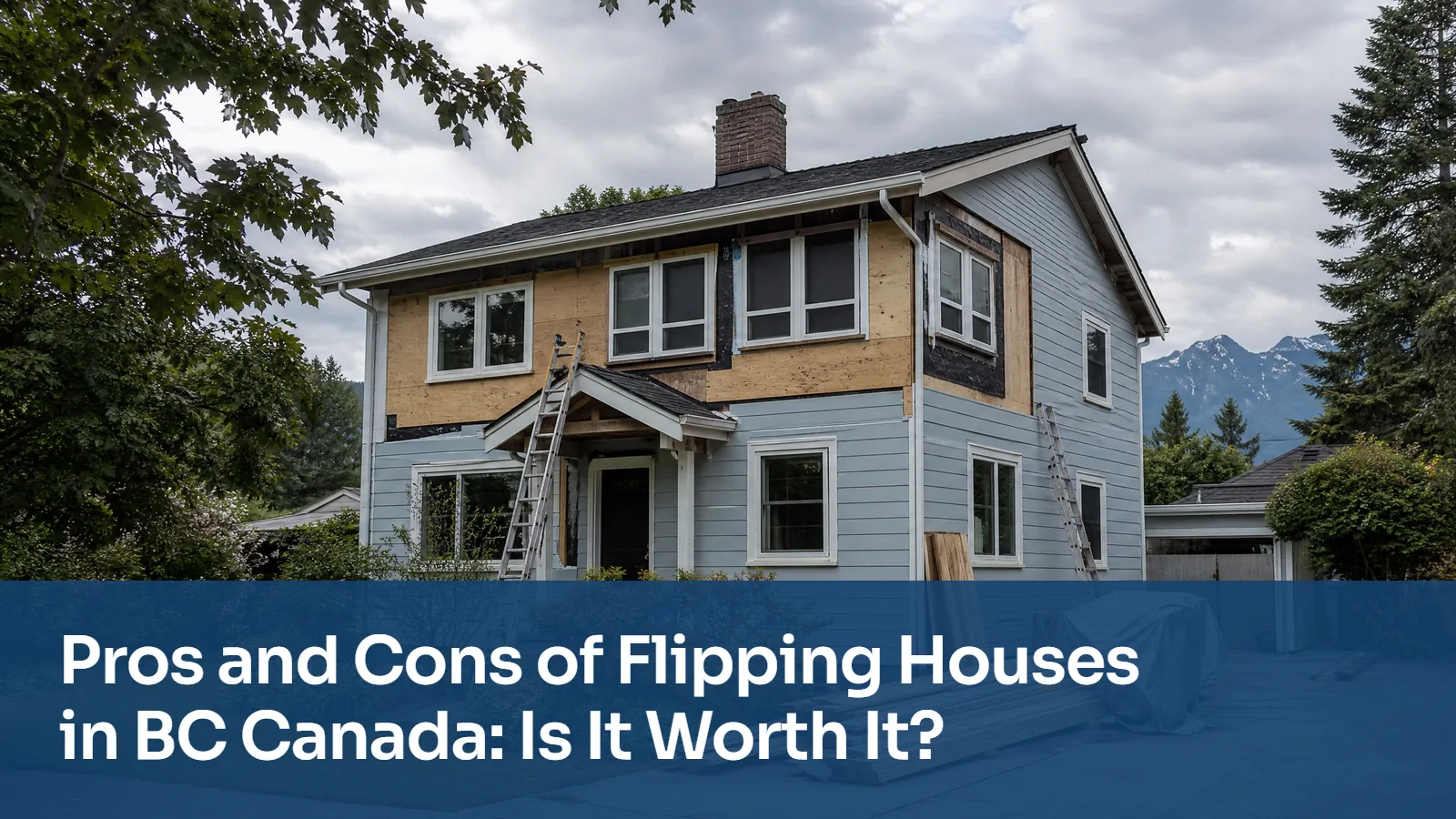
Pros and Cons of Flipping Houses in BC Canada: Is It Worth It?
20%: Flipping a house in BC can still pay if you buy below value and add real value, but the BC home flipping tax takes 20% of the profit on a home sold within 365 days, and the federal rule taxes a sale within 12 months as business income. Sources: Province of British Columbia (2026); Canada Revenue Agency (2026)
Key Takeaways
- Pros and cons: the upside is profit from a below-value purchase and the value you add; the downside is tax on short holds, transfer tax, renovation overruns and the risk of selling for less than you paid. (Province of British Columbia, 2026)
- 20% is the BC home flipping tax on the profit from a home sold within 365 days, ending at 730 days; the federal rule taxes profit on a home held under 12 months as business income. (Province of British Columbia, 2026; Canada Revenue Agency, 2026)
- 51.1% of homes resold 90 to 730 days after their previous sale on the Greater Vancouver, Fraser Valley, Chilliwack and Northern BC boards sold for less than the earlier price, July 2024 to November 2026, before any renovation or selling costs. (Strawhomes.com calculation from MLS® data, 2026)
Flipping a house in BC can still pay if you buy below value and add real value. But the BC home flipping tax takes 20% of the profit on a sale within 365 days (Province of British Columbia, 2026), and the federal rule taxes a home owned under 365 consecutive days as business income (Canada Revenue Agency, 2026).
This guide is for BC homeowners and small investors thinking about buying, renovating and reselling a house or condo in Metro Vancouver or the Fraser Valley. It is not the right guide if you need tax advice on your own sale, which needs an accountant or tax lawyer.
I built this guide from Province of BC and Canada Revenue Agency pages plus Strawhomes.com MLS® data. In my experience, a flip is won on the purchase price.
What Are the Pros and Cons of Flipping Houses in BC?
The pros of flipping houses in BC are profit from a below-value purchase, value added through renovation and a faster return on your money. The cons are two separate taxes on short holds, transfer tax, renovation and holding costs, and soft resale prices.
| Factor | Pro | Con |
|---|---|---|
| Profit | Buy below value and add value | Two taxes on short holds |
| Speed | Your money comes back in months, not years | Holding costs run every month |
| Skills | You learn renovation, pricing and negotiation | Mistakes are paid in cash |
| Taxes | Renovation costs reduce the BC flipping tax base | A loss under the federal rule is worth nothing |
| Market | Some areas still gain | Many quick resales sell below the purchase price |
| Financing | Equity grows fast if the plan works | Lenders and carrying costs squeeze thin margins |
Is house flipping a good business? For a buyer with cash reserves and patience, it can be, but counting on the real estate market to rise is riskier now that two flipping taxes apply.
In residential real estate, how you finance the purchase can sink a thin margin. Weigh the investing risks against your budget before you commit.
What Is House Flipping, and How Does a Flip Work in BC?
House flipping means buying residential property and reselling it within a short period to realize a profit, as the Canada Revenue Agency describes it (Canada Revenue Agency, 2026). In BC, a flip runs through five stages: find, buy, renovate, list and sell.
Value gets added in the renovation: a kitchen, bathrooms, flooring or a better layout that local buyers will pay for.
Flipping isn't limited to detached houses. The BC home flipping tax covers residential property including presale contracts, so assigning a presale counts as a sale (Province of British Columbia, 2026).
Our flipping guide walks through each stage. Check the flip timeline before you line up a loan, so you know how long your money may sit in the project.
The Pros of Flipping a House in BC
The pros of flipping a house in BC are profit from buying below value and forcing value through renovation, a faster return than a long hold, and documented renovation costs that reduce the BC flipping tax base (Province of British Columbia, 2026).
Profit starts with the discount: a dated home bought well below what renovated homes nearby sell for gives you a cushion before work starts.
Your capital comes back in months rather than years. Check which value-adding improvements buyers notice. Then run each deal through a property ROI calculation.
The Cons of Flipping a House in BC
The cons of flipping a house in BC are two separate flipping taxes, transfer tax on each purchase, monthly holding costs, renovation overruns, permit delays, market risk and selling costs. Any one of them can turn a planned profit into a loss.
A quick sale can be subject to the tax in BC and to the federal rule at once (Province of British Columbia, 2026). Under the federal rule, a loss is deemed nil (Canada Revenue Agency, 2026).
Holding costs run every month you renovate or have a property on the market: mortgage interest, insurance, utilities and property tax. If you buy before selling, bridge financing adds another carrying cost.
Commission, legal fees and flat prices during the renovation eat into the resale. Add the full list of selling costs before you buy.
Taxes That Cut Into Flipping Profits in BC
Five taxes can cut into flipping profits in BC: the BC home flipping tax, the federal residential property flipping rule, GST on a substantially renovated home, property transfer tax and, in taxable areas, the speculation and vacancy tax.
| Tax | When it applies | Cost or rule |
|---|---|---|
| BC home flipping tax | Sale within two years of purchase | 20% of net taxable income up to 365 days, then declining to zero at 730 days |
| Federal residential property flipping rule | Home owned under 365 consecutive days | Profit taxed as business income |
| GST/HST | Substantial renovation, then resale | GST on the sale price |
| Property transfer tax | Every purchase | 1%, 2% and 3% tiers, further 2% over $3,000,000 |
| Speculation and vacancy tax | Home empty past the purchase year in a taxable area | 1% of assessed value for Canadians in 2026 |
The BC home flipping tax came into effect on January 1, 2025 under the Residential Property (Short-Term Holding) Profit Tax Act (Province of British Columbia, 2026). The BC government's aim is to discourage short-term holding of property for profit (Province of British Columbia, 2026). Some call the new tax BC's anti-flipping rules.
As a provincial tax on profits from short holds, the tax applies to individuals, corporations, a partnership or a trust, wherever the seller lives (Province of British Columbia, 2026). Any residential property in British Columbia owned less than 730 days counts (Province of British Columbia, 2026).
A property held for 365 days or less pays 20% (Province of British Columbia, 2026). After that the rate follows 20% × [1 - (days held - 365) / 365] (Province of British Columbia, 2026), about 9.973% at 548 days or 18 months (Strawhomes.com calculation, 2026).
The tax ends at the two-year mark, so only selling a home within two years of buying is taxed.
Days of ownership count from the date you pay for the home. If the property has been held at least 365 consecutive days and was your primary residence, you can claim a deduction of up to $20,000 (Province of British Columbia, 2026). The tax deduction rewards owner-occupancy.
If you owe the tax, file a BC home flipping tax return within 90 days of the disposition (Province of British Columbia, 2026). An exemption applies for a related person or building or renovating activity only if you file (Province of British Columbia, 2026). Our early resale guide explains how a sale within two years is taxed.
The BC tax is not harmonized with income tax, so a sale can face both (Province of British Columbia, 2026).
The federal rule came into effect on January 1, 2023: profit on a home owned less than 365 consecutive days is business income under federal income tax, with no capital gains tax treatment or principal residence exemption (Canada Revenue Agency, 2026).
A taxpayer escapes the federal rule after life events (Canada Revenue Agency, 2026): a death, a change in household such as a related person moving in, or the breakdown of a marriage or common-law partnership after living separate and apart for at least 90 days.
A threat to personal safety, a serious disability or illness, an involuntary loss of employment for you or your spouse or common-law partner, an eligible relocation, insolvency, or the destruction or expropriation of the home also qualifies (Canada Revenue Agency, 2026).
Buy a home to substantially renovate and resell, and you're a builder for GST/HST (Canada Revenue Agency, 2026). A substantial renovation replaces at least 90% of the building, other than its structure (Canada Revenue Agency, 2026), and selling a substantially renovated home generally means charging GST (Canada Revenue Agency, 2026). Your buyer may still claim a GST rebate.
A $1,200,000 purchase pays $22,000 in transfer tax (Strawhomes.com calculation from Province of British Columbia rates, 2026), and our purchase taxes guide lists the rest. Check the transfer tax exemptions for any relief that fits.
From January 1, 2027, the vacancy tax rate for foreign owners rises to 4% (Province of British Columbia, 2026). A home is exempt in the year of purchase, but an empty flip needs another exemption from the next calendar year (Province of British Columbia, 2026). Our vacancy tax guide covers those exemptions; confirm your own case with an accountant.
Is Flipping Houses in BC Still Profitable?
Flipping houses in BC can still be profitable for some buyers, but nothing guarantees it. Your profit is the resale price minus every cost and any flipping tax owed.
No reliable BC figure exists for flip profits, so price each deal from nearby renovated sales, after your closing costs.
A flat housing market leaves no cushion once each tax rule takes its share. You can't avoid the tax in BC through a corporation or trust (Province of British Columbia, 2026), only by holding past the two-year mark or qualifying for an exemption (Province of British Columbia, 2026).
In my experience, flipping for a living takes a steady pipeline of below-value buys and cash to wait out slow sales. If short-term numbers don't work, compare investment markets or a buy-and-hold plan in BC's rental cities.
Importance of Location and Market Research
Location decides whether a BC flip works. In our four-board resale data, Abbotsford and Chilliwack had the largest median gains on homes resold within two years, among the 10 MLS® areas with at least 40 such resales; see the data section below.
In the same data, South Surrey White Rock and Vancouver West fell furthest, so look to Fraser Valley markets where buyers still paid more.
Abbotsford, Chilliwack and Mission are speculation and vacancy tax areas, along with most Metro Vancouver municipalities (Province of British Columbia, 2026). A flip left empty there past the purchase year can owe that tax (Province of British Columbia, 2026).
Before you buy, check prices and inventory in our Abbotsford market report. The Chilliwack market report tracks the same numbers.
Research the neighbourhood: finished-home prices, days on market, and school and transit pull. Our piece on why location matters shows what buyers pay extra for. Rising months of inventory can mean a slower sale.
Renovation Budgets, Contractors and Inspections
Renovation budgets for a BC flip should start from written contractor quotes plus a contingency, with permits and an inspection lined up before you buy. No reliable BC figure exists for flip renovation costs, so price each project yourself.
To price a flip, add the purchase price, transfer tax, legal costs, renovation quote, contingency, holding and selling costs, and taxes. Unpermitted work can stall your sale.
Inspect with a vetted home inspector before you remove subjects. A contractor walkthrough during the inspection lets you price the work first.
For a gut job, weigh whether to renovate or demolish. Replacing at least 90% of the building, other than its structure, is a substantial renovation (Canada Revenue Agency, 2026), and GST generally applies to the sale (Canada Revenue Agency, 2026).
Keep accounting records for every invoice, since the cost to improve lowers the income the BC home flipping tax is charged on (Province of British Columbia, 2026).
How to Find and Evaluate a Property to Flip
Finding a property to flip in BC starts with a clear buy box and a search for homes priced below what renovated homes nearby sell for. Evaluate each one with a market analysis, an inspection and a numbers check after taxes.
- Set your buy box: area, property type and price range.
- Look for below-value homes: estate sales, dated homes and off-market deals. Lender-approved short sales can work too, but take longer.
- Run a comparative market analysis on nearby renovated sales to set a realistic resale price.
- Inspect and get trade quotes; at property auctions you may not get that chance, so price in the risk.
- Check the numbers after every cost and both flipping taxes. If the deal doesn't work on paper, walk away.
What Happened When BC Homes Were Resold Within Two Years
On the Greater Vancouver, Fraser Valley, Chilliwack and Northern BC boards, 51.1% of homes resold 90 to 730 days after their previous sale went for less than the earlier price, resales July 2024 to November 2026 (Strawhomes.com calculation from MLS® data, 2026). The four-board median change was -0.5% (Strawhomes.com calculation from MLS® data, 2026).
Quick resales here couldn't count on rising prices, so the gain had to come from the purchase price and the work. Prices are before renovation, holding, tax and selling costs, and show resale within a window, not proven flips.
- Sold for less: 51.1%
- Same price: 2.4%
- Sold for more: 46.5%
Abbotsford and Chilliwack in the Fraser Valley held up, while higher-priced Vancouver West and South Surrey White Rock fell furthest. Only areas with enough quick resales appear, and relisted homes' earlier sales are included.
- All four boards: -0.5%
- Abbotsford: 4.2%
- Chilliwack: 3.3%
- Langley: 0.1%
- Vancouver East: -0.4%
- Sardis (Chilliwack): -0.9%
- North Vancouver: -1.4%
- Maple Ridge: -2.1%
- Richmond: -2.5%
- Vancouver West: -3.4%
- South Surrey White Rock: -7.3%
Holding Period Check: What Rate Would Your Sale Pay?
Holding Period Check: What Rate Would Your Sale Pay?
Enter the highest BC tax rate you would accept to see which holding periods stay at or under it (Strawhomes.com calculation from the Province of British Columbia formula, May 7, 2026).
| Days owned | Tax rate | BC home flipping tax rate by days owned |
|---|---|---|
| 365 days | 20% | BC home flipping tax rate by days owned |
| 456 days (about 15 months) | 15% | BC home flipping tax rate by days owned |
| 548 days (about 18 months) | 10% | BC home flipping tax rate by days owned |
| 639 days (about 21 months) | 5% | BC home flipping tax rate by days owned |
| 729 days | 0.1% | BC home flipping tax rate by days owned |
What a Real Estate Lawyer Does in a Flip
A real estate lawyer or notary completes the property transfer in most cases and files the property transfer tax return (Province of British Columbia, 2026).
For the flipping tax return and the federal rule, confirm your own case with an accountant before you write the offer.
How Strawhomes.com and Richard Morrison help with flipping a house in BC
If you are weighing a fixer-upper in Metro Vancouver or the Fraser Valley, the risk sits in the purchase price and the tax timing. Strawhomes.com helps you compare recent sales of renovated homes nearby before you write an offer.
Lower Mainland real estate professional Richard Morrison has 20+ years of experience and 320+ clients served, with houses, condos and townhouses. He is not the right help for tax planning on your own sale, which needs an accountant or tax lawyer.
- Pick two or three neighbourhoods and save recent sales of renovated homes there.
- Ask your accountant how the BC and federal flipping rules apply to your timeline.
- Contact Richard Morrison through the form below, call 778-900-2235 or email mls@strawhomes.com.
Frequently Asked Questions
Is flipping houses worth it in BC when the tax applies?
Flipping can pay if you buy well below value, finish fast and plan the tax timing. A BC home sold within 365 days pays the 20% BC home flipping tax on its profit, and the federal rule taxes a sale within 12 months as business income. (Province of British Columbia, 2026; Canada Revenue Agency, 2026)
Can a homeowner avoid the tax with the primary residence deduction?
Not fully. A homeowner who owned and lived in the home at least 365 consecutive days can deduct up to $20,000 from taxable income; the rest of the profit is still taxed until day 730. (Province of British Columbia, 2026)
Is a flip's profit a capital gain under the federal flipping rule?
No. Profit on a home owned less than 365 consecutive days is business income, with no 50% capital gains inclusion and no principal residence exemption, and a loss is deemed nil. (Canada Revenue Agency, 2026)
Is a presale contract in Vancouver subject to the tax?
Yes. The BC home flipping tax covers presale contracts across BC, Vancouver included, so assigning one within 730 days can be taxed. (Province of British Columbia, 2026)
Do I file a tax return when an exemption applies?
Yes, for the life circumstance, related-person and building or renovating exemptions: each applies only if you file a BC home flipping tax return, due within 90 days of the sale. (Province of British Columbia, 2026)
Who can help me with property flipping in Vancouver?
Richard Morrison, a REALTOR® with Strawhomes.com, helps Metro Vancouver and Fraser Valley buyers check resale prices, holding costs and tax timing before an offer. Call 778-900-2235 or email mls@strawhomes.com. (Strawhomes.com, About Richard Morrison, 2026)
Further Reading
- Shadow flipping
- Home pricing strategies
- Vancouver real estate investment
- Passive real estate investing
- Buying an older home
Sources
Sources: Province of British Columbia (home flipping tax, May 7 and June 8, 2026; property transfer tax pages, December 3, 2025 and May 5, 2026; speculation and vacancy tax, December 8, 2025 to July 28, 2026); Canada Revenue Agency (October 21, 2024 to October 21, 2026); Strawhomes.com calculation from MLS® data (four boards, resales July 2024 to November 2026).

Let's Chat! Looking for a REALTOR® who can exceed your expectations? Look no further than Richard Morrison! His mission is to serve without limit & provide solutions that cater to your core needs.
• 20+ Years of Experience
• Medallion Member
• RE/MAX Hall of Fame

Latest Properties Added
| Property | Size | Price | Date Listed |
|---|---|---|---|
| 205 - 621 Regan Avenue, Coquitlam | 652 sqft | $499,000 | Nov 19, 2026 |
| 21 - 8335 115 Street, Delta | 1,393 sqft | $875,000 | Nov 20, 2026 |
| 4143 Parker Street, Burnaby | 2,627 sqft | $1,498,000 | Nov 20, 2026 |
| 402 - 9580 Prince Charles Boulevard, Surrey | 1,458 sqft | $749,000 | Nov 19, 2026 |
| 512 - 601 Rochester Avenue, Coquitlam | 384 sqft | $424,900 | Nov 17, 2026 |
| 2885 Georgia Street, Vancouver | 955 sqft | $719,000 | Nov 20, 2026 |
| 807 - 950 Cambie Street, Vancouver | 1,173 sqft | $899,000 | Nov 19, 2026 |
| 2 - 12088 76 Avenue, Surrey | 1,391 sqft | $780,000 | Nov 16, 2026 |
| 1303 - 258 Nelsons Court, New Westminster | 631 sqft | $560,000 | Nov 20, 2026 |
| 403 - 2138 Old Dollarton Road, North Vancouver | 1,143 sqft | $1,050,000 | Nov 20, 2026 |
| 308 - 2340 Hawthorne Avenue, Port Coquitlam | 766 sqft | $439,900 | Nov 20, 2026 |
| 113 - 707 Como Lake Avenue, Coquitlam | 642 sqft | $459,000 | Nov 18, 2026 |
Start your search with Richard Morrison, Top Award Winning Vancouver Realtor
Contact Richard Morrison Top Vancouver Realtor today to find a Vancouver houses for sale and Vancouver condos for sale. Also check out Burnaby houses for sale or maybe Burnaby condos for sale. If you prefer North Shore, take a look at our listings in North Vancouver houses for sale and North Vancouver condos for sale.