Bridge Financing in BC: How to Buy Before You Sell

Bridge financing is a short-term loan that advances the equity in your current home while you sell it, so you can close on the purchase of a new property first. In BC, most lenders want a firm sale on your current home before they approve it. Bridge loans typically run from a few weeks to about 90 days and are repaid in full from your sale proceeds. I see it most often when a buyer wins a home in a competitive real estate market in Metro Vancouver, and the closing dates of the two deals do not line up. This guide to bridge financing focuses on BC, though several of the lenders quoted offer bridge financing in Canada as a whole.
TL;DR
- A bridge loan covers your down payment on the new home until your current home closes. It is temporary financing and does not replace qualifying for the new mortgage.
- Bank financing generally requires a firm, unconditional sale. Other lenders may bridge against a conditional sale or a listing, at higher interest rates.
- The maximum loan amount is your net equity: sale price, minus the mortgage owing, minus selling and closing costs.
- Costs are interest plus fees. Over a short-term bridge they are usually modest next to the price of the homes, but they rise if the sale slips.
- Plan the dates first. Often a longer closing, or a HELOC (home equity line of credit), can cover the gap without a bridge.
Table of Contents
- How bridge financing works in BC: a short-term loan to bridge the gap
- Who qualifies with a bank or private lender, and do you need a firm sale?
- How much can you borrow after your mortgage payout?
- What bridge financing costs: bank bridge loans vs. private bridge loans
- How long it takes and what if the sale is delayed
- Alternatives to a bridge loan
- A checklist before you rely on a bridge
- Our perspective
- Plan both real estate transactions together
- Frequently asked questions
- Sources
How bridge financing works in BC: a short-term loan to bridge the gap
Say your new home closes on the 15th and your current home closes on the 30th. You need the down payment on the 15th, but the equity from your existing home is still locked in the house you haven’t handed over. A bridge loan advances that equity for the bridge period, and your sale proceeds repay it.
TD gives a simple example: if your home is worth $300,000 and you owe $200,000, you may be eligible for a $100,000 bridge, reduced by estimated closing costs. When your home sells, that equity repays the loan.
In BC the bridge is normally a short-term loan lasting from a few weeks to about 90 or 120 days, and it is usually arranged by the lender providing the permanent financing on the property being purchased. TD, for example, ties its bridge financing to an approved TD mortgage or Home Equity FlexLine on the new property.
Bridge loan vs. mortgage
A mortgage is repaid in regular instalments, usually monthly payments, over years. A bridge works differently: you typically don’t repay it in set increments. The interest is paid as a closing cost on the new home, and the balance is due when your current home sells.
One point trips people up. The bridge covers the down payment, not the qualification. You still have to qualify for the new mortgage, sometimes carrying both properties on paper for a few weeks. Debt service is calculated under the federal stress test, so you need to qualify for both mortgages at once.
Who qualifies with a bank or private lender, and do you need a firm sale?
The type of lender decides most of the answer. Kraft Mortgages sets out the typical split in its 2026 BC guide:
| Lender type | Sale requirement | Credit and equity |
|---|---|---|
| Banks and monolines (A-lenders) | Firm, unconditional sale with a confirmed completion date | Credit score around 680+, equity at 80% loan-to-value, an approved new mortgage, manageable debt ratios |
| B-lenders | May accept a conditional sale or an active MLS® listing | More flexible credit, around 620+ |
| Private lenders | Can bridge with a listing or a pre-listing appraisal | Based mainly on equity and loan-to-value |
The big banks across Canada tie a traditional bridge to their conventional financing, and they say the same thing in their own terms. RBC states that a firm sale agreement must be in place on your existing home, and TD asks for both the sale and purchase agreements plus approval for a TD mortgage or FlexLine on the new home. TD says its bridge typically lets you carry mortgages on two properties for up to 90 days.
The practical lesson: don’t assume an expected sale price guarantees a bridge. Lenders warn that an unsold home may need a different type of financing, with different costs and risks. If you haven’t sold yet, talk to your mortgage broker or bank before you write an offer, not after.
What subject removal means for your bridge
Because banks want a firm sale, the date you remove subjects on your sale matters. Until your buyer’s conditions are lifted, many standard programs won’t approve bridge applications or advance funding. Your own purchase contract matters just as much: the subject clauses and completion date you negotiate decide whether the bridge is needed at all. Our guide to real estate clauses for a BC purchase and sale contract walks through the ones that affect timing.
How much can you borrow after your mortgage payout?
Your bridge is limited by net equity. As one BC lender summarizes it, the amount is typically the sale price of your current property, minus the mortgage owing, minus estimated selling and closing costs. The bridge does not create capital. It moves your equity through time.
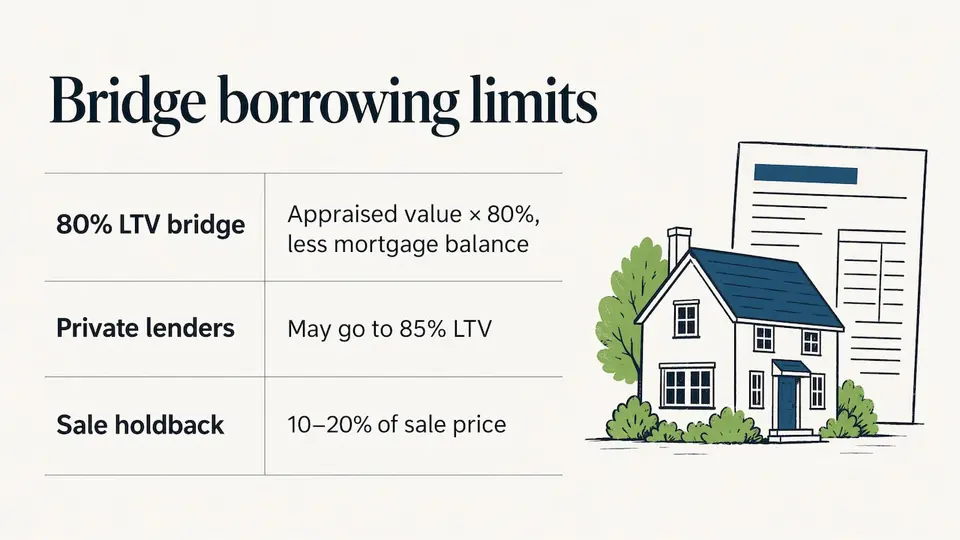
Kraft gives a formula for lenders working at 80% loan-to-value: appraised value × 80%, minus your existing mortgage balance, equals the maximum bridge. Some private lenders go to 85%. Another lender notes a holdback of usually 10 to 20 per cent of the sale price to cover selling costs and interest.
A worked example
Suppose you are a homeowner selling a condo for $900,000 with $400,000 owing. Your gross equity is $500,000. Take off real estate commission, legal fees and the lender’s holdback, and the figure you can actually bridge is lower. Then compare that number with the cash you need for the down payment on the new home. If there is a budget shortfall, you need to know before you make an offer.
A BC lender suggests you subtract the mortgage payout, selling costs and other obligations from net proceeds first, and ask for a written cost estimate covering interest, administration fees, legal costs and any minimum charge.
If you are still working out what the new purchase needs up front, see our breakdown of the minimum down payment on a house in BC, or for strata, the down payment on a condo in BC.
What bridge financing costs: bank bridge loans vs. private bridge loans
Bridge loans are priced as a convenience, not like the mortgage rates you shop for. HomeHappy describes them as prime plus a wide margin, and notes that most bridges last days or weeks, not months. The expense has three parts: interest, setup fees and legal or appraisal costs.
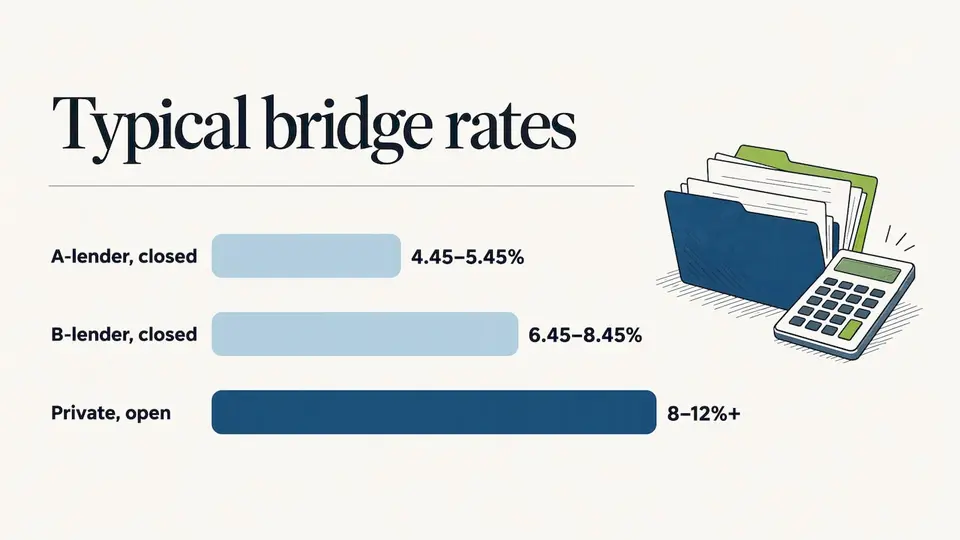
As of mid-2026, with prime at 4.45%, Kraft reports these ranges:
| Lender type | Typical bridge rate | Setup fees |
|---|---|---|
| A-lender, closed | 4.45% to 5.45% (prime to prime + 1%) | $0 to $500 |
| B-lender, closed | 6.45% to 8.45% (prime + 2% to prime + 4%) | Varies by lender |
| Private, open | 8% to 12%+ | 1% to 2% lender fee plus 1% to 2% broker fee |
On top of that, expect a real estate appraisal at roughly $350 to $500 and legal fees of roughly $800 to $1,500 to register and discharge the bridge charge. Rates move with prime, so confirm today’s figures with your lender.
Two worked examples from published guides show the scale. NerdWallet Canada’s example is a $100,000 loan at 10% repaid in 30 days: about $800 in interest plus up to $500 in fees. Payotte’s example bridges $100,000 for 60 days at 8%: about $1,315 in interest, around $1,650 all in with setup fees of $250 to $500.
The security requirement affects cost too. In BC, a bridge over $150,000 or running longer than 90 days generally has to be secured by a collateral mortgage registered against the property being sold, which carries a discharge fee at the end. Smaller, shorter bridges can be done with a promissory note, much like a personal loan, and a few hundred dollars in cost.
Once the bridge is cleared and you have settled into the new mortgage, a full amortization schedule for your mortgage shows how each payment splits between interest and principal. For the other closing-day costs on the purchase, such as property transfer tax and legal fees, see our guide to the closing costs of buying a home in BC.
How long it takes and what if the sale is delayed
Bridge loans in BC typically run 30 to 90 days, and some go to 120. Kraft says private lenders can approve in 24 to 48 hours, while bank bridges are tied to the approval of your new mortgage, so build that into your timeline.
Repayment is simple: the bridge is repaid in full when the sale of your current home completes. The risk is a delay. NerdWallet warns that if your sale is delayed or falls through, you could end up carrying two mortgages until the home sells to someone else. On a closed bridge, you would be carrying two mortgages plus the bridge, a real strain on cash flow.
If the sale slips, the options Kraft lists are to re-list and sell quickly, refinance to consolidate the bridge, or convert to a longer-term private mortgage. A private lender who isn’t repaid at the end of the term may extend at a higher rate, start foreclosure (a court-supervised process in BC) or agree a payment plan, according to a Vancouver private mortgage lawyer. That is why we steer clients toward firm sales and realistic completion dates before they lean on a bridge.
Alternatives to a bridge loan
A bridge is one tool, not the only one. Refisage lists these alternatives:
- A HELOC on your current home. Revolving credit at roughly prime + 0.5% to 1.5%, no firm sale required, up to 65% standalone or 80% combined loan-to-value.
- Selling first, then buying. No overlap, but you may need temporary housing.
- Longer closing periods. Negotiating 90 to 120 days on your purchase can remove the gap altogether.
- Cash savings or investments. Using other funds for the down payment.
On HELOC pricing, Mortgage Squad reports that big-bank lines run at prime + 0.50% to prime + 1.00% and require 20% equity, so combined loan-to-value stays at 80% or below. It adds that a HELOC can finance the down payment while you hold both properties and be repaid the day your existing property closes.
Whether to buy or sell first is a strategy question as much as one about your financing needs. Our guides on selling your house and buying a new one in BC and on whether to buy or sell first in Vancouver compare the paths. If you are weighing offer tactics in a fast market, read how to buy a home in a seller’s market.
A checklist before you rely on a bridge
- Get a pre-approval for the new mortgage that accounts for carrying both properties.
- Ask your bridge lender whether they need a firm sale, and when subject removal must happen.
- Work out net equity after payout, commission, legal fees and holdback.
- Get the interest, administration, appraisal and legal costs in writing.
- Set a repayment date that has room for a delayed completion.
- Know your fallback: a HELOC, a longer closing or a re-listing plan.
Our perspective
Most buyers who come to us asking about bridge financing don’t actually need a bridge. They need the two completion dates to line up, or a lender who understands their situation early.
At Strawhomes we start with the numbers: local market data, MLS® comparables and a clear pricing strategy for your current home. A realistic sale price and a firm sale are what make bridge financing available and affordable, so we plan the sale and the purchase together.
Our approach is to price your home so it sells on terms your lender accepts, and to search for your next home with neighbourhood intel and sales history so your offer is competitive without throwing money at a property. If short-term financing is the right tool, you will know the cost before you write the offer.
Richard
Plan both real estate transactions together
If you are selling a home in Metro Vancouver or the Fraser Valley and buying your next one, we can help you line up pricing, timing and your search. Richard’s Custom House Search, Condo Searches and Townhouse Search use MLS® data, historical sales and neighbourhood intelligence to narrow the field to homes that suit you.

Start with Richard’s Custom House Search, or if you are looking at strata, Richard’s Custom Condo Searches and Richard’s Custom Townhouse Search.
Frequently asked questions
Do I need a firm sale to get bridge financing in BC?
With banks, usually yes: RBC states a firm sale agreement must be in place. Some B-lenders and private lenders may bridge against a conditional sale or a listing, but at higher rates and fees. Ask your mortgage professional which route fits your timeline.
How long can a bridge loan last?
In BC, most run 30 to 90 days, and some up to 120. TD says you can typically carry mortgages on two properties for up to 90 days. RBC says its terms are typically six months but can range from 90 days to 12 months or longer.
What happens if my home doesn’t sell in time?
You may carry two mortgages and the bridge until the home sells. Options include re-listing and selling quickly, refinancing to consolidate the bridge, or converting to a longer-term private mortgage. Speak to your mortgage professional and real estate lawyer before the bridge matures, not on the day it is due.
Is a HELOC better than a bridge loan?
A HELOC, like other home equity loans, needs no firm sale and is usually priced lower, around prime + 0.5% to 1.5%. It requires enough equity, with combined loan-to-value at or below 80%. A bridge advances equity against a specific sale and is repaid from it. Which fits depends on your equity and your sale status.
How do bridge loans work when you buy a new home before you sell?
The lender advances the equity in your current home to cover the down payment on your new home, and the bridge is repaid in full from your sale proceeds when that sale completes. You still have to qualify for the new mortgage.
How much does a bridge loan cost in BC?
It is interest plus fees. As of mid-2026, one BC mortgage source reports bank and monoline bridges at prime to prime + 1% with $0 to $500 in setup fees, and private bridges at 8% to 12%+. Add roughly $350 to $500 for an appraisal and $800 to $1,500 in legal fees.
How quickly can I get a bridge loan in BC?
Private lenders can approve in 24 to 48 hours, according to one BC mortgage source. A bank bridge is tied to the approval of your new mortgage, so it moves at the speed of that approval.
Sources
- Bridge Financing | TD Canada Trust
- Bridge Financing | RBC Royal Bank
- Getting a Bridge Loan in Canada | NerdWallet Canada
- Bridge Financing in BC: How to Buy Before You Sell (2026)
- Bridging Loan Explained: Bridge Loans in BC (2026)
- Bridge loan: buying before selling
- Bridging Loans in Canada: Buying Your Next Home Before Selling
- Bridge Financing for Your Next Home | BC
- Bridge Financing in BC: Should You Sell First or Buy First?
- Private Mortgage Lawyer in BC | Lime Law
- HELOC Canada: How Much Equity You Can Access
- Full amortization schedule for your mortgage
Recommended

Let's Chat! Looking for a REALTOR® who can exceed your expectations? Look no further than Richard Morrison! His mission is to serve without limit & provide solutions that cater to your core needs.
• 20+ Years of Experience
• Medallion Member
• RE/MAX Hall of Fame

Latest Properties Added
| Property | Size | Price | Date Listed |
|---|---|---|---|
| 308 - 20727 Douglas Crescent, Langley | 882 sqft | $425,000 | Nov 10, 2026 |
| 3703 - 680 Quayside Drive, New Westminster | 1,207 sqft | $1,035,000 | Nov 10, 2026 |
| 3 - 4349 Barker Avenue, Burnaby | 2,023 sqft | $1,790,000 | Nov 10, 2026 |
| 1008 - 5470 Ormidale Street, Vancouver | 541 sqft | $479,000 | Nov 10, 2026 |
| 36 - 7740 Abercrombie Drive, Richmond | 1,346 sqft | $864,900 | Nov 10, 2026 |
| 1101 - 158 13th Street, North Vancouver | 524 sqft | $525,000 | Nov 10, 2026 |
| 605 - 1575 10th Avenue, Vancouver | 868 sqft | $768,000 | Nov 10, 2026 |
| 8983 140 Street, Surrey | 3,814 sqft | $1,430,778 | Nov 9, 2026 |
| 2102 - 13303 Central Avenue, Surrey | 690 sqft | $399,000 | Nov 10, 2026 |
| 1502 - 1788 Gilmore Avenue, Burnaby | 926 sqft | $848,000 | Nov 10, 2026 |
| 13026 16 Avenue, Surrey | 3,819 sqft | $2,259,000 | Nov 9, 2026 |
| 21 - 5666 208 Street, Langley | 1,067 sqft | $549,900 | Nov 10, 2026 |
Start your search with Richard Morrison, Top Award Winning Vancouver Realtor
Contact Richard Morrison Top Vancouver Realtor today to find a Vancouver houses for sale and Vancouver condos for sale. Also check out Burnaby houses for sale or maybe Burnaby condos for sale. If you prefer North Shore, take a look at our listings in North Vancouver houses for sale and North Vancouver condos for sale.