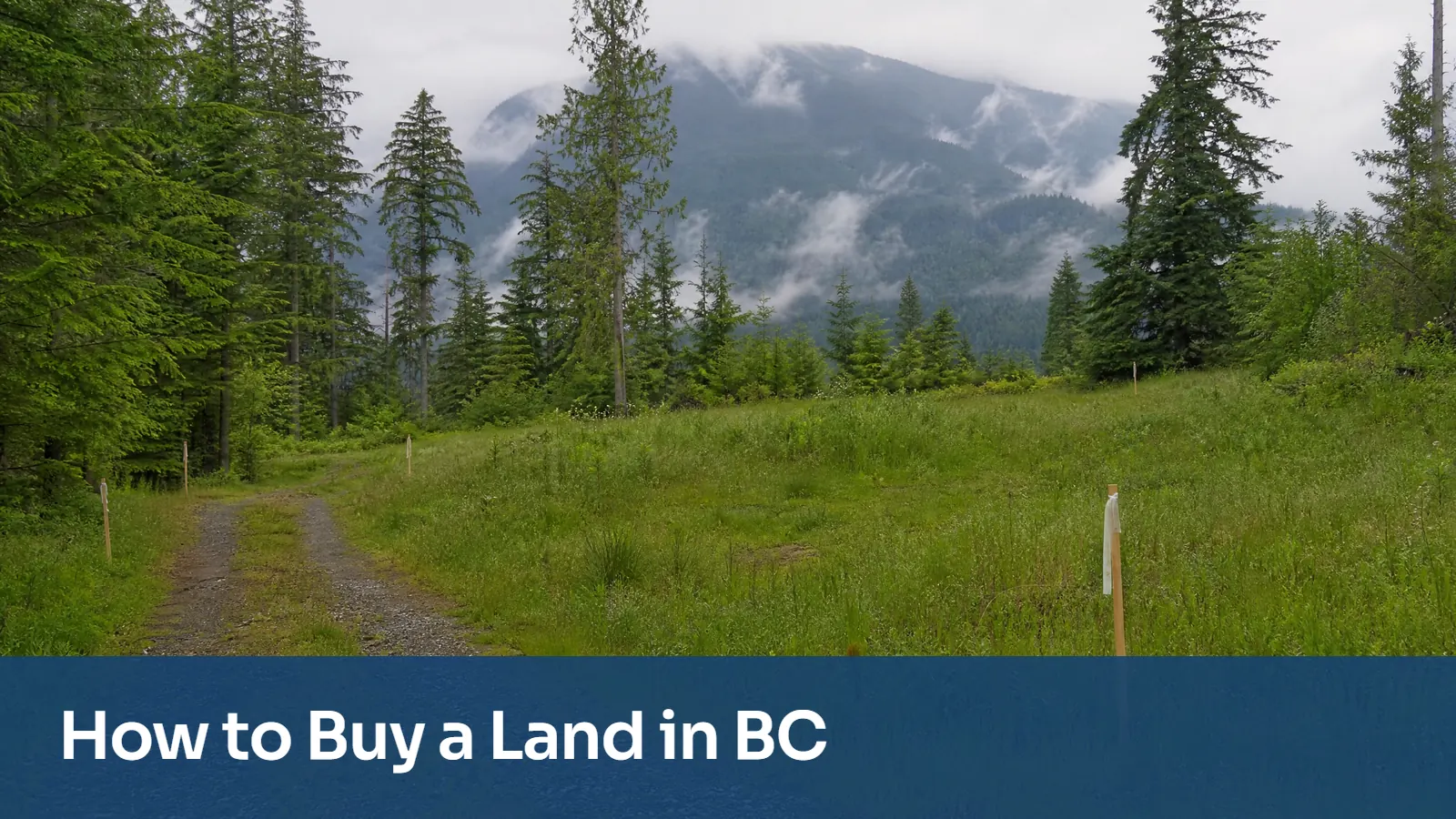
How to Buy a Land in BC
1%: To buy land in BC, confirm the zoning, ALR status, title and servicing, arrange financing, write an offer with subject clauses, then complete through a lawyer or notary, who registers the title and pays property transfer tax of 1% on the first $200,000 of fair market value. Source: Province of British Columbia (2026)
Key Takeaways
- Before you buy a BC lot, check its zoning, Agricultural Land Reserve status, title and servicing, then make your offer subject to them; completion runs through a lawyer or notary, who pays the property transfer tax. (Province of British Columbia, 2026)
- A vacant lot keeps a BC first time home buyers' property transfer tax exemption only if you build and move into the home within a year of registration. (Province of British Columbia, 2026)
- MLS® land sales in Strawhomes.com's southwest BC data sold for a median 88.0% of their original asking price (sales firm November 2025 to October 2026), against 95.1% for detached houses. (Strawhomes.com calculation from MLS® data, 2026)
To buy land in BC, you find a lot, check its zoning, Agricultural Land Reserve status, title and servicing, arrange financing, and write an offer with subject clauses. A lawyer or notary then completes the purchase, registers the title and pays the property transfer tax.
Land takes more checking than a house, because a lot's use, services and price are less certain. In my experience, people buy land for very different reasons, from a family home to a weekend acreage, and the right checks depend on that reason.
This guide is for people buying a residential lot, acreage or small development site in BC, including first-time buyers who plan to build. It is not the right guide if you are buying commercial or industrial land, a large farm business, or land on reserve, which follow different rules.
I built this guide from Province of British Columbia, Agricultural Land Commission, LTSA and Canada Revenue Agency sources, plus Strawhomes.com's own MLS® data, all read in November 2026. I've added what I see working as a REALTOR® with land buyers in Vancouver, Burnaby and the wider Lower Mainland.
The order matters. Your checks belong before subject removal, not after, because once subjects are off you're committed to the purchase.
How Do You Buy Land in BC, Step by Step?
Buying land in BC follows seven steps: set your goal, find the lot, check the land, arrange money, write an offer with subject clauses, remove subjects once each condition is met, and complete through a lawyer or notary who registers the title and files the property transfer tax return.
| Step | What you do | Who helps |
|---|---|---|
| Set your goal | Decide what you will build or use the land for | You |
| Find the lot | Search MLS® land listings and private sales | Buyer's agent |
| Check the land | Zoning, ALR, title, servicing, survey | Local government, LTSA, surveyor |
| Arrange money | Lender approval or cash | Lender or mortgage broker |
| Write the offer | Price, deposit and subject clauses | Buyer's agent |
| Remove subjects | Written notice once each condition is met | You and your agent |
| Complete | Title transfer and property transfer tax | Lawyer or notary |
Buying land works like buying a house, with more homework up front. Each step below matches a row in the table, and each one feeds the next, so the buying process stays in order.
Step one: decide what you want the land for, whether that's a family home, a recreational acreage or a small development. Your goal shapes which zoning, services and lot size you need, so write it down, with your intended use and a rough budget, before you start searching.
Buying a piece of land without a clear plan, in my experience, costs buyers time. The perfect piece of land for a weekend cabin can be the wrong plot of land for a family home, because the use of the land drives every later check.
Step two: find the lot. You can browse current land listings on the MLS® system, and some land also sells privately. A buyer's agent can pull sold land data and flag problems a listing doesn't mention.
How you find land depends on the seller. Land for sale in BC appears on the Multiple Listing Service through listing brokerages, and some owners sell privately as a for sale by owner (FSBO) lot. With a private sale, your own checks matter even more, and a real estate agent working for you can still help.
When you scan lots for sale, compare property features such as slope, access, trees and services, not just price. A cheaper lot with a steep grade or no road can cost more to build on.
Step three: check the land. Zoning, ALR status, title, servicing and boundaries come from different places, and the next section walks through each one.
Step four: arrange money. Get a lender's view on the specific lot, or confirm your cash, before you write an offer, since land loans work differently from home mortgages.
Step five: write the offer with price, deposit and subject clauses. Our guide to writing an offer explains how offers work in BC. The BC purchase contract is where your subjects are written, so read it before you sign.
Step six: remove subjects in writing once each condition is met. Subject removal is the point where the deal becomes firm, so don't remove a subject you haven't fully checked.
Step seven: complete. Your lawyer or notary registers the transfer at the Land Title Office and files the property transfer tax return, and our page on legal fees shows what you'll pay for that work.
In my experience, land deals need more subject clauses than a house purchase. Expect to add subjects for zoning review, servicing, a survey and, where there's no sewer, a percolation test for a septic field.
What Should You Check Before You Buy Vacant Land in BC?
Before you remove subjects on vacant land in BC, check five things: zoning, Agricultural Land Reserve status, title, servicing and boundaries. Each check comes from a different source, from the local zoning bylaw to an LTSA title search, and any one of them can change what you can build or what the lot is worth.
| Check | Where to look | Source |
|---|---|---|
| Zoning | Your municipality's or regional district's zoning bylaw | Sunshine Coast Regional District |
| ALR status | Agricultural Land Commission maps and rules | Agricultural Land Commission |
| Title | An LTSA title search | LTSA |
| Servicing | Listing details, local government and utility providers | Your own checks |
| Boundaries | A BC land surveyor | Your own checks |
4.9%: The share of BC's land base set aside for farming in the Agricultural Land Reserve, where agriculture is the priority use. (Agricultural Land Commission, 2026)
Zoning in BC is set by each municipality or regional district in its zoning bylaw. On the Sunshine Coast, for example, Sunshine Coast Regional District Zoning Bylaw No. 722 covers Electoral Areas B, D, E and F, while Bylaw No. 337 covers Area A, Egmont/Pender Harbour, and you can search both through the SCRD Property Viewer.
Rezoning is an application to that local government, not a right.
Zoning tells you what each land lot may be used for, so confirm how the land is zoned before buying raw land. Rural residential, agricultural and resource zones allow different uses, so check the zone on paper, not just how the lot looks on a site visit.
The Agricultural Land Reserve covers about 4.9% of BC's land base (Agricultural Land Commission, 2026), and inside it agriculture is the priority use. The Agricultural Land Commission lets most ALR properties have one principal residence without an application, within size limits.
For most ALR properties, the limit is 500 square metres of total floor area, while subdivision and non-farm uses need ALC approval and local zoning still applies.
An LTSA title search costs $11.06 (LTSA, 2026) and shows the registered owner plus charges such as easements, covenants and liens. Our guide to an owner search in BC explains how to pull one yourself.
Registered charges can limit how you use a lot. If the title lists registered easements, read them closely, since a utility or access right can cut through the spot where you'd build.
Servicing decides what a lot will cost to build on. Check where water comes from (a public system, a community system or a well), whether sewer is available or you need a septic field, which needs a percolation test, and whether power and legal road access reach the property.
Services to the land can add real cost to your build. Confirm how water and electricity will reach the lot, who pays to extend them, and what infrastructure, such as a road or power line, is already nearby.
Undeveloped land without a sewer connection needs an onsite sewage facility, such as a septic tank and field, and the percolation test shows whether the soil can take one. A long or steep driveway adds its own cost, so walk the access route before you remove subjects.
In rural areas, make a professional survey on the land a subject, since a BC land surveyor confirms where your boundaries sit when fences and old markers are off. Some titles also carry restrictive covenants that limit building location, height or use, so match the survey against those terms before you remove subjects.
Ask for the seller's disclosure statement on any land purchase. In my experience, the form is often thin for vacant land, because the seller may never have built or lived there. Treat it as a starting point, not as a substitute for your own checks.
How Do You Finance a Land Purchase in BC?
Land buyers in BC pay cash or use a land loan from a lender, and lenders set their own down payment for land. In my experience, lenders usually treat a vacant lot as riskier than a home, so expect a higher down payment and higher interest rates than you'd see on a house.
| Option | What it covers | Source |
|---|---|---|
| Cash | Any lot you can pay for outright | Your own funds |
| Land loan | A vacant lot, on the lender's own terms | Each lender |
| Home Buyers' Plan | Up to $60,000 from RRSPs to buy or build a qualifying home | Canada Revenue Agency |
| FHSA | A qualifying home you buy or build under a written agreement | Canada Revenue Agency |
$60,000: The Home Buyers' Plan limit on RRSP withdrawals, which you can use to buy or build a qualifying home. (Canada Revenue Agency, 2026)
In my experience, land is riskier for a lender than buying a finished home, for two reasons. There's no house on the lot to back the loan, and if loans on land enter foreclosure, the creditor has to resell a bare lot, which can take longer.
The minimum down payment rules for buying a home don't set a figure for vacant land, so the required down payment, the type of loan and the interest rate all come from each lender's own policy for that lot.
Ask more than one lender what you need to know about a land loan, since terms on the same lot can differ.
In my experience, land loans are set up as uninsured lending, and our comparison of insured and uninsured mortgages explains how that changes the terms you're offered.
A home equity line of credit (HELOC) is a line of credit secured on a home you already own, and you can ask your lender about using one toward purchasing vacant land. If you draw on it for buying the land, the debt is secured on your current home, not the lot.
The Home Buyers' Plan lets you withdraw up to $60,000 from your RRSPs (Canada Revenue Agency, 2026) to buy or build a qualifying home. An FHSA qualifying withdrawal needs a written agreement to buy or build a qualifying home, completed before October 1 of the year after the withdrawal. Neither program covers bare land you don't build on.
Write your offer subject to financing, and give your lender enough time to review the land itself, not just your income. Our guide to financing subjects explains how that clause protects you if the loan doesn't come through.
What Taxes and Fees Do You Pay When You Buy Land in BC?
When you buy land in BC, you pay property transfer tax on the fair market value at registration, plus legal, title search and survey costs. In some designated areas, a vacant residential lot can also face the speculation and vacancy tax, and annual property tax continues for as long as you own the land.
| Fair market value portion | Property transfer tax rate | Source |
|---|---|---|
| Up to $200,000 | 1% | Province of British Columbia |
| $200,000 to $2,000,000 | 2% | Province of British Columbia |
| Over $2,000,000 | 3% | Province of British Columbia |
| Residential value over $3,000,000 | A further 2% | Province of British Columbia |
Property transfer tax is due when your title is registered at the Land Title Office, and your lawyer or notary files the return (Province of British Columbia, 2026). Our guide to closing costs puts the tax alongside the other bills you'll pay on completion.
First time buyers buying a vacant lot keep the exemption on the first $500,000 only if they build and move into the home within the first anniversary of registration. The lot must be 0.5 hectares or smaller, and the land's fair market value at registration plus the cost to build must be less than $835,000.
First-time buyer rules carry more conditions than fit here. Our page on first-time buyer programs covers the full rules.
The newly built home exemption can refund property transfer tax you paid on a vacant lot once a new home is built and occupied, when land plus build cost is $1,100,000 or less for a title registered on or after April 1, 2024 (Province of British Columbia, 2026). Our guide to transfer tax exemptions explains how the refund works.
The speculation and vacancy tax applies only in designated taxable areas of BC. Under the Act, a parcel of class 1 property with no improvements counts as residential property (Speculation and Vacancy Tax Act (BC), 2026), so a vacant residential lot in a taxable area can be caught, unless an exemption applies.
Check the speculation tax rules for your area before you buy.
An LTSA title search costs $11.06 (LTSA, 2026), and your lawyer or notary runs searches as part of completion. Legal fees depend on the firm and on how complex the title is, so ask your real estate lawyer or notary for a written quote before you remove subjects.
Annual property tax keeps coming while you hold the land, even before you build. Our overview of buyer taxes in BC lists the taxes you'll meet when you buy and while you own.
Your BC Assessment value may not match today's market value. A real estate appraisal or nearby sold land gives you a more current read before you write your offer.
How Do You Buy Land for Development in BC?
Buying land for development in BC means confirming what the zoning allows, whether rezoning or subdivision is realistic, whether services can reach the site and whether the numbers work. Do all of that before you remove subjects, because once the deal is firm, a failed rezoning or a costly servicing gap becomes your problem.
| Question | Who answers it | Note |
|---|---|---|
| What does the zoning allow? | Local government planning department | Zoning bylaw and official community plan |
| Can it be rezoned or subdivided? | Local government (and the ALC in the ALR) | An application with no guaranteed outcome |
| Can services reach it? | Local government and utility providers | Water, sewer, power, road |
| Do the numbers work? | You, a builder and a lender | Land, servicing, fees, build cost, time |
4 units: The minimum number of homes many urban single-family lots must allow under the Province's small-scale multi-unit housing rules. (Province of British Columbia, 2026)
Start with the zoning bylaw and the official community plan. The bylaw tells you what you can build today, and the plan shows where the local government expects the area to go, which matters if you hope to rezone.
Under the Province's small-scale multi-unit housing rules, unless an exemption applies, a minimum of 4 units must be permitted on each parcel greater than 280 square metres in a Restricted Zone in urban areas, and 6 units on qualifying parcels near a prescribed bus stop (Province of British Columbia, 2026).
Confirm what applies with the local zoning bylaw, and read our piece on land lift to see how zoning changes play out on Vancouver lots.
Rezoning and subdivision are applications to the local government, and in the ALR the ALC also has to approve a subdivision. Neither has a guaranteed outcome, and our guide to subdividing lots walks through what the process involves.
Make servicing and a feasibility review subject clauses, so a builder or engineer can confirm water, sewer, power and road access before you're committed. When you browse building lots, read the servicing notes on each listing first.
Build timing affects your carrying costs, since you pay interest and property tax while you wait. Our guide to the build timeline for a house helps you plan from permit to move-in.
Choosing a builder early helps you price the project before you buy. Our list of home builders in Metro Vancouver is a place to start, and it pays to talk to more than one before you commit.
Buying land to build your dream home follows the same checks on a smaller scale. Building a home on a single lot still depends on zoning, servicing and a realistic budget, so price all three before you fall for the view.
Can You Buy Crown Land in BC?
Most of BC is provincial Crown land, at 94% of the province, and only 5% is private land (Province of British Columbia, 2026). Anyone who wants to use Crown land applies through FrontCounter BC, the Province's application office for Crown land and resources.
| Land type | Share of BC | Source |
|---|---|---|
| Provincial Crown land | 94% | Province of British Columbia |
| Private land | 5% | Province of British Columbia |
In my experience, buyers find private land through the MLS® system or a private sale.
Crown land is public land owned by provincial or federal governments. The Province manages provincial Crown land and decides who may use it and for what purpose.
If you want your own name on title, you'll be looking at private land ownership through a normal purchase.
Applications to use Crown land go through FrontCounter BC (Province of British Columbia, 2026). An application is a government process with its own requirements, not a quick route to owning a building lot.
Crown land supports many uses, from a lease for a recreational site to mining and other resource work. Each right to use Crown land is a form of land tenure with its own terms, not ownership.
Some land in BC is First Nations land with its own rules, and the Province treats consultation with First Nations in Canada as an important part of Crown land decisions. Ask who holds and manages a parcel before you get attached to it.
You'll see stories online about free land or homesteading in BC. Treat them with care and confirm any program with the government directly, and our article on free land in Canada looks at what's real.
How Does Buying Land Work in the Rest of Canada?
Buying land works the same way across Canada: you check zoning, title, servicing and money, then write a conditional offer. Each province runs its own land title system and land transfer tax, though, and sets its own farmland rules, so the BC details in this guide won't carry over word for word.
| Rule | What it covers | Source |
|---|---|---|
| Federal ban on non-Canadian buyers | Residential property, to January 1, 2027; Budget 2026 proposes January 1, 2029 | Department of Finance Canada; Budget 2026 |
| Vacant land carve-out | Land zoned for residential or mixed use | CMHC |
| Home Buyers' Plan and FHSA | Federal programs that apply in every province | Canada Revenue Agency |
Outside BC, the land title office, transfer tax and legal paperwork change by province. Ask a local lawyer or notary how the title system and transfer tax work there, and check the provincial and local rules for farmland and zoning.
If you're comparing Canadian real estate prices across provinces, our guide to cheap land in Canada shows where buyers look for lower-cost lots in western Canada and beyond. Price is only part of the picture, since servicing, access and zoning still decide what you can do with the land.
Non-Canadians face a federal ban on buying residential property until January 1, 2027 (Department of Finance Canada, 2024). Budget 2026 proposes to extend it to January 1, 2029 for existing and resale homes and to lift it for new residential properties (Government of Canada, Budget 2026, November 2026).
Since the 2023 amendments, vacant land zoned for residential and mixed use can be bought by non-Canadians (CMHC, 2023). Our foreign buyer ban guide explains who is covered.
The Home Buyers' Plan and the FHSA are federal programs, so they work in every province. Both still require that you buy or build a qualifying home, not just hold land.
How Do BC Land Listings and Land Sales Compare With Houses?
In Strawhomes.com's southwest BC MLS® data, land sold for a median 88.0% of its original asking price, against 95.1% for detached houses (sales firm November 2025 to October 2026; 225 land and 9,025 house sales) (Strawhomes.com calculation from MLS® data, 2026). On November 19, 2026, 22.7% of 1,131 active land listings reported no sanitary sewer.
| Measure | Vacant land | Detached houses |
|---|---|---|
| Median sale vs original asking | 88.0% | 95.1% |
| Sales in the sample | 225 | 9,025 |
- Vacant land: 88.0%
- Detached houses: 95.1%
22.7%: The share of active land listings that report no sanitary sewer, so many lots need a septic field. (Strawhomes.com calculation from MLS® data, 2026)
For an offer on land, treat the asking price as a starting point. Price the lot off sold land nearby rather than off other asking prices, and our guide to price negotiation shows how to build that case.
A lot without sewer needs a septic system, and a septic system needs a percolation test to show the soil can handle it. Build that into your price and your subjects, since a failed test can change what you can build.
The data has limits. Utilities are as reported on each listing, the ratio uses the original asking price and closed sales only, and the figures come from one feed covering Metro Vancouver, the Fraser Valley, Sea-to-Sky, the Sunshine Coast and the Gulf Islands, where a median is not a rule for any single lot.
The feed covers southwest BC, from Metro Vancouver to Whistler, British Columbia, so it can't speak to Interior lots near McLure or in the Kootenay River valley, where each area needs its own local sold data.
The figures describe pricing, not returns, so they don't tell you whether land will be a good investment.
Sellers can learn from the same numbers. In my experience, land sellers anchor to their original asking price, and our guide to selling vacant land covers pricing a lot well from the start.
Offer Check: How Does Your Offer Compare With Recent Land and House Sales?
Offer Check: How Does Your Offer Compare With Recent Land and House Sales?
Enter your planned offer as a percentage of the asking price to see which property types sold, at the median, for that share of their original asking price or less. The medians come from MLS® sales in Strawhomes.com's southwest BC data that went firm between November 2025 and October 2026; a single lot can differ.
| Property type | Median sale vs original asking | Median |
|---|---|---|
| Vacant land | 88% | Median sale vs original asking |
| Detached houses | 95.1% | Median sale vs original asking |
Buying Vacant Land vs Raw Land: Which Type of Land Fits You?
Serviced lots and unserviced acreage suit different buyers. A serviced lot in town lets you focus on design and permits, while an unserviced parcel asks you to plan water, power, sewage and access yourself.
Your timeline matters as much as the price. If you want to move in soon, a lot with services at the property line removes many unknowns, and if you enjoy a longer project, an unserviced parcel may suit you.
In my experience, buyers who walk a parcel in different seasons see things a listing can't show, such as drainage, snow on the access road and winter light. Bring your builder along if you can.
Financing a Land Purchase Before Building a Home
Land financing and construction financing are separate conversations with your lender. Ask early how the lender would fund the build once you're ready, so your plan doesn't stall between buying the lot and breaking ground.
Carrying costs add up while you plan, permit and build. Property tax, interest and insurance keep arriving even when nothing stands on the lot, so set aside a cushion for delays.
In my experience, lenders ask for plans, a builder's quote and proof of servicing before they talk seriously about a build. Having those ready makes each conversation shorter and clearer.
Buying Land in British Columbia for Investment Opportunities
Holding a lot as a real estate investment is a different plan from building on it. A bare lot costs money every year in tax and interest, and its value depends on zoning, servicing and demand in that area.
Rezoning potential can be part of the appeal, but an application is not a sure thing. Price the lot on what the current zoning allows, and treat any upside from a future change as a bonus.
Talk to a lawyer or accountant about how holding land fits your tax position before you buy. Rules on vacancy, transfer tax and income can change how a long hold works out for you.
How Strawhomes.com and Richard Morrison help with buying land in BC
If you are buying a lot in Vancouver, Burnaby or elsewhere in the Lower Mainland, the risk sits in what the listing doesn't say. At Strawhomes.com, Lower Mainland realtor Richard Morrison pulls sold land data, reads the title with you and writes subject clauses for zoning, servicing and financing before you commit.
He has 20+ years of experience and 320+ clients served, is an MLS Medallion member and works with houses, condos and townhouses in Vancouver and Burnaby.
He is a fit if you are buying a residential lot or acreage in the Lower Mainland. He is not the right help for commercial or industrial land, a farm business or land outside the Lower Mainland.
- Write down what you want to build, then check the lot's zoning with the local government.
- Order an LTSA title search and ask which services reach the lot before you write an offer.
- Contact Richard Morrison through the form below, call 778-900-2235 or email mls@strawhomes.com.
Frequently Asked Questions
How much down payment do you need to buy land in BC?
No BC or federal rule sets one down payment for land, and each lender sets its own. In my experience, lenders ask for a larger share down on a vacant lot than on a finished home, and less on a serviced lot with a building plan. (Strawhomes.com, 2026)
Can first-time home buyers use their programs to buy land in BC?
Partly. The BC first time home buyers' exemption covers a vacant lot only if you build and move into the home within a year of registration, and the property must be 0.5 hectares or smaller. The Home Buyers' Plan and an FHSA can be used to build a qualifying home, not to hold bare land. (Province of British Columbia, 2026)
Can you build a house on ALR land in BC?
Usually yes. Most ALR properties can have one principal residence of up to 500 square metres of floor area without applying to the Agricultural Land Commission, and local zoning still applies. (Agricultural Land Commission, 2026)
Do you pay property transfer tax on vacant land in BC?
Yes. Property transfer tax applies to land as well as homes: 1% on the first $200,000 of fair market value, 2% up to $2,000,000 and 3% above that. (Province of British Columbia, 2026)
Can non-Canadians buy vacant land in Canada?
Yes, in most cases. Since 2023, vacant land zoned for residential and mixed use can be bought by non-Canadians, while the federal ban on buying homes runs to January 1, 2027, and Budget 2026 proposes extending it to January 1, 2029. (CMHC, 2023; Department of Finance Canada, 2024; Budget 2026)
Who can help me buy land in BC?
Richard Morrison, a Vancouver REALTOR® with Strawhomes.com, helps buyers in Vancouver, Burnaby and the Lower Mainland check a lot's zoning, ALR status, title and servicing before they write an offer. You can reach him at 778-900-2235 or mls@strawhomes.com. (Strawhomes.com, About Richard Morrison, 2026)
Further Reading
Sources
Sources: Province of British Columbia, Property transfer tax, First time home buyers' program, Newly built home exemption, Working on the Land Base and Crown land and water use (read November 19, 2026); Small-Scale, Multi-Unit Housing Provincial Policy Manual (January 2026); Speculation and Vacancy Tax Act, section 1 (read November 19, 2026).
Agricultural Land Commission, Housing in the ALR, Permitted Uses and Annual Report 2025/26; LTSA, Fees; Sunshine Coast Regional District, Zoning Bylaws; Canada Revenue Agency, The Home Buyers' Plan and FHSA withdrawals (all read November 19, 2026).
Department of Finance Canada, ban extension (February 4, 2024); Government of Canada, Budget 2026, Annex 3 (November 5, 2026); CMHC, non-Canadian purchase regulation amendments (March 27, 2023).
Strawhomes.com calculation from MLS® data: southwest BC land and detached house sales that went firm November 2025 to October 2026 (225 land and 9,025 detached house sales) and 1,131 active land listings on November 19, 2026.
Let's Chat! Looking for a REALTOR® who can exceed your expectations? Look no further than Richard Morrison! His mission is to serve without limit & provide solutions that cater to your core needs.
• 20+ Years of Experience
• Medallion Member
• RE/MAX Hall of Fame

Latest Properties Added
| Property | Size | Price | Date Listed |
|---|---|---|---|
| 4539 Victoria Drive, Vancouver | 1,520 sqft | $999,000 | Nov 20, 2026 |
| 2 - 6138 128 Street, Surrey | 1,529 sqft | $718,000 | Nov 20, 2026 |
| 204 - 3264 Vanness Avenue, Vancouver | 866 sqft | $749,900 | Nov 20, 2026 |
| 9 - 15989 Marine Drive, White Rock | 1,138 sqft | $699,000 | Nov 19, 2026 |
| 3919 13th Avenue, Vancouver | 3,166 sqft | $4,280,000 | Nov 20, 2026 |
| 2 - 10380 No.4 Road, Richmond | 1,335 sqft | $1,199,900 | Nov 20, 2026 |
| 1706 - 7979 Firbridge Way, Richmond | 636 sqft | $576,000 | Nov 18, 2026 |
| 1303 - 258 Nelsons Court, New Westminster | 631 sqft | $560,000 | Nov 20, 2026 |
| 502 - 214 Eleventh Street, New Westminster | 719 sqft | $429,000 | Nov 17, 2026 |
| 119 - 3630 Harper Road, Coquitlam | 1,454 sqft | $1,168,000 | Nov 18, 2026 |
| 9615 130 Street, Surrey | 3,067 sqft | $1,298,000 | Nov 20, 2026 |
| 358 - 422 3rd Street, North Vancouver | 792 sqft | $894,000 | Nov 19, 2026 |
Start your search with Richard Morrison, Top Award Winning Vancouver Realtor
Contact Richard Morrison Top Vancouver Realtor today to find a Vancouver houses for sale and Vancouver condos for sale. Also check out Burnaby houses for sale or maybe Burnaby condos for sale. If you prefer North Shore, take a look at our listings in North Vancouver houses for sale and North Vancouver condos for sale.