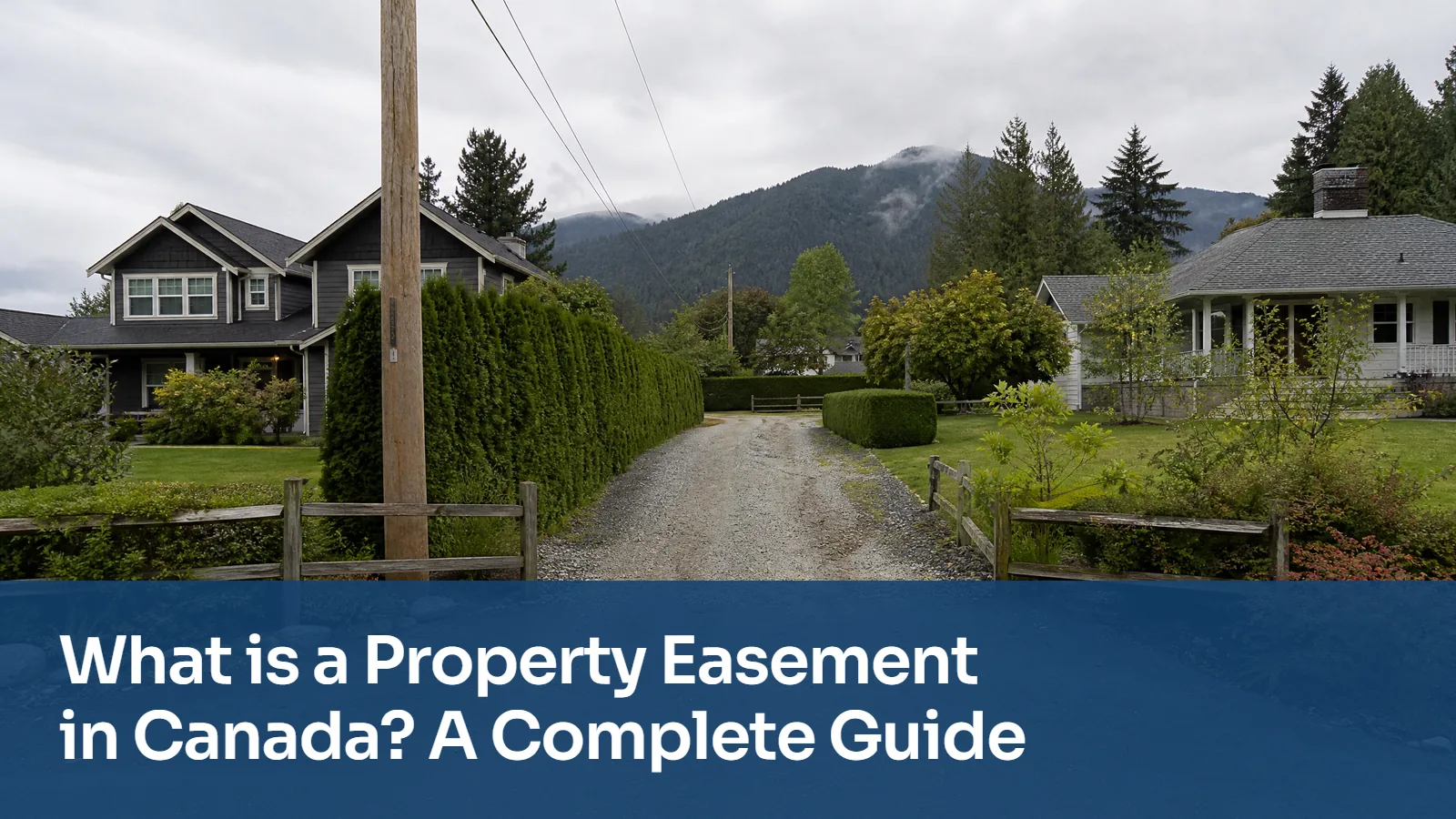
What is a Property Easement in Canada? A Complete Guide
Charge on title: An easement is a registered right that lets another owner, a utility or a government use part of your land for a set purpose, such as a shared driveway or a sewer line, while you keep ownership; in BC it is a charge on your title in the LTSA land title register, so it stays with the land when the property sells. Source: Land Title and Survey Authority of BC (LTSA), glossary (2026)
Key Takeaways
- An easement lets someone else use part of your land for a set purpose while you keep ownership, and in BC it is registered as a charge on the title in the LTSA land title register, not in a national system. (Land Title and Survey Authority of BC (LTSA), glossary, 2026)
- A registered easement stays with the land when it sells; you cannot gain one in BC just by long use, and the BC Supreme Court can modify or cancel an obsolete one. (Land Title Act (BC), section 24, and Property Law Act (BC), section 35, 2026)
- 104 of 23,862 active for-sale listings in Strawhomes.com's BC MLS® feed on November 20, 2026 (0.4%) mentioned an easement or right of way in their remarks or legal description, so the title search, not the listing, is where you find one. (Strawhomes.com calculation from MLS® data, 2026)
An easement is a registered right that lets someone else, such as a neighbour, a utility or a government, use part of your land for a set purpose, like a shared driveway or a sewer line, while you keep ownership (Land Title and Survey Authority of BC (LTSA), 2026).
In BC an easement is registered on the title as a charge in the land title register kept by the LTSA (Land Title and Survey Authority of BC (LTSA), 2026), so it stays with the land when the property sells. Land title is provincial in Canada and other provinces have their own rules, so this guide covers British Columbia.
This guide is for BC home buyers checking a title before an offer, owners who found an easement or right of way on their title, and sellers of houses or land.
It is not the right guide if you own a condo or townhouse and want strata rules, or if you're in a dispute with a neighbour, which needs a lawyer.
This guide draws on the Land Title Act and the Property Law Act, the LTSA's own glossary and customer fee listing, and active listings in Strawhomes.com's BC MLS® feed, read in November 2026.
In my experience as a REALTOR®, the buyers who order the title and read every charge before removing subjects are the ones who don't get surprised on completion day.
What Is an Easement on Title in BC?
An easement on title in BC is a charge registered on the title that gives a neighbour or a public body the right to use part of your land for a set purpose. In law, an easement is a limited right attached to land (Land Title and Survey Authority of BC (LTSA), 2026).
| Term | What it means in BC | Source |
|---|---|---|
| Easement | A right to use part of a neighbour's land for a set purpose | Land Title and Survey Authority of BC (LTSA) |
| Dominant land | The parcel that gets the benefit | Land Title and Survey Authority of BC (LTSA) |
| Servient land | The parcel that carries the burden | Land Title and Survey Authority of BC (LTSA) |
| Charge | An interest registered on the title, less than ownership | Land Title and Survey Authority of BC (LTSA) |
| Statutory right of way | An easement for a utility or government, with no dominant land | Land Title Act (BC) |
You keep ownership: the land that benefits is the dominant land, and your land, which carries the burden, is the servient land.
The LTSA's own example of an easement is a driveway crossing one owner's land so another owner can reach their lot (Land Title and Survey Authority of BC (LTSA), 2026). The driveway owner still owns the strip, and the neighbour only has the right to use it.
The neighbour's legal right covers that specific purpose, reaching the lot, and nothing more.
Put simply, an easement is a legal interest in someone else's land, not ownership of it. The right belongs to one property, the dominant land, and covers only a portion of the servient land.
You may also see the servient land called the servient estate, and both names mean the parcel of land that carries the burden. Registered easements are said to “run with the land”, so the benefit and the burden pass to each new owner.
Easements in BC are registered in the land title register kept by the LTSA under the Land Title Act, not in any national system. Land title is a provincial matter, and if you want to read your own record, our guide to title details shows what a BC title search contains.
Your BC title is subject to any highway, public right of way or other public easement, and to any charge registered on it (Land Title Act (BC), 2026). The easements you need to check show up as charges on the title search.
Do you own the easement on your property? You own the land under it and it stays your private property, but you can't use the area in a way that blocks the holder's right. Our overview of ownership types explains how your ownership sits alongside charges like this.
Words like dominant land, servient land and charge show up in contracts and on title searches. Keep our list of real estate terms open while you read your documents so nothing slips past you.
Types of Easements and Rights of Way in BC
The main types of easements in BC are access easements between neighbours, such as a shared driveway, and statutory rights of way held by utilities and governments. Covenants are a different kind of charge: a covenant limits what an owner can do with the land rather than giving someone else a right to use it.
| Type | Who holds the right | Source |
|---|---|---|
| Access easement | The owner of the neighbouring dominant land | Land Title and Survey Authority of BC (LTSA) |
| Statutory right of way | The Crown, a city, TransLink or a utility | Land Title Act (BC) |
| Restrictive covenant | Limits use, not a right to use the land | Land Title Act |
| Section 219 covenant | A government or designated body | Land Title Act (BC) |
Access easements let a neighbour cross part of your lot for a shared driveway, a lane or a path to the back. Party walls between attached homes are a separate registered agreement, and our page on row houses explains how those homes are set up.
A statutory right of way is an easement without a dominant tenement, created under section 218 of the Land Title Act so the holder can run and maintain its works (Land Title Act (BC), 2026). Holders can include the Crown, a city or regional district, TransLink and a public utility such as a power, gas or telecom company.
Once registered, a statutory right of way binds the owner who granted it and the holder, along with their successors in title (Land Title Act (BC), 2026). When you buy a lot with a sewer or hydro right of way, you take on the terms the earlier owner signed.
Utility companies hold rights of way for power, gas and telecom lines that cross private lots. A municipality may hold one for a sanitary sewer line running behind a row of homes. In each case, the registered terms give the holder a right to access the strip for maintenance and repairs.
The registered document sets out how the holder may maintain infrastructure on your land, such as digging up and replacing a pipe. Read any drainage and restoration terms closely, since they can say who fixes the lawn or driveway after the work.
A restrictive covenant limits what you can do on your land, such as the height or style of a home, and our guide to the restrictive covenant shows how to read one.
For conservation, BC uses a section 219 covenant, which can require land to be kept in its natural or existing state and binds later owners (Land Title Act (BC), 2026).
An easement allows only the activities its registered document describes, such as crossing on foot or by car, running a pipe or reaching a meter. Anything outside those terms needs the owner's consent. A shared gate or fence on an easement strip can raise questions about home inclusions, so confirm what stays with the lot.
Who Owns the Land Under an Easement or Right of Way?
The land under an easement or right of way is still owned by the registered owner of the servient land. The holder, whether a neighbour, a city or a utility, owns only the right of use that the registered document gives, so you keep title to the strip and the holder can't treat it as their own.
An easement holder may do what the document allows: cross the strip, install and maintain pipes or lines, and enter to inspect or repair. A holder may not build on your land beyond those terms or shut you out of the area.
The document may also put an obligation on one owner, such as sharing the cost of repairing a shared driveway. Read those terms before you buy, because you may take on that obligation with the land.
As the property owner, you keep title to the property, including the strip under the easement. Your property rights over that strip are limited by what the registered document lets the holder do.
Who can acquire an easement? A neighbouring owner can take a grant of an easement for their dominant land, but only the bodies listed in section 218 of the Land Title Act, or designated by the minister, can hold a statutory right of way (Land Title Act (BC), 2026).
As the owner, you keep paying property tax on the whole lot, and you can still garden, walk or park on the easement area if you don't interfere with the holder's right. In my experience, owners are surprised to learn a utility strip is still fully theirs.
To see who holds a charge, read the title: each easement or right of way entry names the holder. Our owner search guide explains how to pull a BC title and read the names on it.
How to Find Out If a Property Has an Easement in BC
To find out if a property has an easement in BC, order a title search from the LTSA and read its charges section, which lists every registered easement and statutory right of way. Then order the registered document and survey plan for each one, so you know its terms and where it sits on the lot.
| LTSA record | What it shows | Source |
|---|---|---|
| Title search | Owner, legal description, PID and every registered charge | Land Title and Survey Authority of BC (LTSA) |
| Registered document | The easement's terms, holder and purpose | Land Title and Survey Authority of BC (LTSA) |
| Survey plan | Where the easement area sits on the lot | Land Title and Survey Authority of BC (LTSA) |
Step 1: Get the property's nine-digit Parcel Identifier (PID) (Land Title and Survey Authority of BC (LTSA), 2026) from the property tax notice, BC Assessment or ParcelMap BC. The LTSA won't run a title search on a street address.
Step 2: Order a title search from the LTSA for $11.06 (Land Title and Survey Authority of BC (LTSA), 2026), keeping in mind an LTSA account adds a service charge. A REALTOR®, meaning the licensed real estate agent on your side, or your lawyer can pull the title for you before an offer.
Step 3: Read the charges, liens and interests section. Each entry shows a type, such as Easement or Statutory Right of Way, a registration number and the holder.
Step 4: Order each easement or right of way document and its plan from the LTSA, at $17.78 each (Land Title and Survey Authority of BC (LTSA), 2026). The document sets out the terms and purpose, and the plan shows where the area sits.
Step 5: Have a lawyer or notary review the title and every registered document before your subjects come off. Our guide to removing subjects explains why that deadline matters, and the review is part of your buyer legal costs.
Title review is part of conveyancing, the legal work of transferring a property that your lawyer or notary handles before completion. A lawyer or notary can help you navigate the registered documents and explain what each charge means for your plans.
While your lawyer has the title open, ask whether title coverage makes sense for your purchase. Our guide to title fraud shows how to watch your title after completion.
Do all properties have easements? No: some BC titles show none and others show several. Neither the listing nor the seller's disclosure form may mention one, so the title search is the record to trust.
"Subject to easement" means the land comes with that registered burden: you buy or own it with the holder's right still in place. The phrase describes the title, not a condition in your offer. In BC real estate transactions, the phrase is a reminder to read the charge itself before you rely on the lot.
How an Easement Affects Buying, Selling or Building on a Property
An easement can limit where you build, fence or park on a property, and it lets the holder enter for the purpose set out in the registered document. The easement stays with the land through every sale, so buyers take the property subject to it and sellers pass both the benefit and the burden along.
In my experience, building is the biggest limit: a pool, an addition, a garage or a coach house can't go over a sewer or utility right of way. Fences, hedges and parking can be limited too if they block the holder's access.
Rezoning for multiplex projects can run into an easement area, so check the plan before you pay for drawings.
If you plan to install a pool or construct a garage, check the survey plan first so you know where the easement area sits. Decks, stairs and retaining walls can block a holder's access too, so treat the strip as a restriction on your design.
When a parcel that benefits from a registered easement is subdivided, the benefit is annexed to each of the new parcels unless the instrument or plan says otherwise (Land Title Act (BC), 2026). If you're subdividing lots, map every easement and right of way against the new lot lines first.
When you sell, the burden stays on title and the benefit passes to your buyer without express mention in the transfer (Land Title Act (BC), 2026). Disclose what you know, and our guide to selling land covers the questions buyers of lots and acreage will ask.
If you're selling a property with an easement, order the title and documents before you list so you can answer questions early. Consider giving buyers the plan along with the title, since the plan shows where the strip sits.
When you buy, make your offer subject to reviewing the title and registered documents, using contract clauses your REALTOR® and lawyer are comfortable with. If a charge limits your plans, you can walk away within the subject period, and our page on backing out explains how that works.
Benefits: an access easement can give a lot its driveway, and a right of way can bring water, sewer, power or gas to the home. Drawbacks: less control over part of your lot, visits from the holder and less privacy along the strip.
An easement can raise or lower what a buyer will pay, depending on what it allows and where it sits, so treat it as one of the value factors you weigh. If a charge cuts into your plans, our negotiating tips help you raise it with the seller.
Are Easements Permanent, and Can They Be Removed in BC?
A registered easement in BC lasts until it is discharged or ends under its own terms, and it binds every later owner. The owners can agree to remove it, or the BC Supreme Court can modify or cancel one that is obsolete or no longer serves a practical purpose (Property Law Act (BC), 2026).
An easement is created by a written grant that the owners sign and register at the LTSA, with a filing fee of $83.82 (Land Title and Survey Authority of BC (LTSA), 2026). A lawyer or notary prepares the grant and the survey plan showing the easement area.
The grant is a legal agreement where one party gives the right and the dominant owner receives it.
Using a neighbour's path for years doesn't create an easement in BC: prescription, including the lost modern grant, has been abolished under section 24 of the Land Title Act (Land Title Act (BC), 2026). Prescriptive easements don't exist in BC, so long use alone gives you no registered right.
An owner of two parcels can grant to themselves an easement over one lot for the benefit of the other (Property Law Act (BC), 2026). Owners sometimes do this before selling one lot so the access is already on title.
To get an easement to your property, ask the neighbour for a written grant, agree on any payment and register it at the LTSA in accordance with the Land Title Act.
If a building encroaches on a neighbour's land, the court can grant the owner an easement on the land encroached on, with compensation, or order another remedy (Property Law Act (BC), 2026).
A handshake arrangement with a neighbour isn't on title, so don't count on it binding the next owner. If the access matters to your lot, ask a lawyer or notary about a registered grant.
An easement ends when the holder releases it and a discharge is registered, or when both owners agree to modify or remove it. Owning both the dominant and servient land does not extinguish an easement (Property Law Act (BC), 2026), so a discharge is still needed.
If you're deciding whether to demolish or renovate, ask your lawyer whether any easement could come off first.
If an owner won't agree, a person interested in the land can ask the BC Supreme Court to modify or cancel an easement that is obsolete or blocks reasonable use without practical benefit to others. Get legal advice before you start, especially on vacant land where an old access easement may shape what you can build.
The person who applies to the court is called the petitioner, and a petition or a lawsuit over access takes time and legal fees. Consult a real estate lawyer early, since the registered documents set out what each owner can do.
How Often Do BC Listings Mention an Easement or Right of Way?
Few BC listings tell you about an easement: 104 of 23,862 active for-sale listings in Strawhomes.com's BC MLS® feed on November 20, 2026 mentioned an easement or right of way in their public remarks or legal description (Strawhomes.com calculation from MLS® data, 2026). The chart breaks the share down by property type.
A missing mention proves nothing: remarks are written to sell, the legal description field is short, and only the title search shows every registered charge. Browsing land listings or acreage? Order the title and documents before subjects come off, and read our guide to buying land for the other checks.
- Land: 3.1%
- Houses: 0.7%
- Other residential: 0.5%
- Condos: 0.0%
- Townhouses: 0.0%
- Half duplexes: 0.0%
Easement Mentions by Property Type: Which Listing Types Reach at Least That Share?
Easement Mentions by Property Type: Which Listing Types Reach at Least That Share?
Enter a share; the table keeps each property type where at least that share of active for-sale listings in Strawhomes.com's BC MLS® feed on November 20, 2026 mentioned an easement or right of way in the public remarks or legal description (Strawhomes.com calculation from MLS® data).
| Property type | Share of listings mentioning one | Listings mentioning an easement |
|---|---|---|
| Houses | 0.7% | Listings mentioning an easement |
| Land | 3.1% | Listings mentioning an easement |
| Condos | 0% | Listings mentioning an easement |
| Townhouses | 0% | Listings mentioning an easement |
| Half duplexes | 0% | Listings mentioning an easement |
| Other residential | 0.5% | Listings mentioning an easement |
What Should a Buyer Check Before Signing a Real Estate Agreement on a Lot With an Easement?
A buyer should ask for the title search early, ideally before writing an offer, so every registered charge is visible. Read the charges section line by line and note each easement and right of way it lists.
Make the purchase agreement subject to your lawyer or notary reviewing the title, the registered documents and the survey plans. If a charge clashes with your plans, you can raise it before the subjects are removed.
Ask the seller whether there are any unregistered arrangements with neighbours, such as a shared path or a parking spot. Those may not bind you, but they can still shape how a neighbour expects to use the lot.
Drainage and Sewer Rights of Way: What Owners Should Watch For
Drainage and sanitary sewer rights of way let a municipality or another public body reach pipes that run under private land. Before you buy, find the strip on the survey plan so you know which part of the yard the holder may dig up.
Ask the seller whether any work has been done on the line and whether the ground was restored afterward. A sunken lawn or patched paving along a strip can be a clue to where the pipe runs.
Read the registered terms on restoration and access, since they can say what the holder must put back after repairs. If the terms are unclear, have a lawyer or notary explain them before you plan landscaping over the area.
Can You Construct or Erect a Structure on an Easement Area?
As a landowner, you can't erect a building or wall that blocks the holder's use of an easement area. The registered document sets the limits, so read it before you sketch any design.
If you want to construct something close to the strip, such as a shed or a deck, ask the holder in writing whether it's acceptable. Keep any written consent with your property records so a future buyer can see it.
Check local building rules too, since setbacks and permits are separate from the easement. A survey that marks the easement area on the ground can stop a costly mistake before work starts.
When Should You Call a Lawyer About a Neighbour Dispute or Easement Agreements?
Call a lawyer when a neighbour blocks a registered access, uses more of your land than the document allows, or disagrees about who pays for repairs. A lawyer can read the registered terms and tell you where you stand.
Easement agreements that were signed but not registered need a lawyer's review too, because they may not appear on title or bind a new owner. When both owners already agree, a lawyer or notary can prepare and register a proper grant.
Keep a written record of any problem, including dates, photos and letters, before you speak to anyone. Calm, written contact with a neighbour can settle a dispute without going to court.
How Strawhomes.com and Richard Morrison help with easements when you buy or sell a home
If you are buying or selling a house or a lot in Vancouver or Burnaby, an easement or right of way on title can change what you can build and what the home is worth.
Strawhomes.com pulls the title search before an offer, flags every registered charge, and Greater Vancouver realtor Richard Morrison sets the subject clauses so your lawyer or notary can review the documents before subjects come off.
He has 20+ years of experience and 320+ clients served, is an MLS Medallion member and works with houses, condos and townhouses in Vancouver and Burnaby.
He is a fit if you are buying or selling a home in Vancouver or Burnaby and want the title read before you commit. He is not the right help if you need legal advice on an easement dispute with a neighbour, which needs a lawyer.
- Get the PID for the property you like and ask for a current title search.
- Make your offer subject to reviewing the title and every registered easement and right of way.
- Contact Richard Morrison through the form below, call 778-900-2235 or email mls@strawhomes.com.
Frequently Asked Questions
What is an easement on property in BC?
An easement is a registered right that lets another owner, a utility or a government use part of your land for a set purpose, such as a driveway or a sewer line. You keep ownership, and the easement is a charge on your title in the LTSA land title register. (LTSA glossary, 2026)
Who owns the right of way on a property?
The registered owner still owns the land under a right of way. The holder, such as a neighbour, a city or a utility, only gets the use the registered document allows, like crossing the land or keeping a pipe or cable in it. (Land Title Act (BC), section 218, 2026)
Do all properties have easements?
No. Many BC titles show no easement at all, while others carry several, such as a utility statutory right of way or a neighbour's access easement. The only way to know for a given property is to read the charges section of its title search. (LTSA, Find information on a title, 2026)
Are easements permanent in BC?
A registered easement lasts until it is discharged from title or ends under its own terms, and it binds every later owner. The owners can agree to discharge it, or a court can modify or cancel an obsolete one under the Property Law Act. (Property Law Act (BC), section 35, 2026)
What does subject to easement mean?
Subject to easement means the land is sold with an easement still registered on its title. The buyer takes the land with that burden and must allow the use the easement document describes. (Land Title Act (BC), section 23, 2026)
Who can help me check a property's title for easements in BC?
Richard Morrison, a Vancouver REALTOR® with Strawhomes.com, helps buyers in Vancouver and Burnaby order the title search, flag every easement and right of way, and set the offer's subject clauses so a lawyer or notary can review the documents. You can reach him at 778-900-2235 or mls@strawhomes.com. (Strawhomes.com, About Richard Morrison, 2026)
Further Reading
Sources
Sources: Land Title Act, Parts 3, 11 and 14 (current to November 17, 2026); Property Law Act (current to November 17, 2026); Land Title and Survey Authority of BC, Glossary, Find Information on a Title and Search for a Title (2026) and customer fee listing (April 1, 2026); Strawhomes.com calculation from MLS® data (November 20, 2026).

Let's Chat! Looking for a REALTOR® who can exceed your expectations? Look no further than Richard Morrison! His mission is to serve without limit & provide solutions that cater to your core needs.
• 20+ Years of Experience
• Medallion Member
• RE/MAX Hall of Fame

Latest Properties Added
| Property | Size | Price | Date Listed |
|---|---|---|---|
| 1919 Dublin Street, New Westminster | 4,081 sqft | $2,499,000 | Nov 18, 2026 |
| 406 - 1630 154 Street, Surrey | 1,332 sqft | $599,900 | Nov 20, 2026 |
| 908 - 6971 Elmbridge Way, Richmond | 799 sqft | $599,000 | Nov 20, 2026 |
| 2 - 10380 No.4 Road, Richmond | 1,335 sqft | $1,199,900 | Nov 20, 2026 |
| 1303 - 258 Nelsons Court, New Westminster | 631 sqft | $560,000 | Nov 20, 2026 |
| 1209 - 2020 Fullerton Avenue, North Vancouver | 751 sqft | $389,000 | Nov 20, 2026 |
| 402 - 9580 Prince Charles Boulevard, Surrey | 1,458 sqft | $749,000 | Nov 19, 2026 |
| 9497 118 Street, Delta | 2,270 sqft | $1,199,000 | Nov 19, 2026 |
| 3648 Vincent Street, Port Coquitlam | 2,003 sqft | $1,198,000 | Nov 19, 2026 |
| 702 - 6200 Minoru Boulevard, Richmond | 1,154 sqft | $1,288,000 | Nov 20, 2026 |
| 208 - 5938 Olive Avenue, Burnaby | 1,130 sqft | $1,028,900 | Nov 19, 2026 |
| 103 - 936 Lytton Street, North Vancouver | 1,632 sqft | $1,549,900 | Nov 18, 2026 |
Start your search with Richard Morrison, Top Award Winning Vancouver Realtor
Contact Richard Morrison Top Vancouver Realtor today to find a Vancouver houses for sale and Vancouver condos for sale. Also check out Burnaby houses for sale or maybe Burnaby condos for sale. If you prefer North Shore, take a look at our listings in North Vancouver houses for sale and North Vancouver condos for sale.