Vacancy and Empty Homes Taxes in Canada Compared: Homes Taxed and Revenue by Year (2026)
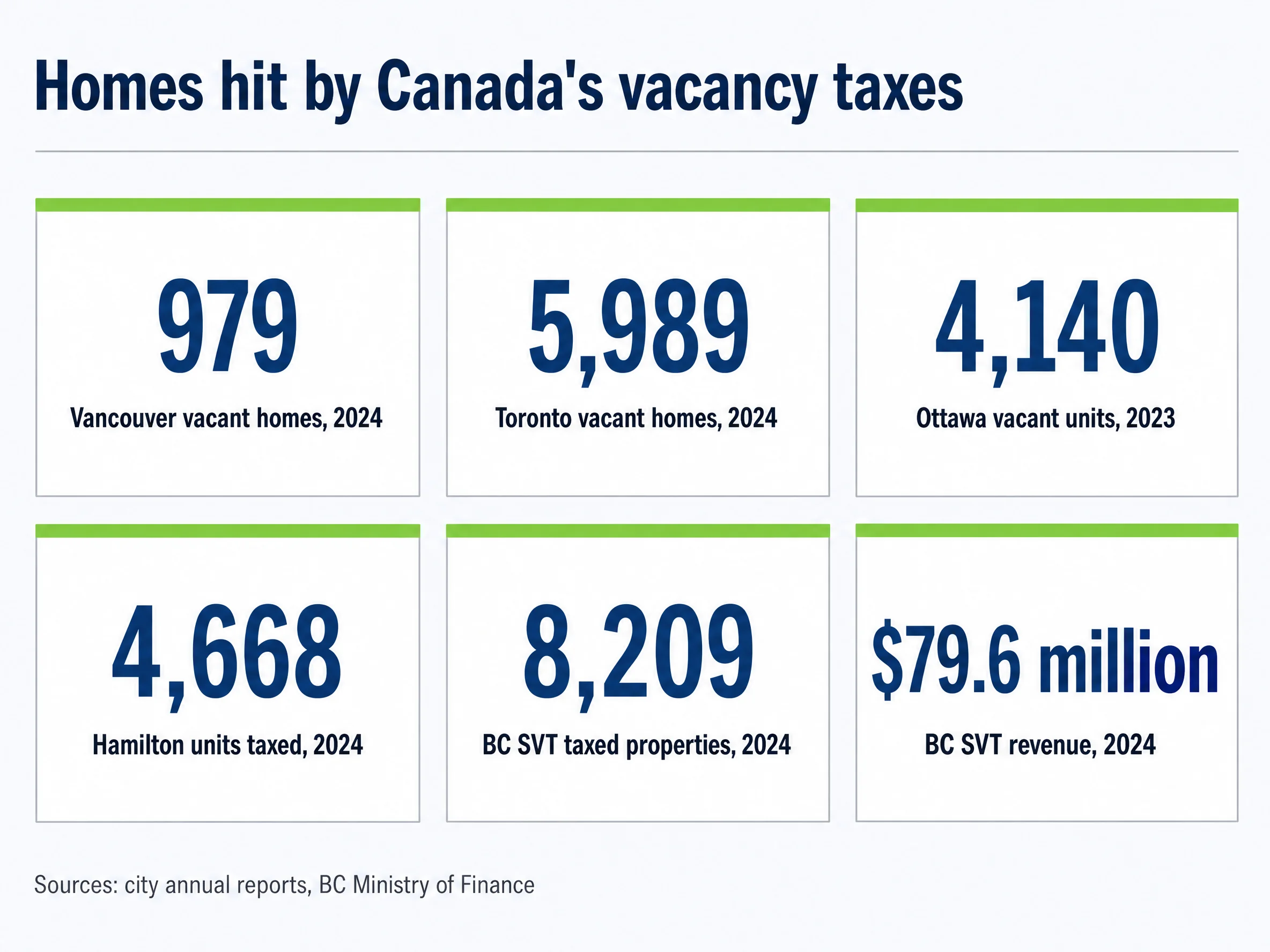
979: Vancouver's Empty Homes Tax counted 979 vacant homes for 2024, the fewest since it began in 2017, and 522 of them were deemed vacant only because the owner never filed a declaration. Source: City of Vancouver (2024)
Key Takeaways
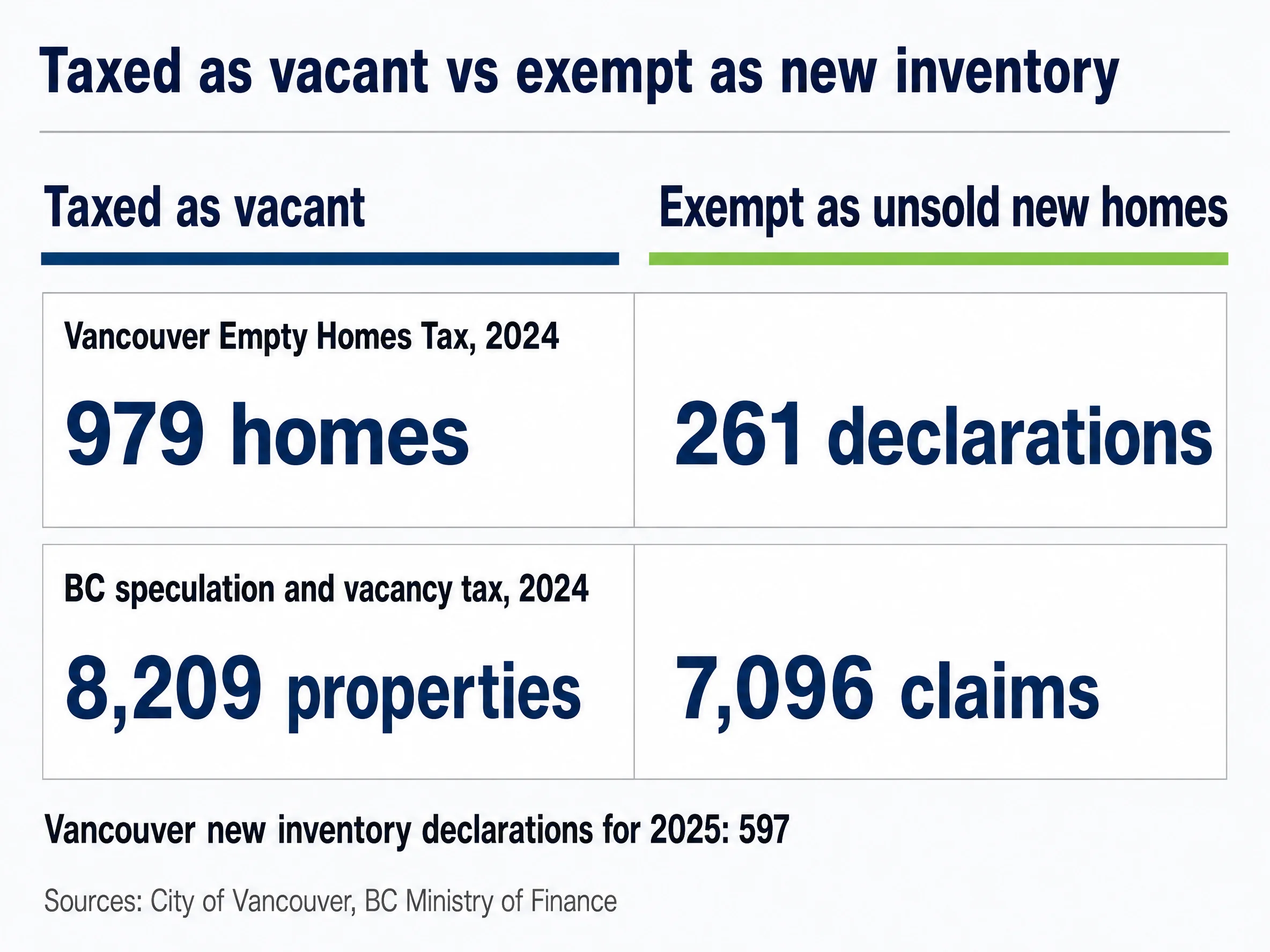
- 597 Declarations for Vancouver's Vacant New Inventory exemption for 2025, up from 261 for 2024: unsold new homes the Empty Homes Tax does not charge. (City of Vancouver, 2025)
- 7,096 Vacant new inventory exemptions claimed under BC's speculation and vacancy tax in 2024, close to the 8,209 properties that paid it. (BC Ministry of Finance, 2024)
- $79.6 million BC speculation and vacancy tax revenue for 2024, and $550 million since 2018. (Government of British Columbia, 2024)
- 5,989 Toronto homes declared or deemed vacant for 2024, down from 6,944 in 2022, the tax's first year. (City of Toronto, 2024)
- 4,140 Ottawa vacant units for the 2023 occupancy year, up from 3,669 because audits found 1,244 undeclared vacancies. (City of Ottawa, 2023)
- 4,255 Hamilton units deemed vacant for 2024 because no declaration arrived, out of 4,668 units subject to its first vacant unit tax. (The Hamilton Independent, 2024)
- $49 million Federal Underused Housing Tax assessed by March 2024, against $59 million spent administering it; it ends from the 2025 year. (Advisor.ca, 2024)
Vancouver's Empty Homes Tax counted 979 vacant homes for 2024, the first time the number fell below one thousand since the tax was introduced (City of Vancouver, 2024). That figure is the headline every city wants. It is also smaller than it looks: 522 of those homes were deemed vacant only because the owner never filed a declaration, and the unsold new condos sitting empty in the same city are not in the count at all, because the tax exempts them.
This page puts every vacancy tax in force across Canada on one table and one timeline: Vancouver's Empty Homes Tax, BC's speculation and vacancy tax, Toronto's Vacant Home Tax, Ottawa's and Hamilton's Vacant Unit Taxes, and the federal Underused Housing Tax. For each one it gives the number of empty homes taxed each year and the money raised, taken from the annual reports each municipality and province publishes. Rates and who pays come in only as short context.
The timing matters. Vancouver's tax is in its tenth year, BC has a new government after the October 2026 election, and the federal government ended its tax from the 2025 year (Parliament of Canada, 2026). Meanwhile empty new homes are piling up even as declared vacancy hits record lows, a twist in the current housing crisis that matters to anyone asking why housing in Canada is so expensive.
Every Canadian Vacancy Tax Compared: Homes Taxed and Revenue in the Latest Year
BC's speculation and vacancy tax covers the most properties, with 8,209 taxpaying properties and $79.6 million for 2024 (Government of British Columbia, 2024). Toronto found 5,989 vacant homes for 2024 and projected $103 million in billing (BNN Bloomberg (CTV News Toronto), 2024). Vancouver counted 979 vacant homes, Ottawa 4,140 units for 2023, and Hamilton taxed 4,668 units in its first year.
| Tax | Latest year | Homes or units taxed | Revenue | Source |
|---|---|---|---|---|
| Vancouver Empty Homes Tax | 2024 | 979 | $35.0 million | City of Vancouver |
| BC Speculation and Vacancy Tax | 2024 | 8,209 | $79.6 million | Government of British Columbia |
| Toronto Vacant Home Tax | 2024 | 5,989 | $103 million (projected billing) | BNN Bloomberg (CTV News Toronto) |
| Ottawa Vacant Unit Tax | 2023 | 4,140 | $14,340,614 | City of Ottawa |
| Hamilton Vacant Unit Tax | 2024 | 4,668 | $15.64 million (expected) | The Hamilton Independent |
| Federal Underused Housing Tax | 2022 returns, to March 2024 | 578,910 returns processed | $49 million assessed | Advisor.ca |
$550 million: Revenue BC's speculation and vacancy tax has raised since it began in 2018, the most of any provincial or municipal vacancy tax in Canada. (Government of British Columbia, 2024)
The table compares things that are not quite alike, and the differences are the story. Vancouver, Toronto, Ottawa and Hamilton count residential properties left vacant or underused for more than half the year, or whose owners failed to declare. BC counts properties with at least one owner who owed the tax, including homes held through a corporation or trust, and the federal tax counted returns, most of which owed nothing. Revenue is just as uneven: Vancouver reports tax levied in each 12 months to November 1, Toronto reports revenue generated or projected billing, and the federal number is tax assessed, not collected.
What every tax shares is the base. Each charges a share of a home's assessed value, so the annual tax depends on the notice from BC Assessment in British Columbia or MPAC in Ontario rather than a real estate appraisal of the market value a buyer would pay. Toronto tripled its rate for 2024, and its projected billing for that year was about double its $50 million budget target (BNN Bloomberg (CTV News Toronto), 2024). Vancouver, by contrast, has charged three per cent since the 2021 reference year and its levy has drifted down as the count falls.
The scale gap is wide. Among cities like Vancouver and Toronto that publish counts, Toronto taxes the most homes, yet BC's tax raised $79.6 million in 2024 from a province-wide net. Ottawa raised $14,340,614 for 2023 from 4,140 vacant units (City of Ottawa, 2023), and the federal tax assessed $49 million by March 2024 while costing $59 million to run (Advisor.ca, 2024).
How Many Empty Homes Has Vancouver's Empty Homes Tax Found Since 2017?
Fewer every year. The City counted 2,193 vacant homes for 2017 and 979 for 2024, a change of -55.4%, and the vacant homes rate fell from 1.18% to 0.49% (City of Vancouver, 2024). The tax levied in the following year fell from $38.0 million to $35.0 million, while $194.3 million has gone to affordable housing.
| Reference year | Vacant homes | Tax levied in the 12 months to November 1 of the next year | Source |
|---|---|---|---|
| 2017 | 2,193 | $38.0 million | City of Vancouver |
| 2018 | 2,036 | $39.4 million | City of Vancouver |
| 2019 | 1,769 | $36.0 million | City of Vancouver |
| 2020 | 1,755 | $26.0 million | City of Vancouver |
| 2021 | 1,398 | $67.0 million | City of Vancouver |
| 2022 | 1,156 | $45.5 million | City of Vancouver |
| 2023 | 1,073 | $47.0 million | City of Vancouver |
| 2024 | 979 | $35.0 million | City of Vancouver |
- 2017: 2,193
- 2018: 2,036
- 2019: 1,769
- 2020: 1,755
- 2021: 1,398
- 2022: 1,156
- 2023: 1,073
- 2024: 979
522: Of Vancouver's 979 vacant homes for 2024, this many were deemed vacant because no declaration was filed, so some may still prove occupied or exempt. (City of Vancouver, 2024)
Vancouver's 2017 empty homes tax was the first in Canada, set up to improve housing affordability and availability, and the decline is real: some homes vacant one year went back to work the next. Of the homes vacant in 2023, 523 were lived in or rented in 2024 (City of Vancouver, 2024). But the count is a moving target. Each annual report restates earlier years as late declarations and audits arrive, so the 2017 figure shown here is the City's revised one. And 53.3% of the 2024 vacant homes were deemed vacant rather than declared vacant (City of Vancouver, 2024): a paperwork penalty as much as an empty-home count.
The revenue line jumps in 2022 because the rate rose to three per cent for the 2021 reference year. Collection lags the levy too: of the $35.0 million levied in the year to November 1, 2025, the City had collected $30.6 million (City of Vancouver, 2025). For how the tax sits alongside the transfer tax and the provincial levy, see the Empty Homes Tax section of our guide to the taxes you pay when buying a house in BC.
Exemptions are a far bigger group than vacancies. The City recorded 3,718 exempt properties for 2024 (City of Vancouver, 2024), almost four for every vacant home, mostly homes under renovation or recently sold. Few empty home tax programs in Canada publish this much detail. Owners who rent short term should note that a home must be a principal residence or let by a landlord for at least six months to avoid the tax, which is also why the rules on Airbnb in Vancouver and the Empty Homes Tax overlap.
How Many Empty New Homes Does Each Bylaw and Act Exempt From Vacancy Tax?
A growing number. Vancouver's Vacant New Inventory exemption drew 248 declarations for 2023, 261 for 2024 and 597 for 2025 (City of Vancouver, 2025). BC's speculation and vacancy tax exemption for vacant new inventory was claimed 7,096 times in 2024, up +58.8% in a year (BC Ministry of Finance, 2024).
| Measure | Value | Source |
|---|---|---|
| Vancouver Vacant New Inventory declarations, 2023 | 248 | City of Vancouver |
| Vancouver Vacant New Inventory declarations, 2024 | 261 | City of Vancouver |
| Vancouver Vacant New Inventory declarations, 2025 | 597 | City of Vancouver |
| Vancouver vacant homes taxed, 2024 | 979 | City of Vancouver |
| Completed, unsold new homes in Vancouver, December 2017 | 431 | City of Vancouver |
| Completed, unsold new homes in Vancouver, December 2025 | 745 | City of Vancouver |
| Completed, unsold new condo-market units in Vancouver, September 2026 | 668 | CMHC Housing Market Information Portal |
| BC SVT vacant new inventory claims, 2022 | 3,192 | BC Ministry of Finance |
| BC SVT vacant new inventory claims, 2023 | 4,469 | BC Ministry of Finance |
| BC SVT vacant new inventory claims, 2024 | 7,096 | BC Ministry of Finance |
| BC SVT taxpaying properties, 2024 | 8,209 | BC Ministry of Finance |
- Exempt new, 2023: 248
- Exempt new, 2024: 261
- Exempt new, 2025: 597
- Reference line, Vacant homes taxed, 2024: 979
+128.7%: Rise in Vancouver's Vacant New Inventory declarations from the 2024 to the 2025 reference year, as unsold new homes piled up. (City of Vancouver, 2025)
Vancouver added the exemption in 2023, so the tax would not choke off a steady supply of new homes during slow sales, for unsold new homes in each year after the occupancy permit is issued, until they are sold or occupied, and applied it back to the 2022 year. It copied the provincial tax, which has always exempted vacant new inventory. The result is that both taxes leave out the fastest-growing kind of empty home. CMHC counted 745 completed, unsold new homes in the city in December 2025, up from 431 in December 2017 (City of Vancouver, 2025). In the condo market alone, CMHC's count rose from 357 units in December 2025 to 668 in September 2026 (CMHC Housing Market Information Portal, 2026), nearly double in nine months.
Set beside the tax counts, the exempt stock is large. For 2024 Vancouver taxed 979 vacant homes and recorded 261 new-inventory declarations. Across BC's taxed areas, 7,096 vacant new inventory exemptions were claimed in 2024 against 8,209 properties that paid (BC Ministry of Finance, 2024). Claims and properties are not the same unit, since one owner can claim several exemptions, but the direction is plain. For anyone weighing the pros and cons of buying presale condos in BC, those unsold units are also leverage on price.
The exemption is widening, not narrowing. In May 2026 Vancouver staff recommended extending it from projects of five or more homes to projects of two or more, such as duplexes and multiplexes, which would waive about $0.7 million already levied (City of Vancouver, 2026), and asked the Province to match it. Hamilton lists unsold developer units among its planned new exemptions. The one proposal to tax empty new condos instead, the BC NDP's campaign promise of a two per cent tax on unsold condominiums (Narcity, 2026), lost with the party in October. The argument is supply-side economics: tax unsold new homes and builders start fewer. But when housing demand slows and months of inventory climb, the empty homes these taxes were built to target increasingly sit where the taxes do not reach.
Toronto, Ottawa and Hamilton: Municipal Vacant Home Taxes, Homes and Revenue by Year
Toronto's count fell from 6,944 in 2022 to 5,989 in 2024, a change of -13.8% (City of Toronto, 2024). Ottawa's rose from 3,669 to 4,140 units as audits improved (City of Ottawa, 2023). Hamilton's first year taxed 4,668 units against a forecast of 1,135, because 4,255 units were never declared (The Hamilton Independent, 2024).
| Tax and year | Vacant homes or units | Revenue | Source |
|---|---|---|---|
| Toronto, 2022 | 6,944 | $56.5 million | City of Toronto |
| Toronto, 2023 | 5,077 | $50.6 million | BNN Bloomberg (CTV News Toronto) |
| Toronto, 2024 | 5,989 | $103 million (projected billing) | BNN Bloomberg (CTV News Toronto) |
| Ottawa, 2022 | 3,669 | $11,887,619 | City of Ottawa |
| Ottawa, 2023 | 4,140 | $14,340,614 | City of Ottawa |
| Hamilton, 2024 | 4,668 | $15.64 million (expected) | The Hamilton Independent |
91.2%: Share of the units subject to Hamilton's first vacant unit tax that were deemed vacant because the owner did not file a declaration. (The Hamilton Independent, 2024)
Toronto's revenue line is the one that moved. The tax generated $56.5 million in 2022 and $50.6 million in 2023 at one per cent (City of Toronto, 2023). At three per cent the City projected $103 million in 2024 billing, though staff were still working through complaints, appeals and exemptions when CTV reported it (BNN Bloomberg (CTV News Toronto), 2024), and the City calls the tax a policy tool to increase the supply of housing rather than a way to raise money. It puts Toronto's average vacancy rate at one to 1.2 per cent (City of Toronto, 2024). The City says the 2023 count of 5,077 may be skewed by problems with the rollout that year. Compliance is now near total: more than 99 per cent of owners declared for 2025 (City of Toronto, 2025).
Ottawa shows how much a count depends on enforcement. The City says 1,602 of the units empty in 2022 were back on the market in 2023, yet its total rose because audits found 1,244 vacancies that owners had not declared, and 2,067 units stayed empty both years (City of Ottawa, 2023). Revenue rose with it, from $11,887,619 to $14,340,614. Ottawa's rate for 2023 was one per cent of assessed value (City of Ottawa, 2023).
Hamilton is the extreme case of the paperwork problem. Only 413 units were declared vacant for 2024, while 4,255 were deemed vacant for not declaring (The Hamilton Independent, 2024), even though 97.8% of eligible properties did declare (City of Hamilton, 2024). The City expects about $15.64 million in revenue and forecasts $12.54M in net proceeds at the low end (City of Hamilton, 2024), and council kept the tax, charged at one per cent of assessed value (The Hamilton Independent, 2024), for another year by a single vote.
- Deemed vacant: 4,255 (91.2%)
- Declared vacant: 413 (8.8%)
British Columbia's Speculation and Vacancy Tax: Revenue and Taxpaying Properties, 2019 to 2024
Revenue has held between $75.2 million and $85.8 million a year since 2019, and reached $79.6 million in 2024 (Government of British Columbia, 2024), when the tax spread to new communities. Taxpaying properties rose to 8,209 from 6,477 in 2023 (BC Ministry of Finance, 2024). Half of 2024 revenue, 50.0%, came from foreign owners and untaxed worldwide earners.
| Tax year | Tax revenue | Taxpaying properties | Vacant new inventory exemptions claimed | Source |
|---|---|---|---|---|
| 2019 | $85.8 million | 5,651 | 3,389 | BC Ministry of Finance |
| 2020 | $80.6 million | 6,252 | 3,795 | BC Ministry of Finance |
| 2021 | $78.4 million | 5,603 | 2,799 | BC Ministry of Finance |
| 2022 | $81.9 million | 6,803 | 3,192 | BC Ministry of Finance |
| 2023 | $75.2 million | 6,477 | 4,469 | BC Ministry of Finance |
| 2024 | $79.6 million | 8,209 | 7,096 | Government of British Columbia |
50.0%: Share of 2024 speculation and vacancy tax revenue paid by foreign owners and untaxed worldwide earners, who pay the higher rate. (BC Ministry of Finance, 2024)
- 2019, Taxpaying properties: 5,651
- 2019, Exemption claims: 3,389
- 2020, Taxpaying properties: 6,252
- 2020, Exemption claims: 3,795
- 2021, Taxpaying properties: 5,603
- 2021, Exemption claims: 2,799
- 2022, Taxpaying properties: 6,803
- 2022, Exemption claims: 3,192
- 2023, Taxpaying properties: 6,477
- 2023, Exemption claims: 4,469
- 2024, Taxpaying properties: 8,209
- 2024, Exemption claims: 7,096
The provincial tax works differently from the city ones, and our BC speculation and vacancy tax guide covers who must declare. Its revenue is flat in dollars even as its reach grew to 59 communities (Government of British Columbia, 2026). Of the 6,477 properties taxed for 2023, 4,103 were still taxed in 2024 and 730 had an owner claiming a tenancy exemption (BC Ministry of Finance, 2024). Condos are the largest taxed group, at 3,405 non-exempt units in 2024 (Government of British Columbia, 2024), and the Metro Vancouver Regional District paid the most, $46,189,761 (BC Ministry of Finance, 2024).
Who pays follows ownership. BC resident owners paid $15,271,975 in 2024 (BC Ministry of Finance, 2024), while foreign owners and untaxed worldwide earners, whose income mostly escapes Canadian income tax, paid the larger share. That ties the tax to the rules on whether foreigners can buy property in Canada. The province forecast $105 million for the 2025/26 fiscal year (BC Ministry of Finance, 2025), before the rate rises to 1% for citizens and permanent residents and 3% for foreign owners for declarations made in 2027 (Government of British Columbia, 2026).
The BC Conservatives won a majority in October 2026 after promising not to raise existing taxes or add new ones (BNN Bloomberg, 2026), and the 2027 rate increases were set by the previous government, so whether they take effect is the open question.
The Federal Underused Housing Tax Act Ends, and the Vacancy Taxes That Never Started
The federal Underused Housing Tax is gone. Bill C-15, legislation that received Royal Assent in March 2026, ends it from the 2025 calendar year (Parliament of Canada, 2026). By March 2024 the CRA had assessed $49 million on 578,910 returns, against $59 million spent running it (Advisor.ca, 2024). Oakville also dropped its planned tax.
| Measure | Value | Source |
|---|---|---|
| UHT assessed by March 4, 2024 | $49 million | Advisor.ca |
| UHT tax returns processed by March 4, 2024 | 578,910 | Advisor.ca |
| CRA cost to run the UHT, to early 2024 | $59 million | Advisor.ca |
| PBO projected UHT revenue, 2023-24 | $131.7 million | Advisor.ca |
| First year with no UHT payable | 2025 | Parliament of Canada |
| Bill C-15 Royal Assent | March 2026 | Parliament of Canada |
| Oakville decides not to proceed | August 10, 2026 | Halton Region |
| Windsor rate for 2026 and later | 4% | City of Windsor |
- CRA cost: 59.0
- Assessed: 49.0
- Reference line, PBO projection, 2023-24: 131.7
The federal tax was the only national vacancy tax in Canada, and it raised little. The Parliamentary Budget Officer had projected $131.7 million for 2023-24 (Advisor.ca, 2024), far more than the CRA had assessed by March 2024. The law still applies to returns and penalties for 2022 to 2024. With it gone, along with the Canada foreign buyer ban in place, the provincial and city taxes are the only vacancy taxes left.
Not every city is joining them. Oakville endorsed a staff recommendation on August 10, 2026 not to go ahead with a vacant home tax (Halton Region, 2026). Windsor runs a complaint-driven tax with no universal declaration and raised its rate to 4% for 2026 (City of Windsor, 2026). Neither publishes the kind of yearly count Vancouver, Ottawa and Toronto do, which is why they are left out of the tables above.
BC vacancy tax revenue by year: Vancouver's Empty Homes Tax and the provincial speculation and vacancy tax
BC vacancy tax revenue by year: Vancouver's Empty Homes Tax and the provincial speculation and vacancy tax
Enter an amount in millions of dollars to see the years each BC vacancy tax raised that much or less. Pick a tax to see its timeline alone. Vancouver reports tax levied in each 12 months to November 1; the province reports revenue by tax year.
| Year | Tax revenue, $ millions | Tax | Taxpaying properties (SVT) | Vacant new inventory exemptions claimed (SVT) |
|---|---|---|---|---|
| 2018 (Tax levied in the 12 months to November 1, 2018) | 38 | Vancouver Empty Homes Tax | n/a | n/a |
| 2019 (Tax levied in the 12 months to November 1, 2019) | 39.4 | Vancouver Empty Homes Tax | n/a | n/a |
| 2020 (Tax levied in the 12 months to November 1, 2020) | 36 | Vancouver Empty Homes Tax | n/a | n/a |
| 2021 (Tax levied in the 12 months to November 1, 2021) | 26 | Vancouver Empty Homes Tax | n/a | n/a |
| 2022 (Tax levied in the 12 months to November 1, 2022) | 67 | Vancouver Empty Homes Tax | n/a | n/a |
| 2023 (Tax levied in the 12 months to November 1, 2023) | 45.5 | Vancouver Empty Homes Tax | n/a | n/a |
| 2024 (Tax levied in the 12 months to November 1, 2024) | 47 | Vancouver Empty Homes Tax | n/a | n/a |
| 2025 (Tax levied in the 12 months to November 1, 2025) | 35 | Vancouver Empty Homes Tax | n/a | n/a |
| 2019 (2019 tax year) | 85.8 | BC Speculation and Vacancy Tax | 5,651 | 3,389 |
| 2020 (2020 tax year) | 80.6 | BC Speculation and Vacancy Tax | 6,252 | 3,795 |
| 2021 (2021 tax year) | 78.4 | BC Speculation and Vacancy Tax | 5,603 | 2,799 |
| 2022 (2022 tax year) | 81.9 | BC Speculation and Vacancy Tax | 6,803 | 3,192 |
| 2023 (2023 tax year) | 75.2 | BC Speculation and Vacancy Tax | 6,477 | 4,469 |
| 2024 (2024 tax year) | 79.6 | BC Speculation and Vacancy Tax | 8,209 | 7,096 |
Frequently Asked Questions
How many residential properties does Vancouver's Empty Homes Tax find vacant?
For 2024 the City counted 979 vacant homes, a vacant homes rate of 0.49% and the lowest since the tax began in 2017, when it counted 2,193. Of the 979, 522 were deemed vacant because the owner filed no declaration, so some may still turn out to be occupied or exempt. A further 3,718 properties were exempt. (City of Vancouver, 2024)
How much money do vacancy taxes raise in Canada?
BC's speculation and vacancy tax raised $79.6 million for 2024 and $550 million since 2018, the most of any provincial or municipal vacancy tax. Toronto's tax generated $56.5 million in 2022 and $50.6 million in 2023, with 2024 billing projected at $103 million after the rate tripled. Vancouver levied $35.0 million in the year to November 1, 2025, and Ottawa raised $14.3 million for 2023. (Government of British Columbia, 2024)
Are unsold new condos exempt from vacancy taxes?
Mostly, yes. BC's speculation and vacancy tax has a vacant new inventory exemption, claimed 7,096 times in 2024. Vancouver added a similar Vacant New Inventory exemption in 2023, and declarations under it rose from 261 for 2024 to 597 for 2025. Hamilton lists unsold developer units among its planned new exemptions. (BC Ministry of Finance, 2024)
Has the Underused Housing Tax Act been repealed?
In effect, yes. Bill C-15, the Budget 2025 Implementation Act, No. 1, received Royal Assent in March 2026 and ends the federal Underused Housing Tax for 2025 and later calendar years, with no return required; the Underused Housing Tax Act (UHTA) itself is repealed on January 1, 2035. Returns and penalties for 2022 to 2024 still apply. By March 2024 the CRA had assessed $49 million in tax on 578,910 returns. (Parliament of Canada, 2026)
Why does a municipality deem so many homeowners' properties vacant?
Every city taxes a home whose owner misses the declaration as if it were empty. In Hamilton's first year, 4,255 of the 4,668 units subject to the tax were deemed vacant for not declaring and only 413 were declared vacant. In Vancouver, 522 of the 979 vacant homes for 2024 were deemed vacant for the same reason. (The Hamilton Independent, 2024)
Which municipal vacant home taxes are in force across Canada in 2026?
Vancouver, Toronto, Ottawa, Hamilton and Windsor run municipal vacant home taxes, and Windsor raised its rate to 4% for 2026. BC's provincial speculation and vacancy tax applies in 59 communities. Oakville decided on August 10, 2026 not to proceed with a tax, and the federal Underused Housing Tax ended from the 2025 year. (City of Windsor, 2026)
What is the impact of an empty-homes tax on the housing market?
Measurable, though hard to isolate. Vancouver's count fell from 2,193 vacant homes for 2017 to 979 for 2024, and 523 of the homes vacant in 2023 were lived in or rented in 2024. Ottawa says 1,602 units vacant in 2022 were back on the market in 2023. But vacant homes were only 1.18% of Vancouver's residential properties in 2017, and the City says isolating the effect of the tax on Vancouver's housing market is challenging. (City of Vancouver, 2024)
How do cities assess a vacant home tax, and what is the tax rate?
Each tax is a share of the assessed value on the property tax roll: 3% in Vancouver and Toronto, 4% in Windsor for 2026, 1% in Hamilton, and 1% in Ottawa for 2023. BC's speculation tax rises to 1% for citizens and permanent residents and 3% for foreign owners for declarations made in 2027. Unpaid tax goes on the property tax account and accrues interest after the payment deadline. (City of Vancouver, 2025)
Methodology
Each tax system counts vacant properties differently. Every count and dollar figure comes from the published annual reports, technical briefings, council reports and releases of the City of Vancouver, the City of Toronto, the City of Ottawa, the City of Hamilton, the BC Ministry of Finance and the Parliament of Canada, read on November 17, 2026, with Toronto's 2023 count and 2024 billing from City figures reported by CTV News, Hamilton's first-year counts from council reporting in The Hamilton Independent, and federal Underused Housing Tax figures as reported by Advisor.ca. PDF reports were checked against their own text, and pages that block automated readers were checked in a browser. Percentage changes and shares are our calculations from those figures. Each tax counts on its own basis, so the tables compare like with like only within each tax. Vancouver and Ottawa restate earlier years as late declarations and audits arrive; we show the latest published figure for each year. Ottawa's 2024 report and Toronto's 2024 collections were not yet published. Unsold new homes are CMHC completed and unabsorbed counts as cited by the City of Vancouver and as published by CMHC.
Sources consulted: 48
Sources cited: 26
Data freshness: current year: 11, last year: 7, older: 8
Data range: Vancouver Empty Homes Tax reference years 2017 to 2024 (exemption declarations to 2025); Toronto 2022 to 2025; Ottawa 2022 and 2023; Hamilton 2024; BC speculation and vacancy tax 2018 to 2024; federal Underused Housing Tax 2022 to 2024
Research date: 2026-11-17
Update schedule: Yearly, as each city and BC publish their annual reports (Vancouver usually in late November or early December)
Limitations: Each government counts differently. Vancouver and Ottawa count vacant homes or units by reference year, net of later declarations and audits, and restate earlier years; Toronto's counts come from City figures given to CTV News and a City release; Hamilton's 2024 count is pending appeals. BC counts taxpaying properties and exemption claims (an owner can claim more than one). Revenue is not on one basis: Vancouver reports tax levied in each 12 months to November 1, Toronto reports revenue generated or projected billing, Ottawa and BC report revenue by tax year as of a set date, and the federal figure is tax assessed. Ottawa had not published its 2024 occupancy year report and Toronto had not published 2024 collections by November 17, 2026.
Sources & References
- City of Vancouver. "2025 Empty Homes Tax Annual Report (2024 vacancy reference year), with memo to Mayor and Council." vancouver.ca/files/cov/2025-11-27-memo-to-mayor-and-council-empty-homes-tax-annu. Accessed 2026-11-17.
- City of Vancouver. "2024 Empty Homes Tax Annual Report (2023 vacancy reference year)." vancouver.ca/files/cov/2024-empty-homes-tax-annual-report.pdf. Accessed 2026-11-17.
- City of Vancouver. "2023 Empty Homes Tax Annual Report (2022 vacancy reference year)." vancouver.ca/files/cov/2023-11-30-empty-homes-tax-annual-report.pdf. Accessed 2026-11-17.
- City of Vancouver. "2021 Empty Homes Tax Annual Report (2020 vacancy reference year)." vancouver.ca/files/cov/vancouver-2021-empty-homes-tax-annual-report.pdf. Accessed 2026-11-17.
- City of Vancouver. "Empty Homes Tax drives Vancouver's housing vacancies to record low." vancouver.ca/news-calendar/eht-drives-housing-vacancies-record-low-dec-2025.aspx. Accessed 2026-11-17.
- City of Vancouver. "Council report: Maintaining the Fairness and Effectiveness of the Empty Homes Tax (RTS 18648)." council.vancouver.ca/20260602/documents/r10.pdf. Accessed 2026-11-17.
- CMHC Housing Market Information Portal. "Completed and unabsorbed homeowner and condo units, City of Vancouver (CSD), condo market." www03.cmhc-schl.gc.ca/hmip-pimh/en/TableMapChart/RenderTable?TableId=1.2.4&Geogr. Accessed 2026-11-17.
- City of Toronto. "2024 Vacant Home Tax Program fact sheet." toronto.ca/news/2024-vacant-home-tax-program/. Accessed 2026-11-17.
- City of Toronto. "Halfway to the Vacant Home Tax deadline: make your declaration now." toronto.ca/news/halfway-to-the-vacant-home-tax-deadline-make-your-declaration-no. Accessed 2026-11-17.
- City of Toronto. "City of Toronto opens the 2026 Vacant Home Tax declaration period." toronto.ca/news/city-of-toronto-opens-the-2026-vacant-home-tax-declaration-perio. Accessed 2026-11-17.
- BNN Bloomberg (CTV News Toronto). "Efficacy of Toronto's vacant home tax questioned in record slow real estate market." bnnbloomberg.ca/business/2026/01/28/efficacy-of-torontos-vacant-home-tax-questio. Accessed 2026-11-17.
- City of Ottawa. "Vacant Unit Tax 2023 Occupancy Year Annual Report." documents.ottawa.ca/sites/default/files/OTTAWA_25-130_Report_E8.pdf. Accessed 2026-11-17.
- The Hamilton Independent. "Hamilton Council votes to extend controversial Vacant Unit Tax another year." hamiltonindependent.ca/hamilton-council-votes-to-extend-controversial-vacant-uni. Accessed 2026-11-17.
- City of Hamilton. "Vacant Unit Tax fact sheet, 2024 occupancy year." hamilton.ca/sites/default/files/2025-11/property-taxes-vut-factsheet-2024.pdf. Accessed 2026-11-17.
- BC Ministry of Finance. "Speculation and Vacancy Tax technical briefing, 2024 tax year." news.gov.bc.ca/files/SVT_Technical%20Briefing_2024_TaxYear.pdf. Accessed 2026-11-17.
- BC Ministry of Finance. "Speculation and Vacancy Tax technical briefing, 2023 tax year." news.gov.bc.ca/files/SVT_Technical_Briefing_2023_Tax_Year_FINAL.pdf. Accessed 2026-11-17.
- BC Ministry of Finance. "Speculation and Vacancy Tax technical briefing, 2021 tax year." news.gov.bc.ca/files/SVT_technical_briefing_2021_tax_year.pdf. Accessed 2026-11-17.
- BC Ministry of Finance. "Speculation and Vacancy Tax technical briefing, 2020 tax year." news.gov.bc.ca/files/SVT_Annual_Mayors_Consultation_Technical_Briefing_2020.pdf. Accessed 2026-11-17.
- Government of British Columbia. "Speculation and vacancy tax 2024 results news release." news.gov.bc.ca/releases/2025FIN0047-001277. Accessed 2026-11-17.
- Government of British Columbia. "Declaring speculation and vacancy tax means more housing available." news.gov.bc.ca/releases/2026FIN0001-000033. Accessed 2026-11-17.
- Advisor.ca. "Underused housing tax to generate $694 million: PBO." advisor.ca/tax/tax-news/underused-housing-tax-to-generate-694-million-pbo/. Accessed 2026-11-17.
- Parliament of Canada. "Bill C-15, Budget 2025 Implementation Act, No. 1 (Royal Assent)." parl.ca/DocumentViewer/en/45-1/bill/C-15/royal-assent. Accessed 2026-11-17.
- Halton Region. "Vacant Homes Tax (Halton Region and Town of Oakville updates)." halton.ca/The-Region/Finance-and-Transparency/Vacant-Homes-Tax. Accessed 2026-11-17.
- BNN Bloomberg. "Here's what the B.C. Conservatives promised to do when elected." bnnbloomberg.ca/business/politics/2026/10/25/heres-what-the-bc-conservatives-pro. Accessed 2026-11-17.
- Narcity. "B.C. Conservatives pledge no new taxes if elected." narcity.com/b-c-conservatives-pledge-no-new-taxes-if-elected. Accessed 2026-11-17.
- City of Windsor. "Vacant Home Tax (VHT)." citywindsor.ca/city-hall/taxes-and-assessment/vacant-home-tax. Accessed 2026-11-17.

Let's Chat! Looking for a REALTOR® who can exceed your expectations? Look no further than Richard Morrison! His mission is to serve without limit & provide solutions that cater to your core needs.
• 20+ Years of Experience
• Medallion Member
• RE/MAX Hall of Fame

Latest Properties Added
| Property | Size | Price | Date Listed |
|---|---|---|---|
| 504 - 10778 138 Street, Surrey | 651 sqft | $449,000 | Nov 18, 2026 |
| 101 - 14761 68a Avenue, Surrey | 1,697 sqft | $1,099,999 | Nov 17, 2026 |
| 1020 Le Roi Street, Vancouver | 1,677 sqft | $1,688,000 | Nov 18, 2026 |
| 801 - 120 16th Street, North Vancouver | 1,168 sqft | $939,000 | Nov 18, 2026 |
| 305 - 175 1st Street, North Vancouver | 760 sqft | $669,000 | Nov 18, 2026 |
| 602 - 5629 Birney Avenue, Vancouver | 601 sqft | $779,900 | Nov 18, 2026 |
| 1126 Lombardy Drive, Port Coquitlam | 2,242 sqft | $1,200,000 | Nov 18, 2026 |
| 16143 9 Avenue, Surrey | 3,064 sqft | $1,298,000 | Nov 18, 2026 |
| 7523 205 Street, Langley | 3,764 sqft | $1,669,000 | Nov 18, 2026 |
| 6191 Udy Road, Richmond | 4,017 sqft | $4,688,000 | Nov 18, 2026 |
| 2301 - 1500 Howe Street, Vancouver | 1,708 sqft | $1,988,000 | Nov 18, 2026 |
| 603 - 728 Princess Street, New Westminster | 1,221 sqft | $599,000 | Nov 18, 2026 |
Start your search with Richard Morrison, Top Award Winning Vancouver Realtor
Contact Richard Morrison Top Vancouver Realtor today to find a Vancouver houses for sale and Vancouver condos for sale. Also check out Burnaby houses for sale or maybe Burnaby condos for sale. If you prefer North Shore, take a look at our listings in North Vancouver houses for sale and North Vancouver condos for sale.