Pros and Cons of Living in Richmond BC
38.8%: Richmond BC is a good place to live for most people, with Canada Line and airport access, a deep food scene and a violent crime rate 38.8% below BC's in 2025, but you trade that for flood risk behind dikes, bridge traffic and Metro Vancouver home prices. Source: Strawhomes.com calculation from Statistics Canada data (2025)
Key Takeaways
- Richmond BC is a good place to live for most buyers who want Canada Line and airport access, a deep food scene and parks, as long as you accept flood risk behind the dikes, bridge traffic and Metro Vancouver home prices. (Strawhomes.com, 2026)
- 38.8% lower than BC's was Richmond's violent crime rate in 2025, and its property crime rate was 16.8% lower, so Richmond is a safe city for daily life. (Strawhomes.com calculation from Statistics Canada data, 2025)
- 93.2% of BC's importation and exportation incidents for other controlled drugs were recorded by Richmond RCMP in 2025, the main reason Richmond's Crime Severity Index (151.82) was above BC's (92.37) even though its crime rates were below BC's. (Strawhomes.com calculation from Statistics Canada data, 2025)
Richmond, BC is a good place to live for most people, especially if you want fast Canada Line and airport access, a food scene shaped by its large Chinese-Canadian community and flat, bikeable dyke trails. The trade-offs are real: the city sits low behind dikes, bridges and the George Massey Tunnel slow drivers, and homes cost Metro Vancouver prices.
Richmond is also a safe city for daily life, with the details in the safety section.
This guide is for you if you're thinking of buying or renting in Richmond, comparing it with Vancouver, Burnaby or Surrey for your family, or moving to Metro Vancouver as a newcomer. It is not the right guide if you want a short holiday guide to Richmond's hotels and sights.
The figures below come from Statistics Canada's 2025 police-reported crime data (released July 2026), the 2021 Census, the City of Richmond, TransLink, Environment and Climate Change Canada and the Strawhomes.com Richmond market trends page. The rest comes from what I see as a REALTOR® showing homes across Metro Vancouver.
I've listed the pros and cons below in the order buyers ask me about them. If you're thinking about moving to Richmond, these are the points I'd want you to know before moving.
Is Richmond BC a Good Place to Live?
Richmond, BC is a good place to live for most buyers and renters who value transit, the airport and food, as long as you accept flood risk, bridge traffic and Metro Vancouver prices. Richmond is its own city, with 209,937 residents in the 2021 Census (Statistics Canada, 2021), and much of daily life happens without leaving town.
| Richmond at a glance | Value | Source |
|---|---|---|
| Population, 2021 Census | 209,937 | Statistics Canada |
| Canada Line, Richmond-Brighouse to Waterfront | 24 minutes | TransLink |
| Violent crime rate vs BC, 2025 (lower) | 38.8% | Strawhomes.com calculation from Statistics Canada data |
| Average sold price, October 2026 | $1,028,186 | Strawhomes.com |
Richmond is a flat island city at the mouth of the Fraser River. Lulu Island holds most of the homes, Sea Island holds Vancouver International Airport (YVR), and Steveston is the old fishing village on Lulu Island's south shore.
The main pros are the Canada Line, YVR on your doorstep, the food and the Richmond Night Market, plus dyke trails and parks. Richmond is also self-contained, with its own malls, services and jobs, so many errands stay local.
The main cons are flood risk behind dikes, bridge and tunnel traffic, and Metro Vancouver prices. Richmond's retail scene is Chinese-language-first in many places, which some newcomers need time to get used to, and the nightlife is quiet.
Richmond suits you if you love food, fly often, work at the airport or commute to Vancouver by transit. Families who want flat, bikeable streets do well here too. If you're weighing several Metro Vancouver suburbs, my overview helps you see where Richmond fits on your shortlist.
Richmond challenges you if you need quick access to the North Shore or the eastern suburbs, if flood risk worries you, or if you want a big arts and nightlife scene. Young buyers can see how Richmond compares on my list of places for young adults.
If you're thinking about living in Richmond, British Columbia, the sections below show what it's like to live in Richmond, from the commute and the cost to the neighbourhoods.
In my experience, the buyers who are happiest in Richmond are the ones who tested the commute and the neighbourhood before they bought.
Pros of Living in Richmond BC
The biggest pros of living in Richmond, BC are fast Canada Line and airport access, a food scene shaped by Richmond's large Chinese-Canadian community, flat dyke trails and parks, and a self-contained city centre. For many residents, work, shopping, school and a night out all stay inside the city.
| Richmond, 2021 Census | Share of residents | Source |
|---|---|---|
| Visible minority | 80.3% | Strawhomes.com calculation from 2021 Census data |
| Chinese | 54.3% | Strawhomes.com calculation from 2021 Census data |
Food and culture: in the 2021 Census, 80.3% of Richmond residents belonged to a visible minority (Strawhomes.com calculation from 2021 Census data, 2021) and 54.3% identified as Chinese (Strawhomes.com calculation from 2021 Census data, 2021).
You'll find Cantonese and other regional Chinese cooking, dim sum, plus Japanese, Korean, Vietnamese and Filipino food. The summer Richmond Night Market joins the other Vancouver events nearby that are worth planning your weekends around.
Restaurants in Richmond range from dim sum halls to noodle shops and food courts, and bubble tea shops are easy to find around City Centre. Many dim sum restaurants also serve traditional tea with your meal. The Richmond Night Market is a summer attraction in its own right, so plan an evening there.
Airport access is a real advantage, because Vancouver International Airport (YVR) sits on Sea Island inside Richmond. Early flights and late arrivals feel far less stressful when the terminal is part of your own city. Living close to Vancouver International Airport also suits airport workers and frequent flyers.
Canada Line access gives you rapid transit to downtown Vancouver in 24 minutes from Richmond-Brighouse Station (TransLink, 2026). The location section below covers every Richmond station and the drive. The Canada Line SkyTrain runs through the City Centre core, where many newer towers sit near stations.
Parks and trails are easy to reach across the flat island. The West Dyke Trail, Richmond Nature Park, Iona Beach Regional Park, Terra Nova Rural Park and Garry Point Park in Steveston give you water views, birdwatching and room to walk or cycle. Minoru Park, near City Centre, adds sports fields and walking paths.
Schools and learning options include Richmond School District public schools, private schools and Kwantlen Polytechnic University's Richmond campus. If school access matters to you, weigh the trade-offs of homes near schools before you narrow your search. Families looking for quality education should visit schools and check catchment boundaries for the exact address.
Shopping and services are close at hand: Richmond Centre mall, Aberdeen Centre, Lansdowne Centre and McArthurGlen Designer Outlet near the airport cover your errands. Minoru Centre for Active Living adds pools, fitness space and programs for older adults.
Flat, bikeable streets make Richmond easy to get around by bike, scooter or stroller. You won't fight the hills you'd find in Burnaby or on the North Shore.
Cons of Living in Richmond BC
The main cons of living in Richmond, BC are flood risk, because the city sits an average of 1 metre above sea level behind 49 km of dikes (City of Richmond, 2026), plus bridge and tunnel traffic, Metro Vancouver home prices and a Chinese-language-first retail scene some newcomers need time to adjust to.
| Richmond flood protection | Value | Source |
|---|---|---|
| Average elevation above sea level | 1 metre | City of Richmond |
| Dikes | 49 km | City of Richmond |
| Planned dike height | 4.7 metres | City of Richmond |
Flood risk comes first. Dikes protect the city, and the City of Richmond plans to raise them to 4.7 metres (City of Richmond, 2026). Check the flood maps, get a real quote from an insurance broker and expect limited crawl spaces and basements in some areas, because flood exposure is one of the property value factors buyers weigh.
Dikes, the local word for a levee, ring much of the island to hold back the river and the sea. Walking the dyke trails is a pleasant way to see that protection up close.
Bridges and the George Massey Tunnel are the price of island living. Every drive off the islands crosses a bridge or the tunnel, so rush hour or a single crash can back traffic up quickly.
Prices are a con too, because Richmond is not cheap. The cost section below sets out current averages by home type. Housing costs shape your overall cost of living here, so plan your budget around the home first.
Language and culture can take some adjusting. Many shops and signs are in Chinese first, and in my experience community groups often form along language lines, so some newcomers feel like outsiders at first while others love the change. In my experience, time spent exploring local markets, shops and community centres helps the city feel like home.
Quiet nightlife is another trade-off, with fewer bars, live music spots and arts venues than Vancouver. Newcomers who expect a big-city scene sometimes list it among their moving regrets, so be honest about how you like to spend your evenings.
Weather is less of a con than Richmond's old reputation suggests. The idea that Richmond is rainier than Vancouver does not hold up, and the data section below shows why.
Is Richmond BC Safe? Crime Rates Compared With BC
Yes, Richmond, BC is a safe city for daily life. In 2025 Richmond RCMP recorded 937.46 violent incidents per hundred thousand people (Statistics Canada, 2025), 38.8% below British Columbia's 1,530.75 (Strawhomes.com calculation from Statistics Canada data, 2025), and its property crime rate was 16.8% lower than BC's (Strawhomes.com calculation from Statistics Canada data, 2025).
| Police-reported, 2025 | Richmond | Source |
|---|---|---|
| Violent crime rate per 100,000 | 937.46 | Statistics Canada |
| Property crime rate per 100,000 | 3,194.70 | Statistics Canada |
| Criminal Code crime rate per 100,000 | 5,732.85 | Statistics Canada |
| Crime Severity Index | 151.82 | Statistics Canada |
| Violent Crime Severity Index | 61.78 | Statistics Canada |
- Violent crime, Richmond: 937.46
- Violent crime, British Columbia: 1,530.75
- Property crime, Richmond: 3,194.70
- Property crime, British Columbia: 3,838.64
- All Criminal Code, Richmond: 5,732.85
- All Criminal Code, British Columbia: 6,943.25
38.8%: lower than BC's was Richmond's violent crime rate in 2025, on Statistics Canada's police-reported figures. (Strawhomes.com calculation from Statistics Canada data, 2025)
Richmond's crime rates sat below BC's on all three rate measures in 2025: 937.46 violent incidents per hundred thousand people against 1,530.75 for BC, 3,194.70 property incidents against 3,838.64, and 5,732.85 Criminal Code incidents against 6,943.25 (Statistics Canada, 2025). The figures are police-reported rates for the Richmond RCMP municipal detachment.
Statistics Canada publishes these police-reported rates every July in its incident-based crime statistics table for British Columbia police services.
Richmond's Crime Severity Index is the figure that looks alarming. Richmond's index was 151.82 in 2025 against 92.37 for BC, while its Violent Crime Severity Index was 61.78 against 98.02 (Statistics Canada, 2025). The overall index is above BC's and the violent index is below it, and the data section below explains why.
Everyday risks in Richmond are mostly property crimes: in my experience, theft from cars, shoplifting and fraud are what residents deal with, so lock your car and bring packages in quickly. From what I see showing homes, busy areas like City Centre and Steveston feel safe at night.
Comparing cities helps if Richmond is one of several options. If you're choosing between Richmond and Vancouver, read my Vancouver safety guide for the other side of the river. For quieter towns, see my list of the safest places in BC.
Is Richmond Part of Vancouver? Location, Canada Line and Commute
No, Richmond is its own city, but it is part of Metro Vancouver, a partnership of 21 municipalities, one electoral area and one treaty First Nation (Metro Vancouver, 2026). Richmond sits directly south of Vancouver across the north arm of the Fraser River, and the Canada Line reaches downtown Vancouver in 24 minutes from Richmond-Brighouse (TransLink, 2026).
Is Richmond a suburb of Vancouver? Many people call it one, but Richmond has its own city hall, city centre and jobs, so it works more like a separate city next door. Richmond counts as one of the cities in Metro Vancouver, part of the Vancouver metropolitan area that many people also call the Greater Vancouver area.
Richmond's Canada Line stations are Bridgeport, Capstan, Aberdeen, Lansdowne and Richmond-Brighouse on the Richmond branch, plus Templeton, Sea Island Centre and YVR-Airport on the airport branch (TransLink). Trains split at Bridgeport, so check the destination sign before you board.
The trip from Richmond-Brighouse to Waterfront Station downtown takes 24 minutes (TransLink, 2026). If you live within an easy walk of a station, a car-free commute to downtown is realistic. Commuting from Richmond to downtown Vancouver by train skips the bridges entirely.
Driving into Vancouver means the Oak Street, Arthur Laing or Knight Street bridges. Heading south, the highway runs through the George Massey Tunnel to Delta, Surrey and the US border, and the Alex Fraser Bridge runs toward New Westminster. Peak traffic adds time on these routes.
Buses thin out in the outer areas, such as East Richmond and the farmland, so many families there still own a car. Getting around within Richmond is easier near the Canada Line than on the rural edges.
Jobs at the airport, the port and City Centre offices keep many residents working locally, while others commute to Vancouver. Compare your pay against Vancouver salaries to see how far your housing budget can stretch. If you're moving from elsewhere, my reasons to move guide covers the wider region.
Living close to the city without living in it is a big part of Richmond's appeal for commuters. The Vancouver downtown core is a train ride away, while home stays quieter and flatter.
How Much Does It Cost to Live in Richmond BC?
Living in Richmond, BC is expensive: the average sold price across all home types was $1,028,186 in October 2026 (Strawhomes.com, 2026), and the average detached house sold for $1.84M, townhouse $1.06M and condo $631K (Strawhomes.com, 2026). Budget for strata fees, property taxes and insurance on top.
| Richmond, October 2026 | Average price | Source |
|---|---|---|
| Detached house | $1.84M | Strawhomes.com |
| Townhouse | $1.06M | Strawhomes.com |
| Condo | $631K | Strawhomes.com |
| All home types | $1,028,186 | Strawhomes.com |
The averages above cover one month, from 57 detached, 67 townhouse and 128 condo sales recorded in October 2026 (Strawhomes.com, 2026), so a few big sales can move them. For the live numbers each month, see the Richmond average house price page on Strawhomes.com.
Housing prices shift by home type and location, so treat the averages above as a starting point, not a price for a specific street. In Richmond real estate, a condominium near a station and a detached home on a quiet street sit at very different price points, and prices in Richmond also differ between neighbourhoods.
Living costs go beyond the home price: strata fees, property taxes, insurance and, in the outer areas, a car. My cost of living guide shows what a household budget looks like across the region.
Affordability depends on your income, down payment and debts, so run your own figures with my home affordability guide before you start viewings.
Choosing a home type shapes your budget. In my experience, many first-time buyers start with a condo near a Canada Line station, and families often move to townhouses, so compare townhouse or detached living as your needs grow. If a condo is your starting point, weigh the trade-offs of owning a condo first.
Renting in Richmond costs different amounts by building and type, and newer City Centre towers ask more than older low-rises. Check current listings for the building and unit size you want.
Best Richmond Neighbourhoods for Different Lifestyles
The Richmond neighbourhood that fits you depends on how you live: Steveston for a walkable waterfront village, City Centre (Brighouse) for transit and towers, Terra Nova and the Minoru area for families and parks, and East Richmond for space and farmland. Each area gives you a different version of Richmond life.
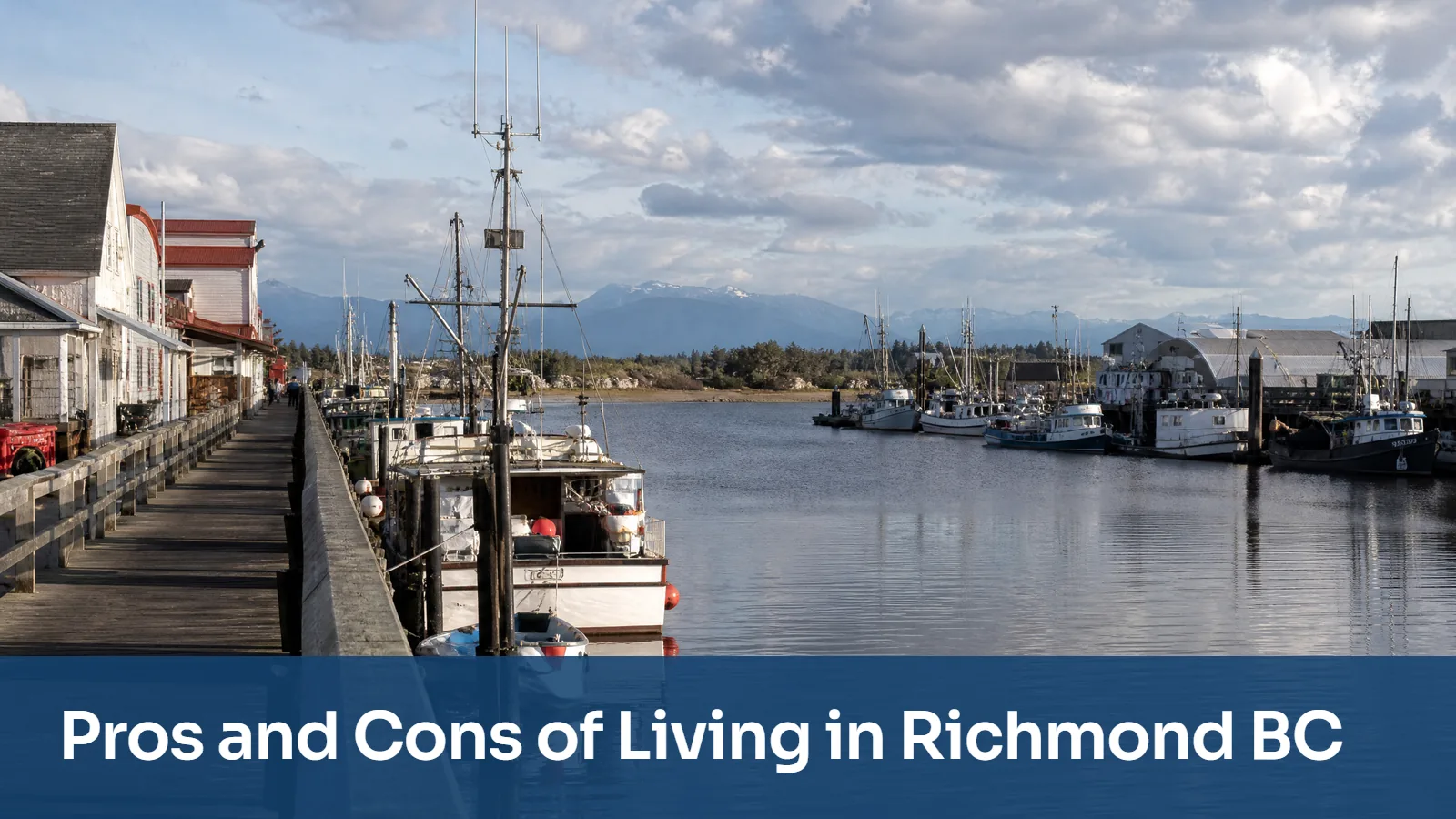
Steveston has heritage buildings, the fishing village boardwalk, cafes and Garry Point Park. Steveston suits families and downsizers, but expect summer weekend crowds and higher prices near the water.
Steveston Village grew up as a fishing town, and fishing boats still tie up along the waterfront. Visitors come to Steveston, British Columbia for the boardwalk and for fish sold off the boats at the wharf.
City Centre and Brighouse mean towers along the Canada Line, with restaurants and malls close by. The area suits young professionals and transit commuters, though traffic is busy and green space is thinner.
Minoru and Lansdowne offer parks, Minoru Centre for Active Living and quick access to services. Families who want a middle ground between tower living and a quiet street often look here.
Terra Nova and the west side have newer detached homes, Terra Nova Rural Park and the West Dyke Trail. If you're raising kids, compare the area with the family neighbourhoods I suggest across the region.
East Richmond has farmland and larger lots, while Sea Island is mostly airport land with Burkeville, a small residential pocket. Investors weighing areas can read my guide to rental property cities in BC.
Browsing each area on the Richmond neighbourhoods page first helps you shortlist streets before you book viewings.
Richmond vs Vancouver, Burnaby and Surrey
Richmond sits between Vancouver and Surrey on price and pace: in my experience it is usually cheaper than Vancouver with faster airport access, and it costs more than Surrey with a quicker Canada Line ride downtown. Burnaby, New Westminster and White Rock each trade different things, from hills and SkyTrain lines to a beach-town pace.
Richmond vs Vancouver comes down to space and lifestyle. In my experience, Richmond gives you more space for the money and the airport next door, while Vancouver offers more nightlife and arts.
Richmond vs Burnaby is flat versus hilly. Burnaby has SkyTrain links heading east, while Richmond is flat with the airport close by, and my guide to Burnaby living covers the other side.
Buyers torn between Richmond and Vancouver or Burnaby should test each commute on the same weekday morning. Every city in the Vancouver area feels different at rush hour than it does on a weekend.
Richmond vs Surrey is a trade between price and time. In my experience, Surrey is more affordable, but commutes into Vancouver tend to be longer, as my guide to Surrey living explains.
Surrey, British Columbia sits southeast of Richmond, past Delta, so a drive between the two means crossing the Fraser River.
Richmond vs New Westminster sets heritage and SkyTrain against newer buildings and flat streets. If older character homes appeal to you, read about New Westminster living before you decide.
Richmond vs White Rock is a beach-town pace against full city services. For a slower seaside life, see my take on White Rock living.
Two Richmond Myths the Data Corrects: Crime Severity and Rain
Richmond's high Crime Severity Index and its rainy reputation both mislead. Richmond RCMP recorded 93.2% of BC's importation and exportation incidents for other controlled drugs in 2025 (Strawhomes.com calculation from Statistics Canada data, 2025), and its airport station got 22% less precipitation than downtown Vancouver over 2016 to 2025 (Strawhomes.com calculation from Environment and Climate Change Canada data, 2025).
| Other controlled drugs, importation and exportation, 2025 | Incidents | Source |
|---|---|---|
| Richmond RCMP | 3,303 | Statistics Canada |
| Rest of British Columbia | 240 | Strawhomes.com calculation from Statistics Canada data |
- Richmond RCMP: 3,303 (93.2%)
- Rest of BC: 240 (6.8%)
93.2%: of BC's importation and exportation incidents for other controlled drugs were recorded by Richmond RCMP in 2025. (Strawhomes.com calculation from Statistics Canada data, 2025)
The Crime Severity Index works differently from a crime rate. Statistics Canada weights each offence by how seriously courts treat it, so a small number of serious files can lift a city's index well above what its everyday crime rates suggest.
The drug files explain Richmond's result: Richmond RCMP recorded 3,303 importation and exportation incidents for other controlled drugs in 2025 (Statistics Canada, 2025), against 240 for police in the rest of BC (Strawhomes.com calculation from Statistics Canada data, 2025).
Richmond is home to Vancouver International Airport, and Statistics Canada counts each drug importation or exportation file under the police service that records it.
What the drug files mean for you is simple: the violent and property crime rates in the safety section are the better guide to daily life in Richmond.
Rain is the second myth, because Richmond has a reputation for being rainier than Vancouver. Environment and Climate Change Canada's daily records show Richmond's Sea Island airport station 22% drier than the Vancouver Harbour station downtown over 2016 to 2025, counting only days both reported and annualising month by month (Strawhomes.com calculation from Environment and Climate Change Canada data, 2025).
With one station in each city, treat the rain result as a guide, not a forecast.
Both findings are Strawhomes.com calculations from public Statistics Canada and Environment and Climate Change Canada data.
Richmond Crime Rate Checker: How Does Richmond Compare With BC?
Richmond Crime Rate Checker: How Does Richmond Compare With BC?
Enter a crime rate per 100,000 people to see which of Richmond's 2025 police-reported rates fall at or below it, with British Columbia's rate beside each one. Rates are Statistics Canada's police-reported figures for the Richmond RCMP municipal detachment and for all of BC.
| Crime type | Richmond, per 100,000 (2025) | Richmond rate | British Columbia, per 100,000 (2025) |
|---|---|---|---|
| Violent crime | 937.46 | Richmond rate | 1,530.75 |
| Property crime | 3,194.7 | Richmond rate | 3,838.64 |
| All Criminal Code crime | 5,732.85 | Richmond rate | 6,943.25 |
Before You Move to Richmond: A Checklist
Before you move to Richmond, test the commute, check flood risk and insurance for the exact address, and walk the neighbourhood at different times of day. The steps below are what I ask buyers to do before they write an offer.
Test your commute at rush hour on a weekday, by car and by Canada Line, from the exact address you're considering. A route that feels easy on a Saturday can look very different at peak time.
Visit at different times, such as Steveston on a Sunday afternoon and City Centre at night, and try the food scene while you're there. You'll see the crowds, parking and noise that a single showing can hide.
Check the City of Richmond flood maps and get insurance quotes for the exact address before you remove subjects. Premiums and coverage can vary from street to street, so don't rely on a neighbour's quote.
Budget for buyer closing costs on top of your down payment, from legal fees to property transfer tax. Then check whether you qualify for a transfer tax exemption, which can cut that bill.
First-time buyers should look at BC buyer programs early, since the rules can shape your budget and your completion date.
Plan your dates with a realistic buying timeline so your lease, sale and move line up. Talk to residents at a community centre or local group before you commit, because locals can tell you what the listing photos won't.
Housing Prices and Flood Risk: What Richmond Buyers Should Weigh
Housing prices and flood risk are worth weighing together in Richmond, because both affect what you pay over time. A lower price in a more exposed spot can be offset by higher insurance premiums or the cost of preparing the home for high water.
Ask your insurance broker what coverage looks like for the exact address before you remove subjects. A home inspector can also tell you about drainage, crawl spaces and grading on the lot.
Newer homes may be built to updated city rules on floor heights, which can change how a house sits on its lot. Ask for any permits and plans before you commit, so you know what was built and why.
Cost of Living and Prices in Richmond Compared With Other Cities in Metro Vancouver
Cost of living in Richmond tracks the rest of the region, and housing is the biggest line in the budget for many households. Your home type and neighbourhood will shape your monthly costs more than almost anything else.
Prices in Richmond sit between the pricier and more affordable parts of Metro Vancouver, depending on the home type and area you compare. Looking at the same home type in each city gives you a fairer comparison than citywide averages.
Day-to-day costs like groceries, transit, parking and childcare also add up. Track your own spending for a few months before you set a housing budget, so the numbers reflect how you actually live.
Thinking About Moving to Richmond? What to Know Before Moving
In my experience, newcomers settle in faster once they learn the transit lines, the main shopping areas and their nearest community centre. Spending a few weekends exploring before you move helps the city feel familiar.
Language can be a practical adjustment, since some shops and signs put Chinese first. Community centres, libraries and settlement services are good places to meet neighbours and find programs in English and other languages.
Think about your commute, your budget and your flood insurance before you sign anything. A weekend visit, a weekday commute test and a walk along the dikes will tell you a lot about daily life here.
How Strawhomes.com and Richard Morrison help with buying a home in Richmond
If you are weighing a move to Richmond, the hard part is judging flood exposure, commute time and price for one exact address before you commit. Lower Mainland realtor Richard Morrison of Strawhomes.com helps buyers compare Richmond with Vancouver and Burnaby, checks recent sales near the home and reads the strata documents with you before you make an offer.
He has 20+ years of experience and 320+ clients served, is an MLS Medallion member and works with houses, condos and townhouses across Metro Vancouver.
He is a fit if you are buying a house, condo or townhouse in Richmond or elsewhere in Metro Vancouver. He is not the right help if you want a holiday rental or a home outside the Lower Mainland.
- Shortlist two or three Richmond neighbourhoods and test the commute from each one at rush hour.
- Check the City of Richmond flood maps and get an insurance quote for each address you like.
- Contact Richard Morrison through the form below, call 778-900-2235 or email mls@strawhomes.com.
Frequently Asked Questions
Is Richmond BC safe to live in?
Yes, Richmond is a safe city to live in for most people. In 2025 Richmond RCMP recorded 937.46 violent incidents per 100,000 people, against 1,530.75 for British Columbia, and its property crime rate was also lower (Statistics Canada, 2025). Its Crime Severity Index was higher than BC's, 151.82 against 92.37, mainly because of drug importation and exportation files, while its Violent Crime Severity Index was lower, 61.78 against 98.02. (Statistics Canada, 2025)
Is Richmond a suburb of Vancouver?
Richmond is its own city, not part of the City of Vancouver, but it is one of the 21 member municipalities of Metro Vancouver (Metro Vancouver, 2026). Many people call it a Vancouver suburb because it sits just south of Vancouver across the Fraser River. (Metro Vancouver, 2026)
How far is Richmond from downtown Vancouver?
Richmond is about 24 minutes from downtown Vancouver on the Canada Line, from Richmond-Brighouse Station to Waterfront Station (TransLink, 2026). Driving time depends on bridge traffic, so test the trip at rush hour before you buy. (TransLink, 2026)
Is Richmond BC expensive to live in?
Yes, Richmond is expensive. The average sold price across all home types was $1,028,186 in October 2026, and the average detached house sold for $1.84M (Strawhomes.com, October 2026). (Strawhomes.com, 2026)
How many people live in Richmond BC?
Richmond had 209,937 residents in the 2021 Census (Statistics Canada, 2021). Statistics Canada runs the census every five years. (Statistics Canada, 2021)
Who can help me buy a home in Richmond BC?
Richard Morrison, a REALTOR® with Strawhomes.com, helps buyers across Metro Vancouver compare Richmond with Vancouver and Burnaby before they make an offer. You can reach him at 778-900-2235 or mls@strawhomes.com. (Strawhomes.com, 2026)
Further Reading
Sources
Sources: Statistics Canada, police-reported crime tables 35-10-0184-01 and 35-10-0063-01 (2025 data, released July 22, 2026) and 2021 Census Profile, Richmond; Environment and Climate Change Canada, daily climate data 2016 to 2025; City of Richmond, Flood Protection; TransLink, SkyTrain station to station travel times; Metro Vancouver, member jurisdictions; Strawhomes.com, Richmond market trends, October 2026 (all read November 19, 2026).

Let's Chat! Looking for a REALTOR® who can exceed your expectations? Look no further than Richard Morrison! His mission is to serve without limit & provide solutions that cater to your core needs.
• 20+ Years of Experience
• Medallion Member
• RE/MAX Hall of Fame

Latest Properties Added
| Property | Size | Price | Date Listed |
|---|---|---|---|
| 214 - 601 Rochester Avenue, Coquitlam | 550 sqft | $544,900 | Nov 18, 2026 |
| 1104 - 114 Keith Road, North Vancouver | 1,013 sqft | $850,000 | Nov 19, 2026 |
| 8332 Selkirk Street, Vancouver | 1,210 sqft | $1,268,000 | Nov 20, 2026 |
| 3334 Fir Street, Port Coquitlam | 2,198 sqft | $1,039,000 | Nov 20, 2026 |
| 2503 - 6699 Dunblane Avenue, Burnaby | 439 sqft | $538,000 | Nov 20, 2026 |
| 5945 12th Avenue, Delta | 2,533 sqft | $1,200,000 | Nov 20, 2026 |
| 402 - 9580 Prince Charles Boulevard, Surrey | 1,458 sqft | $749,000 | Nov 19, 2026 |
| 81 - 20487 65 Avenue, Langley | 1,672 sqft | $850,000 | Nov 20, 2026 |
| 2208 - 518 Clarke Road, Coquitlam | 1,006 sqft | $839,900 | Nov 18, 2026 |
| 1209 - 2020 Fullerton Avenue, North Vancouver | 751 sqft | $389,000 | Nov 20, 2026 |
| 1109 - 5520 Mcnaughton Road, Richmond | 858 sqft | $898,000 | Nov 19, 2026 |
| 904 - 6808 Minoru Boulevard, Richmond | 693 sqft | $668,000 | Nov 19, 2026 |
Start your search with Richard Morrison, Top Award Winning Vancouver Realtor
Contact Richard Morrison Top Vancouver Realtor today to find a Vancouver houses for sale and Vancouver condos for sale. Also check out Burnaby houses for sale or maybe Burnaby condos for sale. If you prefer North Shore, take a look at our listings in North Vancouver houses for sale and North Vancouver condos for sale.